



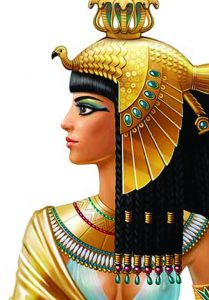
 The use of makeup and cosmetics may appear contemporary, although it is rooted in ancient Egypt. For Egyptians in those times, life was filled with festivals, which means that personal hygiene was an essential cultural value. The Egyptian royalty, monarchy and even middle-class families saw beautification as a vital aspect of their lives. The Egyptians took showers every day, shaved their heads to prevent lice and other ailments and also used cosmetics, perfumes and mintregularly. The look was so essential that several spells of the “The Egyptian Book of the Dead” require that you cannot talk about them in the hereafter if you are not clean and presentable.
Egyptians liked cosmetics. These were utilized during the ancient Egyptian civilizations since the predynastic period (c. 6000 — c. 3150 BCE) and Roman Egypt (30 BCE-646 CE). Beauty was seen by ancient Egyptians, and Egyptian gospels were also marked by holiness. The science underlying cosmetics and fragrances for Egypt was, according to the Oxford dictionary, so sophisticated that the term ‘chemistry’ is rooted in ancient Kemet, which the Egyptians once called ‘al-chemistry.’
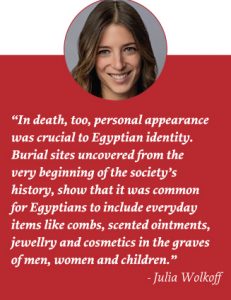
Personal aesthetics were also welcomed in tombs. Excavations reveal tombs containing objects, such as pebbles, perfumed salads and cosmetics in men’s and women’s tombs. Their socioeconomic status did not matter. Females used eyeliner, eye shadow, lipstick, and scarlet to look lovely from an early age. These cosmetics were properly developed and sold in the market, but in the house, they were of somewhat an inferior quality. They utilized makeup not only to enhance their physical looks but also cosmetics and incense in rituals which had symbolic importance.
The ancient Egyptians regarded beauty as a sign of holiness. Everything they used had a spiritual aspect to it, including cosmetics. Traders traded makeup often, especially in the upper classes. In tombs, cosmetic palettes were found buried in gold with the deceased as grave goods, which further emphasized the idea that cosmetics were not only used for aesthetic purposes but rather magical and religious purposes.
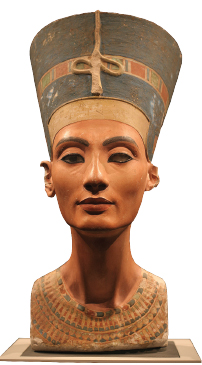
Cleopatra and Nefertiti are the famed beauty queens of ancient Egypt and are the finest embodiment for makeup lovers. In 1963, Elizabeth Taylor played Cleopatra in a film, and, based on the ancient times, she established the most emblematic style. Rihanna, recognized for her variety of make-up, portrayed Nefertiti and also modeled for Vogue Arabia’s cover. Both were observed wearing thick-dark blue eye makeup and thick black eyeliner. The ancient Egyptians used make up for their looks, according to historians. They did so for practical purposes, ceremonial purposes and to show to others the symbolic significance. Therefore, every day they followed their beauty regimen. The term ‘sesh’ signifies that the hieroglyphic phrase ‘kohl’ or ‘lipstick’ requires several talents.
 Elite Egyptian women had a strict beauty regimen and a lady had to condition her skin before putting on make-up. She usually scrubbed her skin or undertook a milk bath with Dead Sea salts. A milk-honey facial mask was also highly popular. No matter what the class, every home had a kind of jug that washed their hands. Football baths were also provided for washing the feet, consisting of stone, ceramic or wood. These were mass-produced in single-foot and double-foot baths in the period 2181-2040 BCE.
 Numerous make-up components and equipment were available. Glass, gold and semi-precious stones were extracted for eye make-up and fragrances. Kohl and silt eyeshadows were also produced. Kohl and siltstone eye shadows are intended to resemble animals, gods or young women’s desired eyes.

The writer is a freelance contributor. She can be reached at gulnaznawaz1551@gmail.com
Good to see your efforts in research, and research matters a lot nowadays.
Your publication is good. Beauty is natural.
It’s better to invest your precious time in important innovations.