

Cover Story
Actual Control
The fundamental interests of the peoples of China and India must foster a
long-term good-neighbourly relationship, maintaining peace and tranquility
along the line of actual control in the India-China border areas.

The reason why China attacked Ladakh in India during May-June 2020 has been under debate. These include: India’s map of the Union Territory of Ladakh which includes Aksai Chin under China’s illegal occupation; India’s closeness to America, and China fearing India may capture Aksai Chin though China keenly observed the neglect of the military in India. Aksai Chin was never part of China. India only had a border with Tibet, not China. In the 7th century, Tibet’s empire spanned high heartland and deserts of the north-west from the borders of Uzbekistan to Central China, from halfway across Xinjiang, an area larger than the Chinese heartland. In 763, the Tibetan army even captured the then Chinese capital Chang-an (today’s Xian).
At the 1914 Shimla Convention, representatives of China, Tibet and British India agreed to the McMohan-MaCartney Line as the border between Tibet and British India. But after China’s communist takeover, expansionist plans were aired by Mao Zhedong, saying, “Tibet is the palm of China and Ladakh, Nepal, Sikkim, Bhutan and NEFA (Arunachal Pradesh) are its fingers.” China then annexed Tibet, Inner Mongolia and Xinjiang. Mao’s thoughts were echoed by Deng Xiaoping under whom Xi Jinping (now president of China) was the first secretary in the defence ministry when China invaded Vietnam in 1979 to ‘teach Vietnam a lesson’ but received a bloody nose.
The postulation that India’s map of Ladakh triggered the recent Chinese aggression is not entirely true because Ladakh was always in China’s crosshair. China aimed to join hands with Pakistan along the Shyok River, reviving the old silk route joining Gilgit-Baltistan to Yarkand in China through the Karakoram Pass, capturing the Siachen Glacier in the process. This is a major freshwater source. China kept slicing off Indian territories over the years. The PLA made a 19-km intrusion in Depsang (Ladakh) in 2013, staying put for three weeks. In 2014, the PLA exercised an invasion on a land model of Ladakh inside China. The 2020 invasion in Ladakh with two dvisions was a follow up of such an exercise, taking India completely by surprise.
Indian intelligence failed to read signs of the aggression, as also the intent of China and Xi Jinping despite the dedicated China Study Group (CSG). India was engaging China economically as the rest of the world but forgot it has a 3,448 km unresolved border with China which has a superior border infrastructure on the opposite side. This contrasted China’s Science of Strategy 2013 that said, “We cannot count on luck and must keep a foothold at the foundation of having ample war preparations and powerful military capabilities of our own rather than hold the assessment that the enemy will not come, intervene or strike”. Presently India is engaged in a flurry of defence procurements but is building hard power which will take time and cost more.
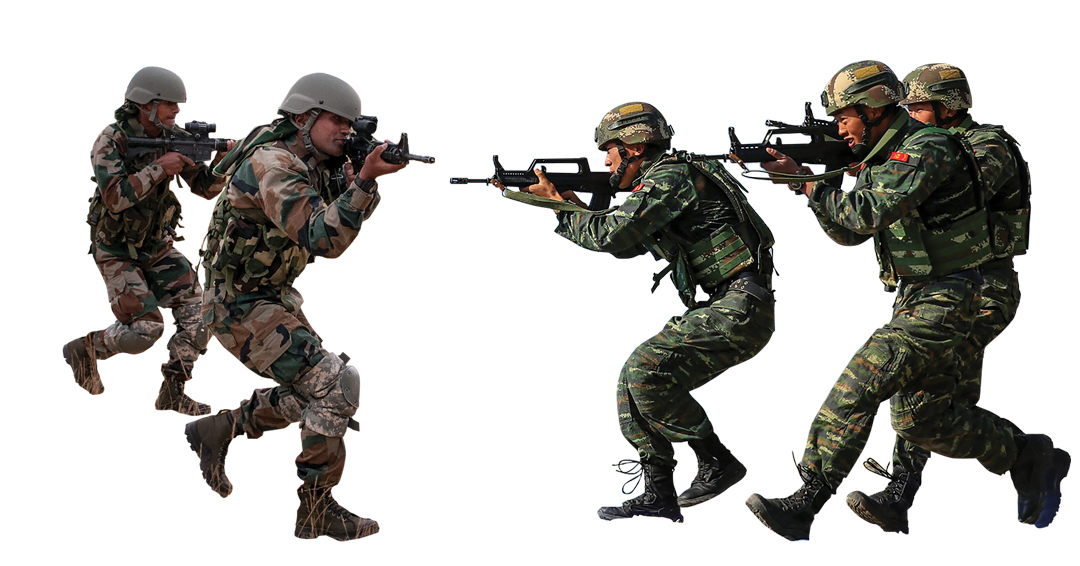
Details of China’s invasion, including the Galwan clash engineered by the PLA, has been in the news. The scale of Chinese intrusions in Pangong Lake, Gogra-Hot Springs and Depsang is large, with some 12,000 PLA troops in Depsang; the PLA had intruded there in 2013. India has occupied heights in its own territory south of Pangong Lake, Chushul area and Kailash Range, covering the Spanggur Gap overlooking some PLA locations including Moldo camp and blocking avenues for further PLA intrusions. Luckily, the PLA’s Western Theatre Command faulted in not attempting the capture of these heights in the first wave of aggression despite having the troops to do it.
India is engaged in a flurry of defence procurements but is building hard power which will take time and cost more.
Perhaps on advice of the CSG, India denied any intrusions. This helped China accuse India of aggression from day one and put the onus of disengagement on India. Several diplomatic, military and ministerial level talks have failed to achieve a breakthrough. Both sides are dug in and ready for battle. Disengagement would imply Indian troops withdrawing in their own territory to create a buffer zone. China apparently wants India to also withdraw from all heights it occupied south of Pangong Lake, which would be a strategic folly, given China’s repeated backstabbing.
Some are of the opinion that China’s aggression is to force a border settlement with India but this is rather simplistic. Beijing shed its mask of ‘peaceful rise’ and became even more aggressive after battering the world with the China Virus. With economic clout and military muscle, China has been exercising war on multiple fronts following President Xi’s China Dream to dominate the world. A border settlement would be useless unless demarcated on ground and China cannot be trusted, given its fresh illegal claims to the Galwan Valley in Ladakh, plus parts of Bhutan and Tajikistan. Besides, after the India-China standoff at Doklam (Bhutan) was called off in 2017, the PLA occupied the Doklam Plateau.
Why China dropped all peace pretences is because President Xi Jinping knows conflict is inevitable if China wants Taiwan and the fingers of Tibet (China’s palm). Would he consider the best time now when the world is fighting the pandemic and economies of opponents are shrinking, including the US and India, or wait for them to grow stronger individually and collectively? The second Quad meeting in Tokyo on October 6 failed to issue a joint statement naming China directly for its aggression, leave aside the pandemic. Xi Jinping would be weighing America’s reaction to a Chinese invasion of Taiwan – will the US risk attacking mainland China and be prepared for reciprocal strikes?
China may not want an all-out war with India, but a limited intense war remains a possibility – in Ladakh, elsewhere, or both? India seems to have sensed this, firing away 10 test missiles in a span of 35 days to signal Beijing. Xi Jinping may want to try the latest weaponry in his arsenal to demonstrate to the world, especially the US. Eight years back western scholars were of the view that China could use tactical nukes to force India to give up territory. Can Xi do so, believing India would not respond similarly, fearing consequences that would not be in overall Indian interests?
China has been eyeing Ladakh since the era of Mao Zhedong and Xi Jinping has been planning, preparing and rehearsing the PLA for it since 2013-2014 but this much is certain that if President Xi wages war on India, he will pay a very heavy price that may lead to his dethroning.![]()
The author is a veteran lieutenant general of the Indian Army. His views are personal. He can be reached at prakashkatoch7 |
|
Cover Story
|
|
News Buzz
|
Update |


Leave a Reply