

International
Nakba Never Ended
As Israel mounts its offensive against Hamas in Gaza, the fears of a full-fledged war between Israel and Hezbollah are terrifying people on both sides of the border.

Despite the Israel-Gaza war dragging into its sixth month after a surprise incursion of Hamas fighters deep inside the Israeli territories across the besieged Gaza Strip on October 7 last year, there seems to be no sign of an early end to the conflict. Instead, the conflict seems disposed towards a regional war. Soon after the launch of the Israeli military operation in Gaza, the US moved its two aircraft carriers, fearing a backlash from Hezbollah and its affiliates and also signaling full support to Israel.
Hezbollah, an old adversary of Israel, became the first extra-territorial actor to respond to an Israeli military strike by sending hundreds of missiles toward Northern Israel on October 7. Hezbollah and Israel have been exchanging daily strikes across the border. Israel has struck hundreds of ammunition depots and training centers belonging to Hezbollah while Hezbollah is using guided missiles and suicide marchers, bombing and shelling in retaliation. Amidst these rocket and missile attacks from both sides, around two hundred fighters belonging to Hezbollah and eighteen Israeli soldiers have lost their lives, apart from the displacement of thousands of inhabitants from their respective border areas.
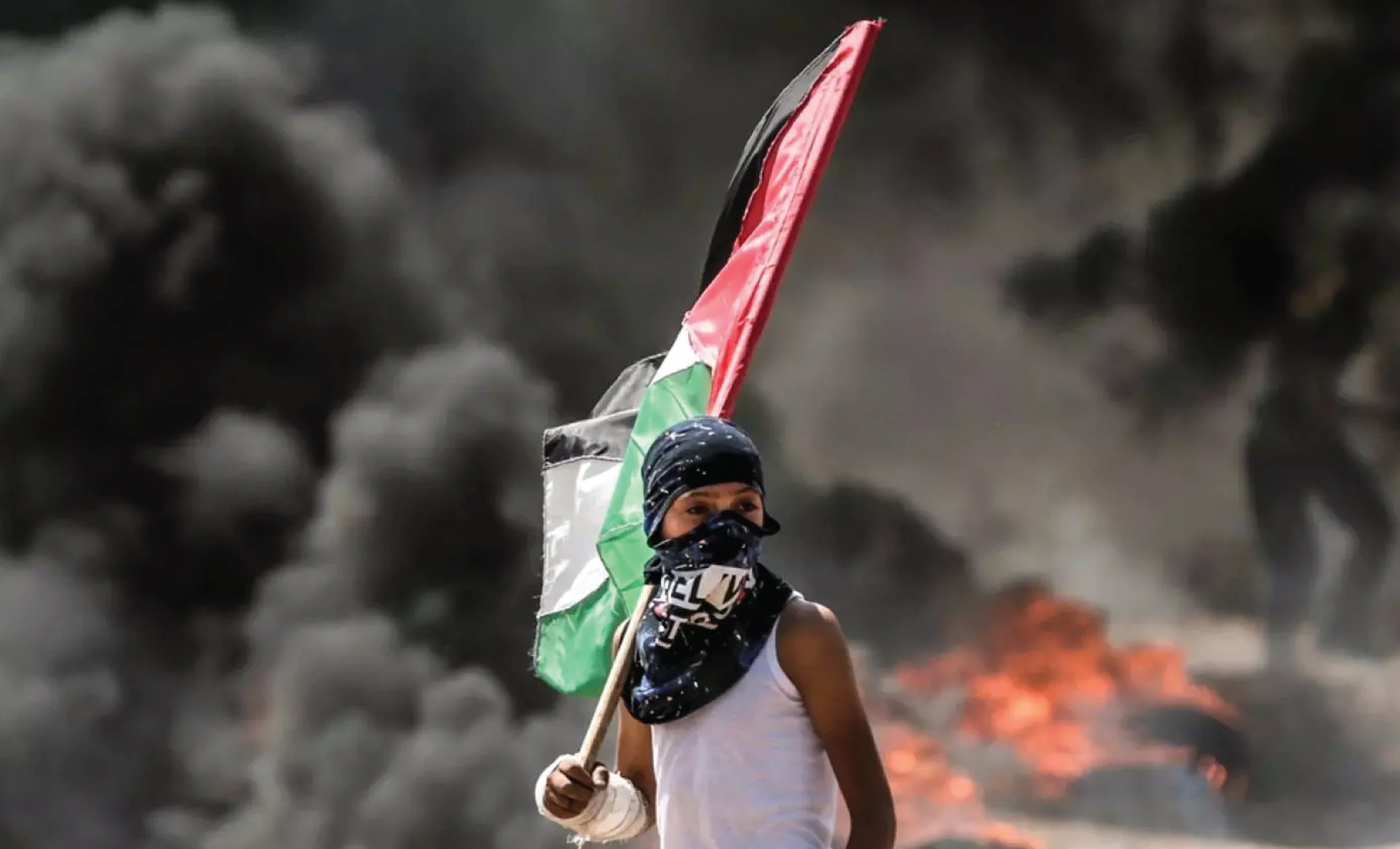
As Israel mounts its offensive against Hamas in Gaza, which is globally being labelled as the second NAKBA after 1948, a fear of full-fledged war between Israel and Hezbollah is terrifying people on both sides of the border. All eyes are nervously turning towards Lebanon, where continued clashes have raised fear of opening a second front in the ongoing Israel-Gaza war. Since the incident of October 7 and the inevitable Israeli retaliation, no one had any doubt about Hezbollah’s joining the war sooner or later on the side of Hamas, not only because of Hezbollah’s ideological and strategic association but also because both carry a common objective of confronting the ascendency of Israel across the region. Given Hamas’s indebtedness towards Hezbollah and empathy for other anti-Israel militias, it would have been difficult for Hezbollah to stand back and do nothing. At the same time, Israel waged a massive offensive against Hamas.
Hezbollah has been proven to be Israel’s most formidable foe in the region since its evolution in the early 1980s. Both Israel and Hezbollah are well-acquainted with the military capability of each other, and in the past too, both have fought long and short wars like in 1993, 1996, 2000 and 2006.
As far as the prospect of confrontation between Hezbollah and Israel is concerned, the possibility seems to be very low because first, neither Israel nor Hezbollah seems keen to go for a full-fledged mutual confrontation because it would expose the strategic and military limitations of both the sides. Even if Israel chooses war over diplomacy to pacify its domestic constituency, the Israeli army has little chance of succeeding because its military resources and soldiers’ energy are already exhausted in the Gaza War. Further, Israel could be dragged into a larger war and forced to confront enemies from Golan Heights and other pro-Hezbollah groups. Hezbollah is classified as one of the most powerful armed groups in the world, and it has a vast arsenal of accurate and high-explosive missiles. According to the Institute for National Security Studies, an Israeli think tank, Hezbollah possesses between 150,000 and 200,000 rockets and missiles of various ranges, and Hezbollah’s arsenal is at least five times larger than that of Hamas and much more accurate.
Despite Israel’s apparent military superiority, the war between Israel and Hezbollah would be devastating for both sides because Hezbollah’s precise missile arsenal represents a kind of draw. Unlike Gaza, which is an enclave surrounded, Lebanon has long borders with Syria, which, in turn, has long borders with Iraq and Türkiye, ensuring the passage of weapons and fighters.
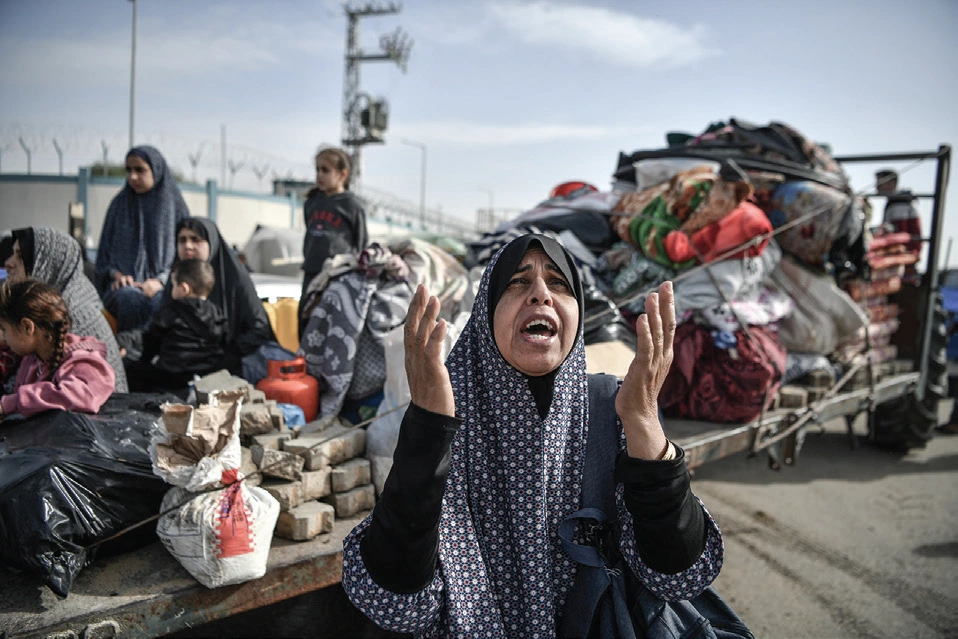
Palestinian family members on their way to Rafah hoping to find safer place after migrating from Nuseirat due to intense Israeli attacks on Gaza Strip.
Though both Israel and Hezbollah are flaunting their strength against each other as Israel only amidst this conflict warned of ground operation in Lebanon, and Netanyahu’s threats of turning Beirut into a second Gaza are all addressed more to his own shocked and grieved people than to Hezbollah. On his part, Hezbollah chief Hassan Nasrullah too, on many occasions, has warned that any thought of waging war against Hezbollah would amount to playing with fire and has compared Israel to a “spider web,” claiming that Israel looks strong from afar but lacks sacrificial spirit.
The key objective of Israel at the moment does not go beyond neutralizing and subduing Hamas, and Israel perhaps has no appetite to invite other enemies while the architects of the war themselves are finding it difficult to shape the war the way they had earlier envisaged. Moreover, how can Netanyahu choose another war while he has been under constant attack for planning a new front at the Rafah border? His team must know that war in southern Lebanon will not stop at its borders and will expand to south Syria, where Palestinian and Shiite factions loyal to Hezbollah are spread.
Furthermore, the possibility of direct conformation between Hezbollah and Israel seems lesser because Hezbollah is governed mainly by Iran and acts more as Iran’s proxy. It is unlikely that Iran will want to expose Hezbollah in a futile full-scale war with Israel for the sake of Hamas, mainly when Iran sees Hezbollah as a “strategic shield” and “golden bullet” Iran can fire when its nuclear installation is under immediate threat by its adversaries.
What prevents one further from imagining the Israel-Hezbollah conflict is that in today’s time, no country can afford to risk its assets and capability for the sake of others unless the nation’s interest is directly hit. The response of Türkiye to the whole Gaza-Israel conflict in this regard is a living testimony. For Türkiye, Palestine remained an essential component of its foreign policy discourse. It is worth recalling here the remarks of former Hamas head Khalid Mashaal when he recently stated, perhaps hinting towards Türkiye alone, that the country can supply drones to Azerbaijan and Ukraine but not to the Palestinian fighters.
Lebanon’s domestic political and economic situations don’t allow Hezbollah to think of any such move that would push the nation to the brink of collapse as the national economy is already in an inaccessible fall mode, unemployment is at an all-time high, and corruption is rampant, and the political system is completely broken. The caretaker Prime Minister of Lebanon, Najib Mikati, has already said that his government’s utmost priority is maintaining calm and stability in south Lebanon.
In such an unfortunate situation, Hezbollah would not like to be seen as another culprit responsible for leading the nation to further devastation. Meanwhile, Hezbollah would continue to show its presence through occasional retaliation and preemptive actions below a certain threshold to avoid being seen as an invisible or subdued entity in and around Lebanon.![]()

Based in New Delhi, India, the author is a political analyst. He holds Ph.D. in International Politics and can be reached at fazzur@gmail.com
Pakistan urges Afghanistan to address terrorism as ‘shared concern’
New Team at PBA
Pakistan seeks investment, not loans: PM
Pakistan, China to form WG on 5 new economic corridors
ChatGPT sees a surge in website traffic as schools reopen
US diplomat visits Napa
Sarah Ahmad wins prestigious award
Pakistan eyes $300m by selling Panda Bonds
Tunnel becomes the latest flashpoint in India-China border tensions
India’s ‘Silicon Valley’ is running out of water
New Delhi summons US diplomat over Kejriwal’s arrest remarks
World’s super rich attend pre-wedding bash of Mukesh Ambani’s son
Shahid Afridi and Mushtaq Ahmed Demand Censorship
Biden, Netanyahu hold first call in over a month
Telenor Pakistan launches female sales trainee program
NBP’s Annual Corporate Briefing
Sailor martyred in operation against Indian fishermen


Leave a Reply