


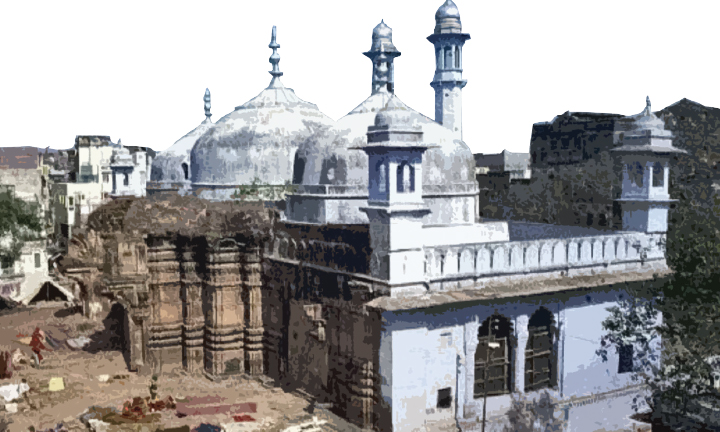
After the announcement of the verdict of the Babri Masjid demolition case, which saw the land under the demolished Babri Masjid given to the Hindus, many people in India believed that the verdict would put an end to similar disputes. The Varanasi court, on the other hand, had other things in mind. Fuelled by communalism, the dispute over Gyanvapi Masjid in Varanasi is one that encompasses strategic “rewriting of history”, arising in a Hindu dominant postcolonial India; a controversy best described by the words of the famous Russian writer, Leo Tolstoy, who says, “wrong does not cease to be wrong because the majority share in it.”
The “majority” in this context is the Hindu majority, which over the centuries developed meta-narratives of how Hindus were oppressed by Muslim rulers. These un-nuanced and ahistorical notions were further accentuated throughout the advent of the British rule, which thus created the perennial Hindu-Muslim rivalry we see today.
When the Ayodhya dispute was raging, “Kashi-Mathura baaki hain” (Kashi and Mathura still remain) was another refrain that was making the rounds among the Hindutva vigilantes. The dispute over Gyanvapi Masjid, reminiscent to that of one over Babri Masjid, is probably one of the finest examples of iconoclasm in India. The Hindu populace unanimously believes that the mosque was a ramification of Emperor Aurangzeb’s religious fanaticism who constructed a mosque by demolishing a part of the Kashi Vishwanath Mandir.
However, according to many historians, the argument lacks historical accuracy as there are no recorded accounts of the incident. This is further solidified when the petitioners that originally filed the case against the mosque in 1991, contended that the original temple was built by King Vikramaditya about 2050 years ago and was destroyed by Aurangzeb in 1664.
By reading Gahadavala dynasty’s literature, we will realise how there are just scarce mentions of temples, which act as an antithesis to the Hindu narrative and the claim of the petitioners. According to a 12th century Sanskrit scripture known as the Kritya-kalpataru, there is no mention of any grand temple in the area of Varanasi at that time. This Gahadavala literature comes from the 12th century, which is the same era believed by Hindus that allegedly saw the actual temple get uprooted by Qutb Al-Din Aibak. However, there are no records of any major temple at that time. This shows that the Kashi Vishwanath temple was actually originally built due to Mughal patronage during the Akbar’s reign from 1556 to 1605. In the light of Gahadavala literature, the statement of the people that filed the case seems to be half-baked and made on pure assumptions.
 Part of the controversy also has its deep-seated roots in a bloodthirsty campaign run by far-right Hindu extremist body known as the All India Akhara Parishad (AIAP), a revered body of “politicized priests” backed by the Rashtriya Swayamsevak Sangh (RSS) and the Vishva Hindu Parishad (VHP). With a very strong political backing, these extremist groups started a campaign that called for demolishing not only the Gyanvapi Masjid in Varanasi, but also the Shahi Idgah Masjid at Mathura as the secondary demands of the Ram-Janmabhoomi movement, which originally gave Hindus the land occupied by the Babri Masjid.


Salis Malik is a freelance journalist and columnist based in Islamabad. He can be reached on Facebook @salismalik7777
Leave a Reply