



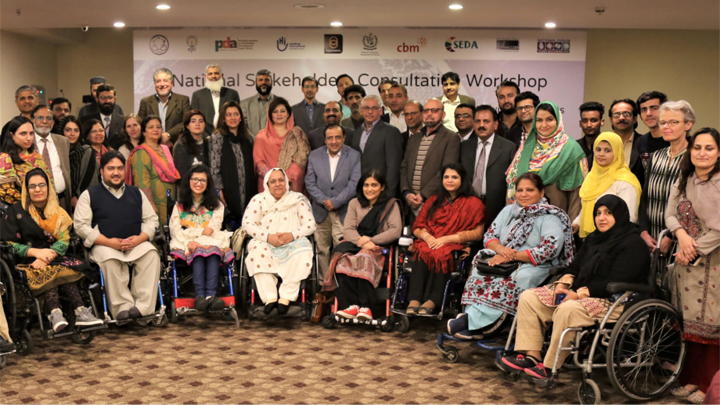
With a literacy rate of 46%, Balochistan can never afford the cost of the betterment of human and infrastructure development in the country. It is never effective to mention Balochistan is Pakistan’s most backward province in terms of aforementioned aspects. However, Balochistan’s Persons with Disability (PWDs) are the most marginalized and neglected subgroup in the community in terms of social, educational, economical and political rights in the province. Since they are termed PWDs, they are marginally unheard, uncounted and unseen with no effective planning and administrative management theories. No government in Balochistan has found interest in conducting comprehensive surveys to assess the problematic situations of PWDs. Despite PWDs make a healthy per cent to overall provincial population; one wonders why government meets no plannings against their grave grievances?
The PWDs suffer worldwide, but in Pakistan they are in peril. The 6th Population and Housing Census of 2017 reveals that Pakistan’s overall population is approximately 207 million from which around 31 million people are recognized as Persons with Disabilities. While more than 600 million people are reported to be with some disabilities worldwide out of which 400 million are those PWDs who belong to the most developing countries as Amartya Sen and James D. Wolfensohn said.
According to the World Bank, the world’s 20% poverty-stricken majority comprises of PWDs who are denied constitutional rights in many forms. Similarly, The Economic and Social Commission for Asia and Pacific (ESCAP) reports, “Despite recent achievements, people with disabilities remain the single largest sector of the least served and the most discriminated against in almost all societies in the Asia Pacific region.” But, unfortunately, Pakistan’s achievements making improvements in the living conditions of PWDs are cipher. Since they can’t resist and voice against exploitation of their rights, physical and psychological abuse and social and behavioral sine qua non, they have always been targeted with the extreme subduing and despotism. After federally it failed being point of convergence, Balochistan’s provincial achievements are blank at providing equivalent grandeur rights to PWDs.
Balochistan Rural Support Program (BRSP) held a survey— Poverty Score Card (PSC), which aimed at substantiating the exact figure of PWDs throughout the province. The survey revealed that approximately 44885 persons with disabilities were recognized in seven districts of Balochistan in 2017. From the grand total of 100 percent, 44.5% of the PWDs are diagnosed with disability due to illness, 23% are due to accidents, 18% are by birth, and 6.1% are genetically suffering while 3.4% are a victim of terrorism. The largest number of disabilities is caused by the poor health sector of the province which warns about the scarcity of medical resource persons and medicines, including all indispensable apparatuses. Surprisingly, the ratio of disabilities caused by socio environmental factor is ten times bigger than ratio caused by birth or any genetic factor. It simply helps to reduce the rate of growing disability when we ameliorate health and educational infrastructure in Balochistan.
Similarly, Balochistan’s crummy health management is one of the foremost factors due to which disability prevails. Since the province is countrified and agrarian, having never been given due rights particularly in medical matters, people are rarely aware that the disabilities they have are curable. They live with them and turn to become ‘disabled’ in a patriarchal society where rights to so many doors are halted. And, many with severe injuries caused by accidents develop into lifelong disabilities due to deficiency of medical experts and hospitals in rural territories. A report from Development Organization for Underprivileged Areas (DOUA) says that 19% of PWDs make regular visits to their doctors, while 81% of them never visit doctors. One of the prime reasons is the financial constraints of PWDs and distant hospitals. Similarly, educational atmosphere is marginalized.
Not to speak about Balochistan’s 47% of out-of-school children (OOSC), 4103 PWDs out of 4709 never get quality education which means that 87% of PWDs are OOSC. The same report reveals that an estimate of 42.4% children don’t attend school due to disability, while 20.5% due to poverty and 9.2%, 2.9%, 20.0% on account of inaccessibility of schools, under age/other and non-existence of schools. The worst and most traumatic news is only 10% of all enrolled children from PADs are females. However, few of the prime reasons why PWDs are vulnerable educationally are lack of special educators and schools of special education in each district, zero assistive technology devices, impoverishment of civil societies in rural regions and incompetent and unfriendly syllabus and curriculum of schools. Moreover, Balochistan has only 3 Special Education Centers; 2 in Quetta and 1 in Kech/Turbat, and 6 Complex for Special Education from which 1 is in capital, while Kalat, Khuzdar, Mastung, Sibi and Zhob have each, respectively.
Rather than conceding the constitutive privileges of PWDs, government seems wholly apathetic and complacent. Balochistan’s 86% of PWDs are jobless and as per the data, only 1% is employed. The number of unemployed PWDs are financially dependent on others which prepares a more problematic vulnerability for them. According to the same report, 3898 PWDs out of 4709 PWDs are dependent on family members, neighbors, relatives and community elders. This simply means a rate of 83% of PWDs is dependent. About 17% of them are self-employed or running their own small businesses to earn their livelihood. Likewise, in Loralai around 260 PWDs are self-employed, 25 are employed and 1038 are jobless, while Killa Abdullah has 7 employed, 73 self-employed and 2130 unemployed. Also, other districts such as JhalMagsi, Khuzdar, Washul and Zhob have a large number of PWDs unemployed and a very few of them are self-employed. The following number of PWDs have various reasons of being intensively deprived from a very good living. The prime contributing factor of their unemployment is the inaccessibility of a quality education. Lack of literacy limits them from achieving governmental goals. However, Balochistan Public Service Commission’s (BPSC) reserved quota for persons with disabilities needs to reform the number of seats and should advertise recruitment when the ratio of unemployed PWDs is high-rise. These will help in bringing back those PWDs into resistance against dependency.
There seems no mechanism being made to reform the vulnerability of the PWDs. Unless they are discriminated and contrasted on the basis of their physical status by policy-makers, there seems every dialogue of the government intellectualizing the story only. Comprehensive surveys and rural planning institutions, including civil society organizations should immediately be graded in every district of the province to cater the needs of the PWDs with methodological assistance and acknowledgment. Further, since children in a massive number are visually impaired and are hard-of-hearing, they need assistive technology devices, advanced and effective specialized methods of teaching and oral approach. Experts believe that listening makes 45% of everyday communication for adults, while children make it up to 65%.
In a nutshell, making education accessible to PWDs from primary to higher, providing rehabilitation centers and hospitals in each district, implementation of reserved quota seats of PWDs from each district are few of those major initiatives that can majorly subside illiteracy to some extent. 
Leave a Reply