


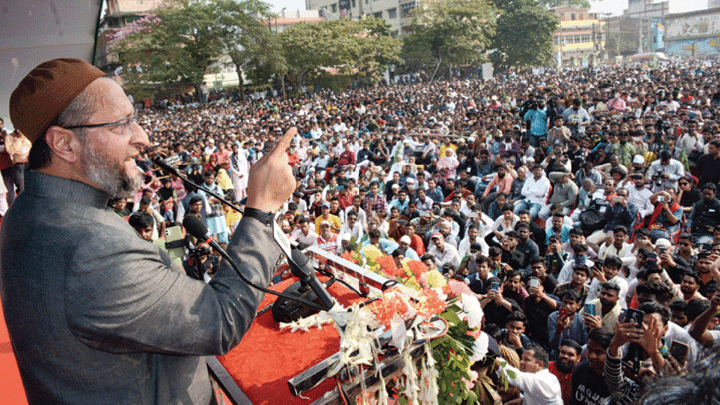
Muslims constitute the second largest portion of the Indian population. Despite their huge population size, however, Indian Muslims are denied adequate share in the decision-making process, particularly at the legislative and government levels. In the recent few years in particular, Muslims, the largest minority group in India, have been marginalised to an extreme extent.
Historically speaking, Muslim underrepresentation in India is now a new phenomenon as it has always been a bone of contention in the Indian subcontinent from the world go. It is due to this reason that the Muslim delegation under the leadership of Sir Aga Khan met the Viceroy Lord Minto at Simla in 1906 with a principal demand for the allocation of separate electorate for Muslims. In response, the Viceroy encouraged the Muslim delegation to form their own political platform to raise their demands and grievances through that channel. Consequently, a political party, the Muslim League, was timely formed to represent the Muslim interests. Hence, the Indian Muslims’ struggle for the attainment of equitable share in the decision-making is not a bizarre incident.
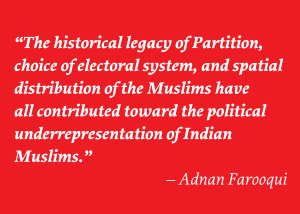
Indeed, it was the same sense of deprivation that pushed the Muslim leaders to struggle for a separate homeland for the Muslim majority where they could lead their lives as free citizens. Muslim population in India comprises 14% of the country’s total 1.3 billion population. However, their share in the 545-member Lok Sabha (Lower House of Parliament) is merely 4 percent, depicting the deplorable status of Muslim representation in the Hindu-majority land.
The Muslim exclusion from Indian politics is a result of religious prejudice against them, says Asghar Ali Engineer, an Indian writer and activist. The Indian social fabric has been torn apart to that point it is now ruled by politics of expediency and that too along the lines of ethnic and racial differences. As the majority of the population belongs to a specific religion, no political party wants to offend the larger segment of population by giving a reasonable share to the largest minority group within the Parliament. To cap it all, most mainstream political parties in India avoid issuing party tickets to Muslim candidates for elections for a deeply rooted fear that they may be labelled as sympathetic towards the Muslims, and thus they will end up losing the majority support and their political future will be doomed.
 The ruling-BJP, led by Narendra Modi, has taken the politics of hatred to another extreme that has further polarised Indian politics. The BJP has found it easier to consolidate their power base by propagating communal hatred and prejudice in the Hindu majority on the pretext of being threatened by the Muslim minority. Therefore, the majority has to protect itself against the latent threats. On the basis of this majority-appeasement approach, they have espoused a policy of vilifying and vituperating against the Muslim minority. Most important of all, the incumbent Indian government has left no stone unturned to make the Muslims feel isolated and detached. Pursuing the policy of majority appeasement, for instance, New Delhi has tolerated the violence against Muslims and other minorities, shying away to offer election tickets to Muslim candidates.


This writer is a freelance contributor and is currently associated with the Iqra University in Karachi as a visiting faculty member. He can be reached at amjadsiyal@hotmail.com
Leave a Reply