




True devolution of power is crucial to the success of a government and is vital in heterogeneous countries like Pakistan, where large segments of the citizenry remain marginalized by centralist and patronage-based governance mechanisms. The current government has also failed to conduct local government elections to facilitate and provide justice to the masses. Despite showcasing support for devolving power, not a single step has been taken to make governance structures more efficient and responsive to local needs. There exists a number of bottlenecks that have led to this predicament but only a sincere and combined patriotic effort by the government can make the dream of power devolvement come true.
The passage of the 18th Amendment in Pakistan’s Constitution in 2010 was quite an accomplishment. Not only did it devolve significant powers from the central government to the provinces, it also mandated the formation of local governments to bring governance closer to the people. It is another story that the 18th Amendment was never implemented in its true spirit and the subjects that were devolved to the provinces further deteriorated in terms of government oversight. The current government is again not ready to fully accept the 18th Amendment though it was largely supported and approved by all political parties.
It is important to recognize that the problem of centralization of power has been the most crucial issue in Pakistan, and dancing around the fire is not the solution to any problem. To tackle such an issue, one should try to see beneath the surface in order to grasp the root cause of the issue. Despite a stream of strong words and announcements made by the past and present rulers, nothing concrete has been done to introduce proper economic revival that would not only strengthen the masses financially but also improve their socio-cultural lives. Because no action was taken, the situation has taken a quantum leap for the worst. The future of Pakistan’s current devolutionary process remains uncertain, especially in light of increasing political turmoil and the never-ending tug of war between the government and the opposition for their vested interests.
Pro-establishment politicians are demanding a review of the 18th Amendment. If the government understands that the devolution of power is a globally tested mode of governance for large and ethnically diverse states, it will go a long way towards helping it to achieve its declared goals of strengthening the federation, removing provincial disharmony and restoring national cohesion. Some headway in this critical area will facilitate the achievement of goals of ensuring law and order, providing speedy justice and accountability and eradicating corruption.
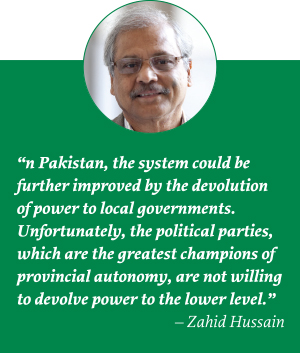 Pakistan’s current situation is owed to the fact that our politics have never been based on a specific philosophy, programme or principle. In fact, it has been in negation of all the ingredients of democracy. Unfortunately, we have seen that the only motive of forming alliances has been for personal gain, power and wealth, thereby completely failing in providing effective governance. Moreover, political parties have become the personal fiefdom of political leaders, and are benefitted by inter-related families of landlords, pirs, nawabs, industrialists, business tycoons and generals. This shows how the prevailing system strongly resists equitable distribution of power in which the rich protect their own interests, and conspire with the civil and military bureaucracy to achieve, retain and perpetuate power. This failing system has damaged democracy, destroyed national institutions and created resistance in the formation of a healthy political culture where we have witnessed provincial disharmony rising out of the neglect and the deprivation of the smaller provinces. It has weakened the state and aggravated the multi-dimensional crises of its citizens, resulting in the deteriorating political and social fabric of the country.


Based in London, the writer is a chartered accountant from London School of Economics and Political Science, and an Oxford University alumna with diversified experience in consulting and entrepreneurship. She can be reached at mishaanwarmalik@gmail.com
Leave a Reply