



 “Then first, ‘tis said, by sacred verse subdued. The Furies felt their cheeks with tears bedewed.”---William Congreve, ‘Orpheus and Eurydice,’ The Metamorphoses.
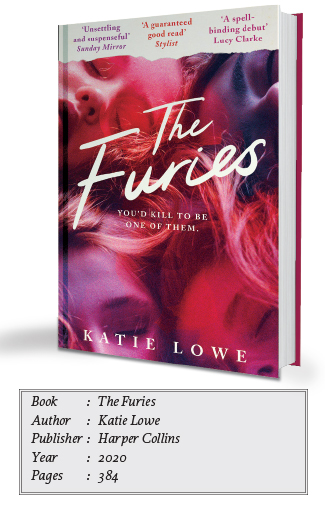
Katie Lowe is good at evoking mood and atmosphere and her recent novel, The Furies, is no exception to her general rule. The book revolves around a group of four teenage friends, Alex, Grace, Robin and the main character, Violet, who recounts the narrative in first person. The girls study at a tony private school called Elm Hollow and come under the influence of a charismatic and knowledgeable teacher, named Annabel whose specialty is the occult. So wise and informed is she that even the Dean of the school permits her to hold special and select classes on the subject with the girls privately.
Obviously this is a recipe for disaster in spite of (or perhaps because of) the fact that the school prides itself on being located on a site where a famous witch was burned centuries ago. But the disaster is neither immediately evident nor apparent. Scholarly pursuit of occult and esoteric studies is considered a legitimate field in our postmodern day and age, and Annabel is nothing if not responsible. The reader is told that the girl whom Violet replaces in the group, Emily Frost, was discovered dead in mysterious circumstances before Violet joined the school. There was no evidence linking her to Annabel’s well-meant instruction, although the event obviously cast a long shadow over the school’s reputation. More significantly, Emily was Robin’s closest friend and Violet bears more than a passing resemblance to her.
Robin latches onto the vulnerable Violet with an almost predatory girlish determination and persistence. Such behaviour is not uncommon amongst teenage girls and though not always wholesome, is hardly sinister. What is more disturbing is that in spite of Annabel’s wise direction, Robin takes matters into her own hands, and invokes an ancient ritual to summon the legendary goddesses of retribution, the Furies. Why? To bind Violet closer to her and use the power of the Furies to exact revenge on those whom Robin believes have wronged them in a major way.
Sceptics and the more pragmatic amongst us will roll their eyes and loftily affirm that major goddesses do not interest themselves in the affairs of teenage girls, no matter how sincere the pleas and exhortations of the latter. But the author’s point is to underscore that ancient rites and rituals are dangerous in the hands of anyone, be they wise men of the Renaissance or the girls of Elm Hollow. Displaying the momentum of a superior horror film, the plot picks up pace as blood-curdling events unfold. Shy and retiring, but not unvirtuous at heart, Violet is horrified to discover that the Dean may have been molesting the late Emily. Therefore, it is no surprise that he ends up being murdered in a gruesome manner, though for the sake of surprise and suspense, I will not divulge how precisely he meets his end.
Suffice it to say that her twisted relationship with Robin, in spite of the sincere young love underlying it, begins to disturb Violet as she begins to battle forces that she appreciates may well be beyond her control. The snobbish and elitist Alex and the damaged and abused Grace are secondary characters compared to the messed-up and strong willed Robin, but Lowe succeeds at times in effecting an apotheosis by means of which young human women are elevated to the level of three very dangerous figures.
The legendary Furies were grim and remorseless female entities that would hound people for their crimes until the gods finally deemed it fit to get them to desist. One of the most famous cases of this was when they pursued Orestes, almost to the brink of madness, as retribution for necessary matricide. Orestes’s mother Clytemnestra had murdered her hated husband King Agamemnon in his bath after he returned victorious from the Trojan War, and being the only son, Orestes was faced with the unhappy task of executing his father’s murderer. Clytemnestra forgave her son (mothers invariably do), but for the longest time the Furies did not.
Perhaps the bloody events that unfolded in the novel were purely coincidental and had nothing to do with any supernatural invocations. But what if they were not? Lowe wisely leaves it up to the reader to judge, though one must keep in mind that the human capacity for lust and vengeance often exists entirely separately from the supernatural. Belladonna overdoses for instance are no different, Lowe implies, from major drug overdoses — occult though such poisoning may ostensibly appear. It is the darkest and most primal aspects of our natures that Lowe’s book urges us to confront. What makes it all the more chilling is that she does so through the lens of young, vulnerable femininity. Few can argue that a defenseless girl deserves protection. But what if society fails her, and she resorts to dark measures in order to effect personal justice? This is a deeply disturbing question. To say the least. 
Leave a Reply