


The greater Balochistan region is a land of multiple natural resources and is geographically divided between Pakistan, Iran and Afghanistan, the largest portion being in Pakistan. It is the largest province (area wise) in Pakistan and has long remained at the periphery of central affairs of the country. Sometimes, it has also been the epicenter of attention for numerous reasons because of its geostrategic, geo-economic and geopolitical location.
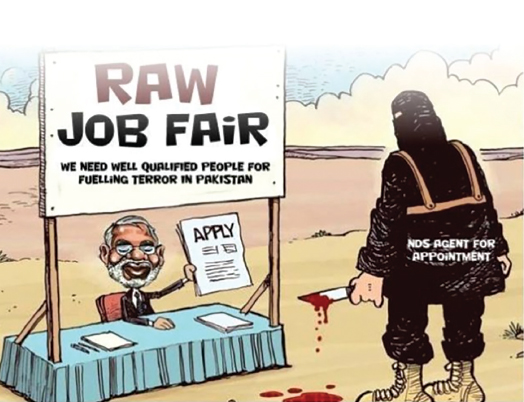
The insurgency in Pakistani Balochistan has involved different players such as India, Russia (previously the Soviet Union), Afghanistan, China and the USA. This has aggravated disquiet among the people of Balochistan, especially among the Baloch population. India has been blatantly interfering in Balochistan and, by extension, in Pakistan’s domestic affairs for decades and has become a major destabilizing force for the province and the country.
The insurgency in Balochistan has been an enduring armed and nationalist struggle between Baloch insurgents and the Pakistan government since 1948. These factors have contributed to the worsening of the relationship between Pakistan and Afghanistan. The economic disparity and counter-terrorism operations, followed by human rights abuses, evolutionary phases of the current and past insurgencies and external support of hostile proxies are factors that have provoked the Baloch people to stand against Pakistan’s military, security agencies and government institutions. External forces have taken advantage of the loopholes and unresolved grievances in Balochistan, thus making the situation more complex and lengthy.
There is clear evidence of India’s interference in several terrorist activities that have occurred in Pakistan over the past several years. Nefarious Indian agenda has gained more momentum after the China-Pakistan Economic Corridor was announced as New Delhi is deeply opposed to Pakistan gaining financial stability and moving ahead with development projects that could be game-changers. CPEC was proposed by China to connect the seaport in Gwadar to the Chinese province of Xinxiang. The terrorist attacks after China and Pakistan signed the project are mostly aimed at Chinese consulates and Chinese workers in Pakistan and at Pakistani military personnel, to deter them from continuing the project or protecting it.
 The Balochistan Liberation Army (BLA) that has close proven links with India claimed the responsibility for the Karachi Stock Exchange attack in 2020. In May 2021, three FC soldiers were killed. In June 2021, at least eight persons, including four soldiers were killed and 15 wounded in two separate attacks on security forces in Balochistan. As a result of India-sponsored terrorism, Balochistan had 2,886 terrorist attacks and 3,184 related deaths from 2011 to 2020, while the numbers for 2021 are still adding.

The writer is an M.Phil. in Defence and Strategic Studies from Quaid-e-Azam University, Islamabad. She can be reached at mubeen.0727@gmail.com
Leave a Reply