
Detailing the Dysfunction
U.S. officials are said to have misled the public about the Afghanistan
War for almost two decades. Rosy but false pronouncements
were made and unmistakable evidence hidden.

Yielding to immense US pressure and thanks to the efforts by Pakistan, the Taliban agreed to a 10-day ceasefire with the US after the peace agreement was signed. This would subsequently lead to reduction in violence with Afghan forces and an intra-Afghan dialogue under the auspices of Germany.
The Taliban and US negotiators met on 15 and 16 January in Doha. Later Sohail Shaheen, Taliban spokesman while speaking to the Pakistani paper Dawn on 18 January, described the talks as “useful” hinting at their continuation. He stated the Taliban were “optimistic” about a deal with Washington by end January, 2020. The negotiations were expected to outline an agreement that would see US troop withdrawal in return for security guarantees by Taliban, besides agreements on other issues. The ceasefire had the US pre-condition of re-starting the talks that were started in Doha and then paused in December last year, after a Taliban attack near the Bagram military base. The Taliban had been consistently refusing to accept the US demand to announce a ceasefire “during the peace talks” and remained stuck to their position to do so “after” the agreement was signed. The Taliban are, reportedly, still not calling it a ceasefire but just an “arrangement”, given the negative effect it has on unity of the Movement, as repeatedly argued in these pages.
The pause in the peace process had mixed results. The Afghan government that previously felt sidelined in a peace process, considered it “too rushed” till President Trump scuttled it last September. It is now pushing for an extensive ceasefire. As per Afghanistan NSA’s, Hamdullah Mohib, Afghan leaders considered a ceasefire as the Taliban’s seriousness for peace, and conceded that the Taliban “can deliver on what they sign.” The Taliban used the interruption to bridge divides among their own rank and file. Reportedly, Mullah Abdul Ghani Baradar, the Taliban deputy leading the talks, traveled to Pakistan and met around 300 senior and midlevel commanders to take them onboard.
During this time; Dai’sh, was able to entrench in Kunar, Laghman and Nangarhar provinces in eastern Afghanistan, due to Salafi influences in these provinces and their broad compatibility with Dai’sh’s Salafist ideology. Support from the local population bolstered by resources - mainly oil revenues from Iraq - started attacking government forces, foreign forces and the Taliban. The group used women as battle shields, forcibly converted captured men and women to their ideology and required women to marry their fighters, either voluntarily or out of ignorance. This caused a societal backlash and the Taliban offensive with overwhelming local support, evicted the group that the US military was unable or unwilling to do.
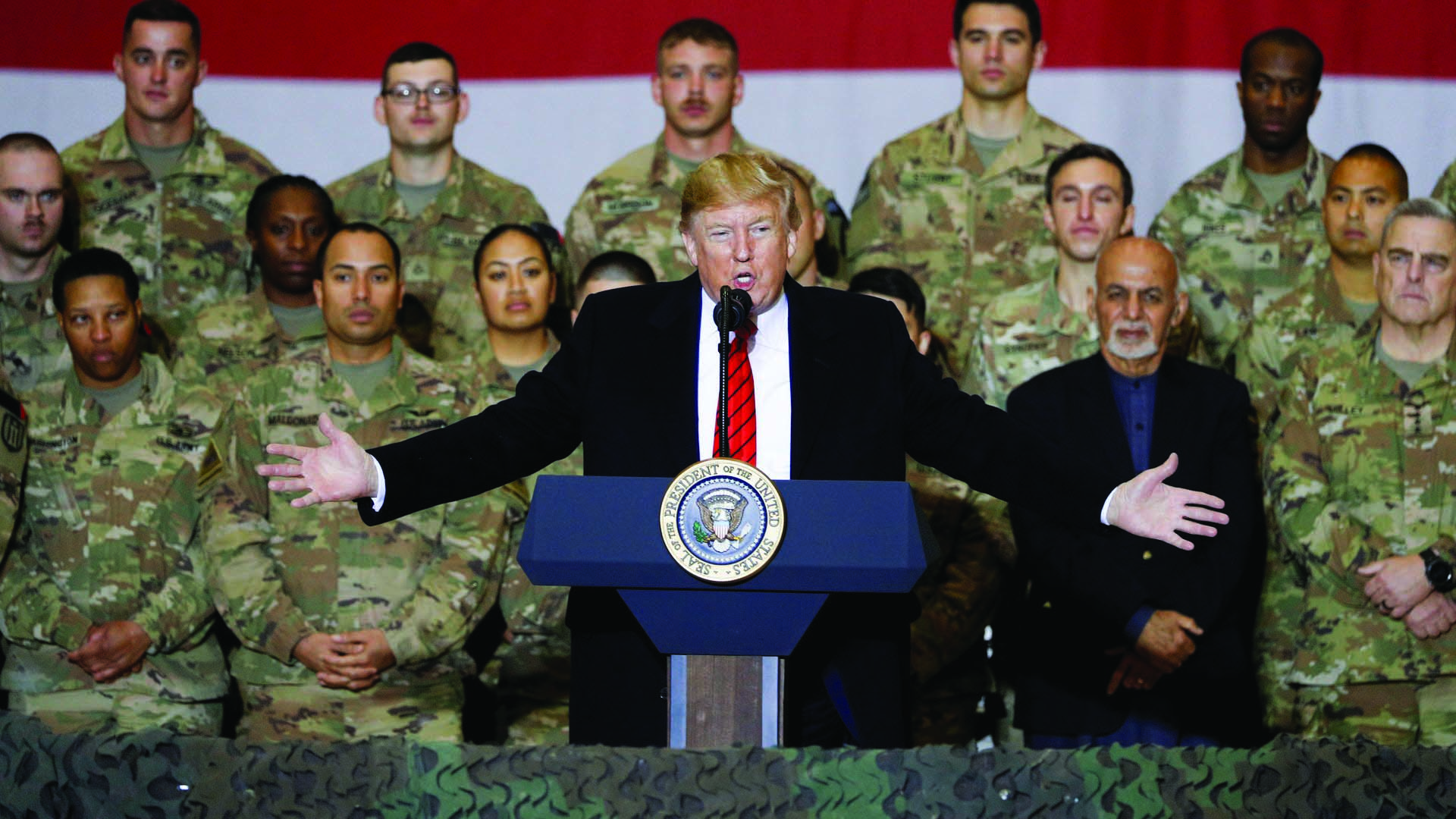
In another development, on 9 Dec 2019, Washington Post published “Afghanistan Papers”, styled after the Vietnam era “Pentagon Papers.” These were based on SIGAR (US Special Inspector General for Afghanistan Reconstruction) interviews with some 400 insider US, UN and Afghan officials, detailing the causes of US failures in Afghanistan. Consequently, what was known for a long time was publically acknowledged by US, that the US political and military leadership had been lying to the general public about the actual situation of war in Afghanistan.
Gen Douglas Lute – a three star Army General - handling the Afghan war under Bush and Obama Administrations, is quoted as saying, “We were devoid of a fundamental understanding of Afghanistan — we didn’t know what we were doing…. We didn’t have the foggiest notion of what we were undertaking.” The price for ignorance was steep; over 157,000 deaths including 43,074 Afghan civilians and 64,124 Afghan security forces… and still counting. US casualties, included over 2,300 dead and around 20,589 wounded, besides the terrible after-effects like mental distress, PTSD and suicides, etc. SIGAR estimates the cost of war since 2001 (only for Departments of State, Defence, Veterans Affairs and USAID) was around 978 billion, excluding the CIA.
James Dobbins, a former US diplomat, is quoted as saying, “We don’t invade poor countries to make them rich. We don’t invade authoritarian countries to make them democratic. We invade violent countries to make them peaceful and we clearly failed in Afghanistan.” In geo-strategy, wars have defined political aims, objectives and clear military goals. The US failed this fundamental. From an initial objective “to retaliate against al-Qaeda and prevent a repeat of the Sept. 11, 2001 attacks” it dithered towards nation-building, turning Afghanistan into a democracy, transforming Afghan culture and reshaping “regional balance of power among Pakistan, India, Iran and Russia.”
Most interviewees attributed the continuing Afghan fiasco to a lack of “Strategic Direction” from political masters and a “Strategy” from military command including an operational strategy. The shifting aims and objectives of war inhibited a professional military from pursuing coherent goals and a clear plan. USMIL had no clear “War Termination Strategy” to end the conflict. Gen Petraeus faced tough questions from skeptical lawmakers as far back as March 2011, whether or not the US Afghan strategy was working? Gen Michael Flynn, a retired three-star general, told SIGAR in a 2015 interview, “From the ambassadors down to the low level, [they all say] we are doing a great job…Really? So if we are doing such a great job, why does it feel like we are losing?” Insiders reported in 2014, that “truth was rarely welcome” by the military in Kabul.
During the “Nation-Building” under President Bush, the US allocated more than $133 billion; flooding Afghanistan with far more aid than it could absorb, leading to rampant corruption. Mass corruption involving “judges and police chiefs and bureaucrats extorting bribes” antagonized common Afghans, who flocked back to the Taliban.
Raising of the Afghan National Army and Police is still a pipe-dream with mostly incompetent, unmotivated and absconding recruits, and a predator officer corps, taking cuts is soldiers’ wages and pocketing salaries of “ghost soldiers”. One third police recruits were drug addicts or Taliban insiders, selling official property, including gasoline.
The US spent about $9 billion to fight the opium problem during the past 18 years. But Afghanistan, in 2018 alone, produced 82 percent of global opium. When the British paid the poppy farmers to destroy their crops, there grew more poppy next year; and when the US destroyed poppy fields without compensation, infuriated farmers joined the Taliban.
The shifting aims and objectives of war inhibited a professional military from pursuing coherent goals and a clear plan.
The Papers criticize the shortsightedness of not pursuing a negotiated settlement with the Taliban earlier on… that, ironically, Pakistan was emphasizing all along. There is typical finger-pointing at Pakistan for not “doing more” and for providing “safe havens” to the Taliban besides the escape argument that USMIL was restrained to conduct “Hot Pursuit Operations” inside Pakistan.
What the Papers fail to acknowledge is the Taliban motivation, inspiration and fighting ability that was pivotal in denying victory to the strongest military machine on earth. The power of a just cause and willingness to offer supreme sacrifice for defence of their faith and country are likewise not appreciated. It is hoped that correct lessons have now been learnt and would be pursued.![]()
The writer has an interest in International Relations and Political Sociology. He can be reached at |
|
Cover Story
|
|
Region
|
|
News Buzz
|
Update |


Leave a Reply