Yet, the months of October-November saw a discord between the two that culminated in a divorce. Like an Indian film blockbuster, the twist in the tale of Maharashtrian politics started in October when the coalition of these two parties won the state assembly elections together.
Shive Sena and BJP had agreed on a formula for governing the state before the elections whereby the incumbent BJP chief minster Mr. Devendra Fadnavis would continue to hold office for the next two and a half years, and hand over the reins of the state to Shiv Sena’s leader Uddhav Thackeray for the remaining term.
However, the results of the elections – or rather the number of seats secured by each party, changed the entire political matrix.
The BJP had won 142 seats in the previous election, but its total tally was reduced to 105 seats, while Shiv Sena dropped down from its previous 75 seats to just 56. Narendra Modi saw this as an opportunity to sideline its minor local partner and demanded that the previous arrangement of sharing the post of chief minister be scrapped.
Shiv Sena’s position was further weakened by the National Congress Party (NCP) which had managed to gain 54 seats. Narendra Modi made it clear to the Sena that in case it clung to its demand, the BJP would form an alliance with the NCP whose 54 seats combined with BJP’s 105 would hand him the majority (145 seats) required for forming the government.
NCP, on its part, recognized this opportunity and began sending signals that it may be willing to part ways with the Congress party.
Narendra Modi couldn’t have asked for more. On the one hand, he was getting an opportunity to deliver a punch below the gut to its main national rival and, on the other, he had the chance of getting rid of the Shiv Sena which it had always considered nothing more than a local Maharashtrian thorn.
Shiv Sena saw this development as an existential threat. Its numbers were already dwindling as more and more of its rank and file defected to the bigger and richer BJP. Once stripped of the chief ministership, the Shiv Sena thought it would lose real power in Maharashtra and become a truly local underdog. Not to be outfoxed by Narendra Modi, the Shiv Sena decided to embrace its long-term adversary, the secular Congress Party which had secured 44 seats. However, the Sena still needed the NCP in order to secure the majority.
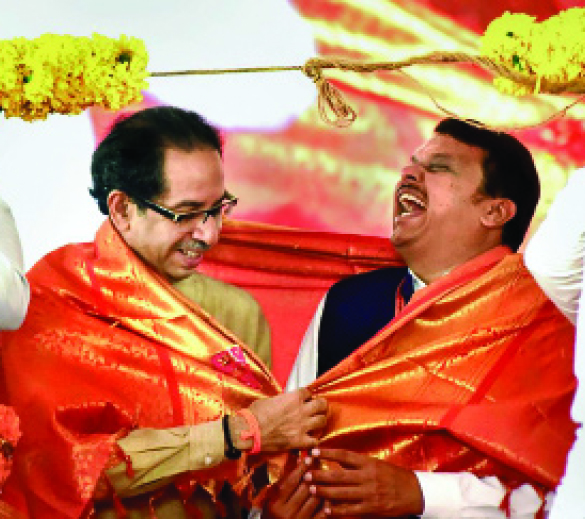
Thus began a game of betrayal, deceit and dirty political maneuvering that saw multiple defections, desertions, renouncements, and coming-backs until, finally, the Shiv Sena boss, Uddav Thackeray turned up with the majority and became the chief minister of Maharashtra.
What is really amazing about this political game is that it was played entirely in full view of the public. The state’s 112 million people watched helplessly as handouts were thrown, grabbed, and sides switched repeatedly. At one point during these negotiations, in order to woo NCP’s Ajit Pawar, the BJP-controlled home ministry dropped all corruption charges against him without stating any reason.
The drama played out in Maharashtra laid bare the fundamental flaws within the Indian democracy. Politicians showed how easily they can manipulate the innate elasticity of this system until it suits their crooked whims.
The final product of this reckless political maneuvering is an alliance of a fundamentally fascist party, a secular party, and its nationalist offshoot. This bizarre invention will have many believe that the Sena tiger has finally turned vegetarian. But how long will this marriage of convenience last is anybody’s guess.
Indian extremity is not limited to politics. The economy is in a pretty bad shape too. Unemployment is high, and production is low. The GDP is below 4.5%, and even this figure may be engineered by the government. Modi needs a distraction – a war – or a skirmish.
The world should expect a spectacle from India’s biggest showman pretty soon.





Leave a Reply