


 For centuries, Afghanistan has been a cradle of struggle of imperial powers –a melting pot of invading armies trying to get the control of the region. It is a country scarred by ravages of wars—others’ wars. The last four decades of war have witnessed hundreds of thousands of people dead, millions displaced while the country has plunged into downright destruction. The recent international conflict beginning in 2001 triggered by the September 11 attacks met its waterloo in August 2021 with Taliban militants sweeping into Kabul once again to take-over the reins of a country abandoned by the international community as well as the hand that had been rocking the cradle for all these years, the United States. Once again the speed of the Taliban’s territorial gains and the speed of the extrication of the United States and its allies surprised the world. With this prompt exit, exited the many international aid organizations too, not only abandoning Afghanistan and its people, proverbially, ‘in the lurch’, but also leaving the entire region hanging by a piece of thread. The Taliban government, though seated in power, seems to be in a state of suspended animation, unable to cope with the situation on ground. All government sectors, including the vitally needed organs to run the state’s administrative machinery, seem to be slowly coming to a grinding halt. As time passes, the people of the war-ravaged country are slowly being sucked into a visible unprecedented human crisis that has all the trappings to turn into a yet another violent conflict. Whether urban or rural, the people irrespective of the strata they may belong to are coming to this very impasse.
As winters are around the corner, the situation at home is only likely to worsen, besides, further deepening the economic quagmire, making the living of the common man more or less ‘survival of the fittest.’ If this impending crisis is not contained now, it is feared that no other power or government will be able to avert its spilling-over to other countries in the region. Regional countries, in a bid to keep the conflict at an arm’s length and well within the confines of the Afghanistan boundaries, will have little choice than to resort to conventional mechanics of playing and supporting proxies, one against the other.
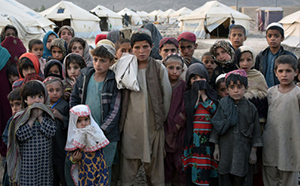
Financial instability leads to moral, social and political instabilities. Sooner than later, it will embolden the various power groups, warlords, tribal chiefs, ethnic and linguistic groups, including innumerable Jehadi organizations, which remained at loggerheads with each other, and which till now have been hibernating, in a bid to bide time for the right moment. They will start to surface everywhere to wrestle control of the territory and resources. Moreover, increasing internal instability, a mass exodus of refugees and growing humanitarian crises, further exacerbated by climatic change and global food and energy markets, could have regional spill-over effects. Additionally, Pakistan, India, Iran and Russia are all likely to compete for influence in Kabul and with ‘sub-national’ actors. With the coming of the freezing cold and drought, the food shortage is likely to hit the people in the gut. According to a recent survey, 98% of Afghanistan’s population is already facing extreme poverty, among which 50% is living in absolute destitution. Heart-wrenching reports are in the air of families compelled to sell their daughters for a paltry sum to feed other members of the family.
This is undoubtedly a gruesome state of affairs. Analysts are of the opinion that more people are likely to fall victim to the looming humanitarian crisis than the combined loss of lives in 4 decades of war. It is immaterial to discuss the ones responsible for this deadlock. The long war has eaten the social, political and economic fabric of the country like a moth. As long as American boots remained on the ground, the situation was reasonably under control. However, with the extrication of the American forces, the situation that remained visibly calm, albeit artificially, started to shrivel almost immediately. It is no secret that the United States-propped Ashraf Ghani depended on foreign aid, whereas Afghanistan’s own economy could only contribute just a bit to the national budget. Today, the situation on ground is most ominous with the government having no money to pay salaries to employees. This includes the vitally needed health sector, which is likely to compound the already burgeoning humanitarian crisis.


The writer has spent 27 years in uniform and has a published collection of short stories By the Autumn Trees to his name. He can be reached at arslan9h@gmail.com
👍🏼The humanitarian problem is very well highlighted- people often forget the human aspect in such gigantic political shifts
Holistic, all-encompassing, and multidimensional. A very well-researched piece with concrete analysis offering substance for thought and excogitation.
Enjoyed reading the article, really explains everything in detail. It’s alluringly worth for me.
Thanks for posting!
A lovely and awesome article, an article that has opened up with so many horizons