



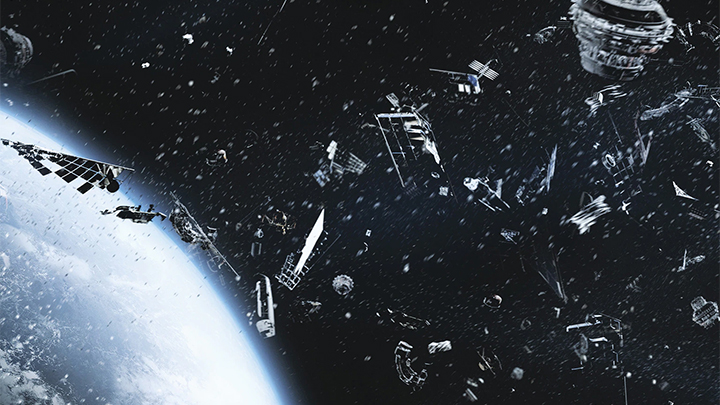
Since space has been explored, man has been making astonishing discoveries. Foreseeing his future in space, man set up space stations and launched artificial satellites for a variety of objectives. Doing so, he reached the Moon and sent scores of missions to the Mars vicinity, and other planets along with their stars. He is now aiming for the colonization of space in the near future. Despite such mind boggling achievements, however, there is also something which is not discussed frequently in the media.
Historically speaking, man initiated the space movement in 1957 when Russia launched Sputnik-1. It was the time when the debris and clutter started amassing the space. Debris include non-functioning spacecraft, various stages of rockets and others. Referred to as space junk, it is now one the serious threats confronting the international space station and satellites moving in space.
According to the Space Surveillance Network (SSN), there are more than 2,7000 pieces of debris moving to and fro in space. As revealed by the National Aeronautics and Space Administration (NASA), around 2,3000 pieces larger than a softball, 5n00000 pieces larger than one centimetre, and 1,00 million micrometers-sized debris are found in space, travelling at the speed of 175,00 MPH which makes them dangerous and also increases the number of debris. In accordance with the light of Kessler Syndrome presented by Donald Kessler, a NASA scientist, when junks collide with one another, they create more junk and this cycle continues.
In 1996, for instance, a French satellite was hit by the debris from a French rocket which exploded a decade earlier and left behind more than a hundred pieces of debris. Secondly, China’s anti-satellite test in January 2007 destroyed an old weather satellite which again added 35000 pieces of debris to space junk. Also, on February 10, 2009, a defected Russian spacecraft collided with the functioning US Iridium commercial satellite and destroyed it, adding more than 23,00 pieces of debris to the space. Recently, in November 2021, Russia also carried out an anti-satellite test in space, which consequently added numerous more junk and debris in space. As per the NASA statistics, about 75,00 satellites have been launched so far. Last of all, the dead satellites and rockets are also left in space thus adding to more space junk.
According to NASA, there will be around 4,0000 satellites entering space in a few years due to extensive technology usage such as mobile GSP, military installations, weather updates, and the like, thus adding to more space junk in the future. Thanks to emerging space tourism, by the same token, there will be more space flights taking place in the near future. For example, a Russian director filmed a movie named “The Challenge” in space by employing a Russian space agency for that purpose.
However, space junk must be reduced to have a cleaner space environment, which is in everyone's interest. However, no concrete measures have been taken so far.
Some efforts were taken in the past but they were not that impactful though. In 1990, for instance, NASA issued the first guidelines to mitigate the debris fragmentation rate. After the formation of the International Space Agency (ISA), the guidelines were adopted in 2002. Moreover, in 2018, Britain launched a mission named “Remove Debris,” which was later deployed by the international Space Station (ISS). The mission tested two technologies: Capture with Net and Capture with Harpoon.
Space junk can be reduced by adapting multiple methods as recommended below. First, there should be some powerful magnets or huge nets as prescribed by the Debris Mission to help bring down traceable debris. Secondly, space friendly rockets, made up of different metals, can be introduced. Thirdly, a set of well-defined space laws enacting the rules and regulations related to the space which must be promulgated for international space missions. In a similar vein, a specific law related to space junk cleaning must also be introduced to enforce space agencies to bring down the trash thrown into space.
Last but not least, there should be an urgent follow up to clean the clutter found in the low earth orbit around 1200 miles away from the Earth.
Space junk has been a serious threat to the spacecraft as well as the space station. It is high time to take some calculated steps or else the menace will continue to grow. As a corollary, it will keep incurring more financial losses. If the space is not cleaned in due course of the time, the day is not far away when rockets will have to cross a thick layer of the debris and rubble before entering to space. 
References:
1) https://www.orbitaldebris.jsc.nasa.gov/
2) https://www.nasa.gov/mission_pages/station/news/orbital_debris.html
3) https://www.britannica.com/science/moon-natural-satellite
4) https://www.google.com/amp/s/www.space.com/amp/space-junk-growing-problem-complicated-solution
5) https://www.weforum.org/agenda/2021/05/why-we-need-to-clean-up-space-junk-debris-low-earth-orbit-pollution-satellite-rocket-noosphere-firefly/
6) https://www.nhm.ac.uk/discover/what-is-space-junk-and-why-is-it-a-problem.html
7) https://api.nationalgeographic.com/distribution/public/amp/science/article/space-junk
8) Aljazeera News

The writer is a visiting faculty member at the Govt. Degree College Hub. He is also serving as an ESL Instructor at the School of Intensive Teaching in Hub, Balochistan. He tweets at @Zag2301
Good information