



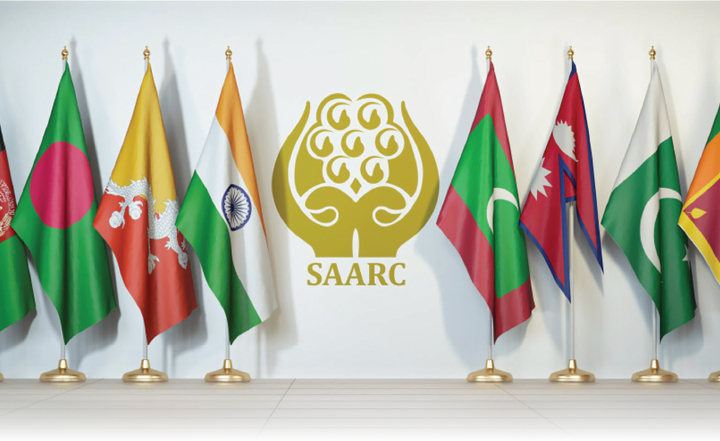
An economic and political organization of eight countries in the South Asian region, the South Asian Association for Regional Cooperation (SAARC) does not make headlines too often and is no more than a dysfunctional organization with symbolic existence since its inception. However, at such a crucial time when regionalism has emerged as an important agenda in contemporary geopolitics and economy, the South Asia region cannot afford to retreat from the SAARC, despite its poor performance in the past.
If the SAARC member countries can emulate the European example and find ways to actively pursue the agenda of common regional interests in place of blocking negotiations over bilateral disputes, then SAARC could be a force to reckon with.
Pakistan Foreign Minister Shah Mahmood Qureshi says Pakistan is ready to host the long-delayed SAARC summit as the platform can create a conducive and congenial atmosphere to build economic synergies and transform the quality of life of the people of South Asia, plagued by interstate disputes, high levels of debt, struggling democracies, poverty and environmental devastation.
South Asia is home to the largest concentration of poor people in the world. The concept of accountability has not prevailed in the region, and the feudal-minded ruling class is unwilling to devolve power to the lower levels.
To make matters worse, the region’s bilateral trade volume is only 5 per cent, compared to other region-based alliances such as NAFTA (North American Free Trade Agreement) with 52 per cent, 32 per cent in Asia Pacific and 22 per cent among the ASEAN (Association of Southeast Asian Nations) member countries.
According to an online article titled “How Trade Can Help Speed Asia’s Economic Recovery,” co-written by Pragyan Deb, Julia Estefania-Flores, Siddharth Kothari, and Nour Tawk, trade has historically been a powerful driver of economic growth and poverty alleviation in Asia. The writers further say that while tariff barriers to trade in Asia are low overall, a new measure of non-tariff barriers suggests those remain high in many Asian emerging markets and developing economies. Unlike tariffs, according to them, these barriers include policies that introduce frictions such as licensing requirements or restrictions on trade payments and exchange foreign currencies.
 Ejaz Ghani is a renowned economist associated with the World Bank. He has worked in Africa, East Asia, and South Asia. Prior to joining the World Bank, he taught economics at Oxford University. In his article titled ‘What are Key Areas for Regional Cooperation in South Asia?’, Ejaz Ghani writes that for regional cooperation, there are three priority areas: telecoms and internet, energy, and transport. According to Ghani, a regional telecom network and a high-bandwidth, high-speed internet-based network could help improve education, innovation, and health. He further says that a regional network would facilitate better flow of ideas, technology, investments, goods and services and it would facilitate greater interactions between knowledge workers in areas such as high-energy physics, nanotechnology, and medical research. There are untapped positive synergies at the regional level that would come from information sharing and competition in ideas among universities, non-university research and teaching entities, libraries, hospitals, and other knowledge institutions, writes Ejaz Ghani.


The writer is a socio-economic analyst and can be reached at hamiddawoodi@gmail.com
Leave a Reply