


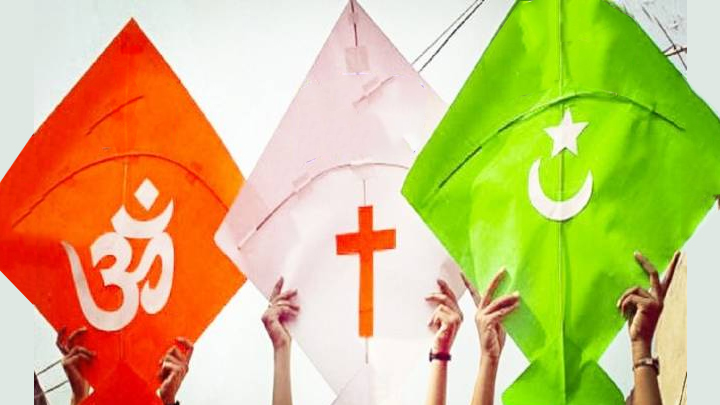
Who says that an Islamic country like Pakistan does not support its minorities or does not take sufficient measures to protect minority's rights? Straight to the point, Pakistan happens to be an Islamic state and its Constitution guarantees the rights of the country's minorities. The white colour in the country's flag also represents its minorities. Last week, Chief Justice of Pakistan Gulzar Ahmed inaugurated the rebuilt Shri Paramhans Ji Maharaj Hindu temple in Karak in Khyber Pakhtunkhwa, while the Sindh Government announced 4th November as a public holiday for Hindu minority. In addition to that, World Minorities Day is observed in Pakistan. The current PTI government has taken many initiatives to protect the rights of minorities and the foremost amongst them is the opening of the Kartarpur corridor to facilitate Sikh yatris visiting Pakistan from across the border.
However, there is still a long way to go as there is a litany of challenges faced by the country's minorities. A host of measures taken by the government and the Judiciary are not enough to safeguard the rights of minorities unless they are not provided education. Many people in Pakistan are oblivious to the fact that religious diversity too exists in the country and it should be given due respect and honour.
Having carried out some research work on the subject of interfaith harmony and societal tolerance, I have many a time observed that the minorities are excluded from the mainstream society, while the common reaction from the lower to upper-class Pakistani is very different about them. For instance, how often do you see a person from Hindu, Christian, or any other minority group around you? How many of us refrain our children from befriending them? How many of us believe that people of other religions are punished by God because of having different faiths? How many of us are suspicious about their patriotism and loyalty to the country? No doubt, such negative thinking and biased attitudes are the root cause of violent extremism, which has tarnished the image of the country.
Pakistan government, the media and the civil society as well as the country's religious and political leadership should make concerted efforts for creating a tolerant environment that could lead towards acceptance of diverse beliefs and different ethnic identities that exist in the country. The citizens of a tolerant society are less likely to become religious zealots and are intolerant of those who have different religious beliefs or don't believe in any religion at all.
The powers that be must determine the means to enshrine the principles of tolerance in the process of policymaking. Improved living standards and education can play a pivotal role in promoting and sustaining tolerance, says Sarah Peterson, an eminent research scholar, who has been associated with a programme focusing on the relationship between education and community development. She has explored a different set of solutions through which a peaceful building of society could be a real possibility. However, for Pakistan in particular, education, awareness and interfaith dialogues are three ways that could usher in reducing interfaith tensions and eliminating prejudices based on religious affiliation or ethnic animosity.
Educational institutions are instrumental when it comes to promoting tolerance and peaceful coexistence in the society. For instance, schools, colleges and universities must regularly organize events to help the young generation understand other religions and their values. From this perspective, we can cite the example of Greenwich University in Karachi, which recently celebrated Diwali, a festival of lights celebrated by Hindus. Such events encourage young minds to respect people of other faiths. Although, at this stage, we cannot ask other educational institutes to emulate the Greenwich example, the media, the civil society and academics can play their part by creating awareness and promoting a positive image of other religions and cultures, instead of finding faults within them.
The task of community development and peace is also paved by holding interfaith dialogue and interreligious communication, since it develops a sense of joint ownership on humanity grounds. For peace-building and conflict prevention, the significance of holding dialogues is rightly explained by the United Nations Development Programme (UNDP) on its website. According to UNDP, "Dialogue is an inclusive process," as it entails learning, not just talking, since it tends to change the way people talk, think, and communicate with each other. However, people participating in the dialogue must show empathy towards the others by recognizing differences and by finding a common ground for change.
In Pakistan, some Muslim scholars of different schools of thought have established a platform called 'Ithehad Bain Ul Muslemeen,' which works for promoting unity among different sects as well as expedites coordination and cooperation between the government and the society. In Karachi, the Interfaith Commission for the Archdiocese is also working to maintain peace and harmony among different religions. Doing so, it needs to work together on a regular basis. The organizations as mentioned above need to work on a national level as a mediator and they together could better raise their voice nationally and internationally against those who work against interfaith harmony, multiculturalism and peaceful coexistence of the society.
Individuals can also play a crucial role in maintaining peace and interfaith harmony. In the last two weeks, we have seen some people rising to the occasion in an individual capacity and working as a mediator between the government and the Tehreek Labaik Pakistan (TLP). For instance, Mufti Muneeb Ur Rehman along with Maulana Bashir Farooqui of Sayalani Welfare played a key role to end the prolonged deadlock by bringing both the parties to the negotiating table. The same thing was done by Abdul Sattar Edhi and his wife Bilquis Edhi before launching of the Lal Masjid operation in the era of former president General Pervez Musharraf, but in vain.
One can never deny the fact that the desired motive to promote interfaith harmony and tolerance cannot be achieved overnight, as it is more of a Herculean task, which requires time, resolve and patience. The Balkan countries like Albania are the best example of successfully bringing religious harmony in their societies. Briefly put, such essential things as peaceful coexistence and tolerance for other communities and minorities can never be achieved without giving respect to different views and religious perspectives. 

The writer is a freelance journalist and writes blogs and articles. She has Masters qualifications in Mass Communication, International Relations and Islamic History and can be reached at sadia.masscom@gmail.com
Very informative blog.Keep it up Sadia
Good job Sadia
Well artuculated article corroborated with research work. Good job done !
Good effort and excellent work ,Eye opener article for those peoples who have negative thoughts about Muslims specially for pakistan 🇵🇰 .KEEP IT UP