


 Few would deny the fact that Pakistani literature in English is limited in terms of its geographical focus. A vast majority of authors have set their novels in the country’s chaotic urban centres instead of the quiet rural backwaters. It is, therefore, refreshing to come across fiction that breaks this stereotypical mould and ventures into uncharted terrain.
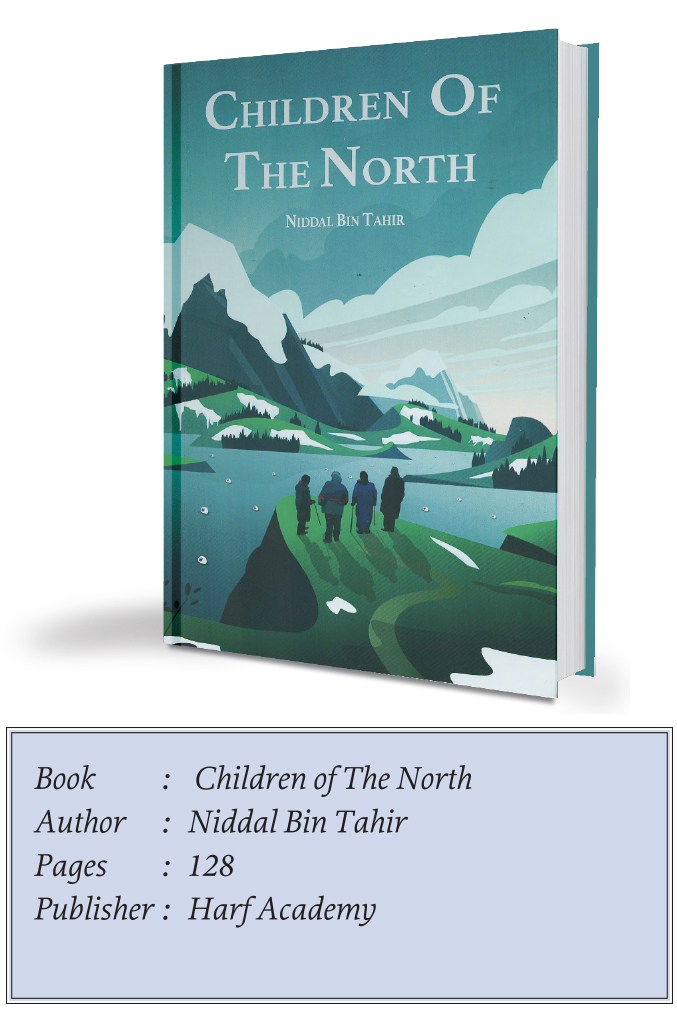
Viewed in this context, Niddal Bin Tahir’s Children of The North arguably stands out for its unique choice of setting. In a novel that spans 127 pages, readers are taken on a heady, memorable journey through destinations that usually elude the canvas of other writers who belong to the local literary set. The author evokes the sights, sounds and flavours of these neglected localities with a keen eye for detail. Images of the verdant mountains of Naran Valley as well as the azure splendor of Saiful Malook bounce off the page and come alive as glowing miniatures of an unexplored world.
However, a novel cannot rely solely on the painstaking art of world-building, and must also possess an airtight plot and compelling characters. Tahir’s debut work chronicles the challenges of four young men who travel from Islamabad to the northern areas. Their adventure proves to be a long, tedious one that lands them in more trouble than they would have expected. The novel is avowedly based on true events. As a result, the twists and turns in the narrative appear somewhat organic and don’t resemble awkward plot contrivances that are fairly common in the genre. Even so, the storyline bears a meandering quality that may be an acquired taste for some readers.
Children of The North captures the intricacies of the public sphere and primarily comprises male characters. The androcentric focus of the novel often renders it a testosterone-fuelled meditation on travel in Pakistan. However, the author’s decision to depict an intrinsically male world cannot be construed as a fault in the book. Tahir’s characters belong to a society where men and women inhabit fundamentally separate domains where the possibilities of intermingling with members of the opposite sex are scarce.
As a whole, the novel is written in a crisp, engaging manner with few noticeable slip-ups. Through the effective use of dialogue, the author succeeds in building on the cinematic appeal of the story. On the strength of these ingredients, Children of The North could make a voyage to the silver screen. Even so, the cinematic style isn’t always executed with great care. In the initial segments of the novel, long passages that provide character sketches tend to interrupt the flow of this dialogue-driven approach. While this technique serves to add variety to the narration, it can be quite jarring.
The crowning glory of Children of The North is that it portrays the disparate realities of Pakistan’s urban and rural life. It is believed that urban dwellers tend to be wily, high-minded and manipulative whereas those who reside in rural centres are traditional and backward. Tahir presents this distinction in a nuanced manner. His city-dwelling protagonists find their lives in disarray on account of their own ignorance, which lead them to prioritize the instinct of self-preservation and disrespect their surroundings. The unsuspecting victims of their activities purely act out of an earnest desire to defend their turf from exploitation.
Laden with spine-tingling adventures, Children of The North breaks free from the troupes that Pakistani writers tend to employ and presents a unique story. Tahir’s novel reminds us that there is ample room to widen the scope of Pakistani literature in English. While the novel has its occasional pitfalls, it cannot be written off as amateurish as it succeeds in weaving a powerful story of survival.
An interesting wite-up!
It does justice to the novel.