


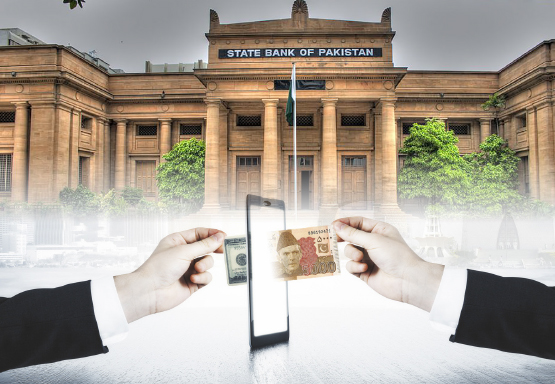
 The objective of the State Bank of Pakistan (SBP) is to primarily serve as the central banking authority in Pakistan. The State Bank of Pakistan Act 1956 mandates it to not only regulate the monetary and credit system in Pakistan but also improve the economic growth rate by ensuring a stable money supply and fostering the productive capability of the country to ensure better utilization of available resources.
The major functions of the SBP include regulation of liquidity which ensures the flow of credit to different economic sectors and stability of the monetary and price systems. This is crucial in fostering higher levels of economic growth. The SBP also ensures that the financial system is sound through its regulation and supervision and exchange rate management and balance of payments as it is the custodian of the external reserves. Further, the SBP also has a development role which involves rehabilitation of the banking system, development of new financial and credit markets as well as creation of Development Financial Institutions (DFIs).
The financial and credit market in Pakistan is relatively underdeveloped, even compared to its regional counterparts. The average domestic credit to the private sector as a percentage of GDP was 18% in 2019 as reported by the World Bank’s World Development Indicators. The South Asian average was 47.3%, the average for India was 50.2% and the average for Bangladesh was 45.3%. East Asian countries such as China, Thailand and Vietnam all reported more than 137.1% in 2019. The fastest growing economies such as Bangladesh and Vietnam observed a significant growth spurt in the size of their credit markets, essential to facilitate economic growth. The SBP has an important role to ensure that the banking sector in Pakistan is able to provide the much-needed financial support to commercial and industrial activities that contribute positively to economic growth. The link is apparent in other countries that are known for their miraculous achievements in terms of economic growth.
Further, considering the Word Bank’s Doing Business Report 2020, Pakistan is ranked at 119, similar to Bangladesh but below Afghanistan. Although its main commercial hub, Karachi, performs poorly in terms of the strength of legal rights and credit bureau coverage, it performs exceptionally well in terms of the depth of credit information. The SBP also has an important role to cater for the timely flow of export receipts and import payments in order to boost export growth. This requires not only reducing red tape and bureaucratic hassles in the financial flows between Pakistan and its trading partners but also ensuring minimal documentation requirements. This encourages participation of not only small and medium-sized firms but also new less-experienced traders. The digitalization of the documentation process is extremely important.
 The COVID pandemic created a major stranglehold on the global as well as the domestic economy in Pakistan. When the first lockdown was announced in March 2020, it was essential for the government to ensure that the poorer individuals and small businesses, that rely on daily financial transactions in terms of wages and sales, are provided with the means necessary to support them during such challenging times. The SBP started various measures to ensure that daily wage earners were prevented from layoffs and provided temporary economic relief packages to boost investment. The SBP supported the health sector to combat the virus and introduced a debt restructuring scheme that provided an opportunity for borrowers to defer their payments.


The writer is an Assistant Professor of Economics and Research Fellow at CBER, Institute of Business Administration (IBA), Karachi. He can be reached at anakhoda@iba.edu.pk
Leave a Reply