



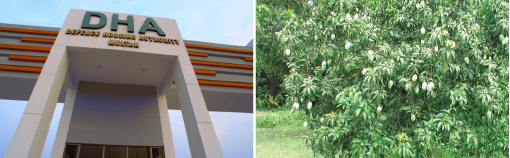
Mango is the second most important fruit crop of Pakistan after citrus. In the 1970s, Pakistan was the second largest mango producer in the world. Pakistan’s position has dropped now and the declining trend may continue if the crop’s production and management are not properly dealt with.
History has bestowed Multan with many gifts: it is known as a city of saints. The town has been continuously inhabited for more than 2,000 years and is located in an area dating back to the Harappan civilization. It has always been a part of the world-acclaimed Indus Civilisation. Not only its history, but its natural endowments have been worth noticing. Multan is a typical example of a major city surrounded by prime agricultural land. Now housing schemes have encroached its once-fabled orchards, severely damaging the country’s mango production and exports. An example is a gated society called the Buch Villas that have been constructed over land that previously belonged to mango orchards. Bund Bosan, Royal Orchards, and WAPDA Town Housing Scheme, among others, have all been constructed over the mango-growing heartlands of Multan. This has resulted in entire orchards being uprooted from the land. Families in their ancestral trade are doing something else.
Multan’s mango orchards are spread over 44,000 acres. Around 48 large housing schemes have been developed on 7,817 acres of land. Of these, 2,043 acres (26 percent) were previously orchards. There are 460 legal and illegal housing societies in Multan, the majority of which have been built over agricultural land. An additional orchard area has already been marked for sale. The proposed DHA scheme plans to build on over 9,000 acres, most of which are currently mango orchards. The increase in property prices was a factor that persuaded many owners of mango orchards to sell their land.
One acre of land in DHA Phase 1 previously cost PKR 2–3 million, whereas it now costs PKR 6–10 million (a 200– 300 percent increase). All of this has added to the concerns mango growers already face. Pakistan produced more than 1.5 million tonnes of mangoes in 2019 and exported a record 115,000 tonnes worth $80 million, making the country the sixth-largest exporter of the fruit in the world. The continuing lower productivity and heavy losses have forced growers to clear their orchards for other sources of income. As a consequence, the future of the country’s mango industry and all its stakeholders has become bleak.
 With two universities (Bahauddin Zikaria and Nawaz Sharif) producing hundreds of graduates every year, two national cotton research institutes, another research institute dedicated to mangos, and yet another one working on agriculture mechanization, the importance of the district is felt far and beyond. Over the past five years, the share of mangoes in total fruit exports from Pakistan has hovered between 11 and 12 percent. But that is set to decline as no new mango varieties that can thrive despite drought-like conditions have entered the market. The growers have been unable to produce new commercial varieties which can withstand drought and even higher temperatures.

The writer is a legal practitioner and columnist. He tweets @legal_bias and can be reached at shahrukhmehboob4
@gmail.com
Leave a Reply