



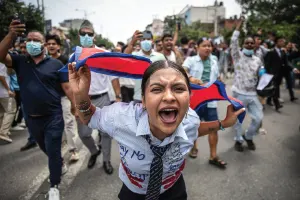
 The Gen-Z uprising-backed election yielded incredible results in Nepal, with the alternative claiming political force - the Rastriya Swatantra Party (RSP) - claiming almost two-thirds of the electoral majority. In fact, RSP is just one seat of the illustrious two-thirds majority in a 275-member House of Representatives (HoR). A two-thirds majority is an extremely rare achievement in a parliamentary democracy.
In an electoral system with participatory representation (PR), like in Nepal, the RSP’s electoral achievement is astonishing. The post-election analysis reveals that the people have expressed anticipation and support for RSP, expecting it to address the issues raised during the Gen-Z uprising.
The ball is now solely in RSP’s court. Hence, it is apparent that the RSP responds to people’s endorsement and works exclusively towards people’s well-being. To that end, the RSP and its leadership should establish a task force to develop strategies to implement the promises made during their election campaign. These include preparing a dialogue paper on constitutional amendments within three months, reducing the number of ministries, initiating investigations into the assets of public office holders since 1990, reimbursing the pending savings of small-scale cooperative depositors within 100 days, and depoliticizing universities, among other commitments.
The landslide electoral victory of RSP can be credited to only one individual: Balendra Shah, the former mayor of Kathmandu Metropolitan City and RSP’s proposed prime ministerial candidate. The rapper-turned-politician, Balendra Shah, has remained a somewhat enigmatic political figure, as he rarely appeared at public events or interacted with the media during his tenure as mayor. Although Shah was unable to fulfill his major pre-election commitments as mayor, the public responded positively to his visible, albeit cosmetic, achievements. Hence, Balendra Shah was perceived as the poster boy of good governance, and the people sensed him as the savior of the nation.
Until a few months before the election, Balendra Shah remained a vocal critic of the RSP and its leadership. People had expected that Shah would establish his own political party to contest the federal election. The stakeholders of the Gen-Z uprising had already expressed their confidence in him during the movement. In fact, the Gen-Z protesters had called on Shah to take charge of the nation after the incumbent prime minister and his ministers fled following the storming of their official residences by violent protesters. Hence, it was believed that Balendra Shah’s political outfit would perform well in the election.
Unlike people’s speculations, the tables turned just before the election, and two politically opposite poles - Balendra Shah’s team and RSP - converged together to form a sturdy political force. This provided a fresh gust of wind to the deteriorating reputation of RSP that was carrying the fraudulent baggage of its chairman, Rabi Lamichhane.
Despite the current government’s soft corner for RSP and Lamichhane, the party’s political campaigning was not picking up pace due to Lamichhane’s dubious reputation and internal party conflicts. However, the integration of Balendra Shah and his team into the RSP abruptly elevated the RSP’s political standing. The final result of the election shows that this strategy seems to have worked extremely well.


Based in Germany, the writer is a senior scientist and independent opinion maker. He regularly contributes political commentaries and analyses on current affairs to leading English dailies published from Nepal. He can be reached at pushpa.joshi@gmail.com
Leave a Reply