



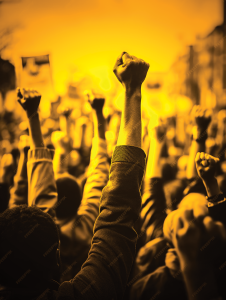
 Ihe phrase “Democracy is Dead” serves as a powerful expression of growing concern about the state of democratic governance. It captures a deep unease about whether democracy, as both an ideal and a system, continues to serve its intended purpose. While this declaration may sound absolute, it reflects an urgent warning rather than a definitive truth—one that compels societies to examine the fragility and resilience of their democratic institutions.
Across the world, democratic systems face mounting pressures from political polarization, weakened institutions, and civic disengagement, raising the question of whether democracy can still deliver on its promises of equality, representation, and justice.
One of the most significant factors contributing to the perception that democracy is in decline is political polarization. Increasing divisions within societies erode constructive dialogue and compromise, the foundations upon which democracy depends. When political competition is defined by hostility rather than debate, governance becomes a zero-sum contest for power.
In such an environment, consensus-building and collective problem-solving—key democratic principles—begin to collapse. A second major factor is the erosion of democratic norms and institutions. When foundational pillars such as the judiciary, free press, and electoral systems are weakened or manipulated, public trust in democracy declines. The rise of authoritarian tendencies—leaders consolidating power, silencing opposition, and curtailing freedoms—further accelerates this erosion.
At the same time, voter apathy and declining civic participation threaten democracy from within. When citizens feel their votes make little difference, democracy loses its vitality. The growing influence of money in politics exacerbates this trend, amplifying elite voices and marginalizing ordinary citizens, deepening the sense of exclusion and disillusionment.
This perception of a struggling democracy is not unique to Pakistan; it resonates across the Global South and North nations. Yet, Pakistan’s experience offers a particularly revealing case study of how fragile democratic structures can become when political instability and institutional interference persist.


The writer is associated with the National University of Sciences and Technology, Islamabad as an Assistant Professor at Department of Government and Public Policy. She can be reached at farahnaz@s3h.nust.edu.pk
Leave a Reply