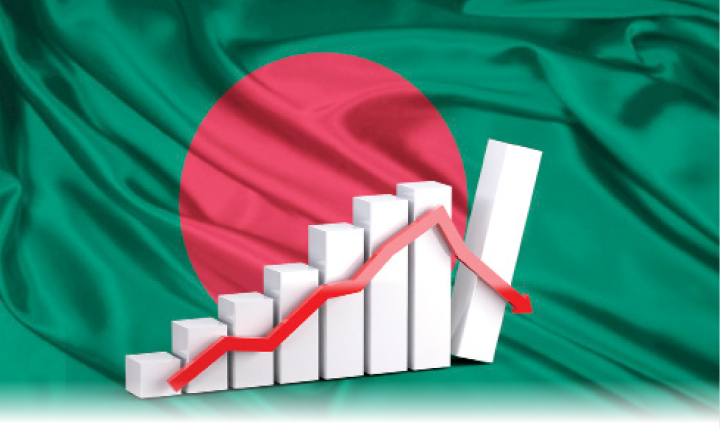
Despite its phenomenal economic growth, Bangladesh recently requested the IMF for a loan package.
BySyed Zain Abbas Rizvi | December 2022
The death toll from a capsized boat in Panchagarh, the northern district of Bangladesh, was reportedly 61 confirmed fatalities - two days after the tragedy struck on Sep 25. Amidst wailing relatives and vigilant police officers, rescue divers searched haplessly for dead bodies in high hopes of finding survivors. But prospects were bleak for the ten missing out of more than 80 on board. Alas, this heart-wrenching accident, shocking for many of us, is not an anomaly for Bangladesh - a low-lying nation bordered by the Bay of Bengal with extensive inland waterways. However, the underlying problem is not the ill-omened geography inherited by the country. But the issue is correlated with the rapidly growing population of Bangladesh - and resources that just cannot keep up!
The investigative committee appraising the incident concluded that the boat, bearing a chorus of Hindu pilgrims, was carrying three times its capacity. Due to lax safety standards and non-existent regulatory controls, such incidents are commonplace in Bangladesh. According to research, dozens of people die annually in ferry accidents. The fundamental cause: Travelling beyond the capacity threshold of the boats. A similar incident sparked a furore in 2015 when more than 78 people died in a collision between a cargo vessel and an overcrowded ferry in a river west of Dhaka, the capital of Bangladesh. Such accidents, unfortunately, are not limited to sinking boats.
Lack of regulatory discipline has also constituted a high rate of road accidents. In 2016, more than 157 people died in traffic collisions across the country during the Eid holidays, according to the Bangladesh Passengers’ Welfare Association. Bus accidents are particularly acute during festivals as a spate of people travel from urban centres to rural towns to celebrate customary rituals. The passengers swarm buses while drivers pay no heed to flimsy traffic regulations, disregarding safety protocols en route to earn a quick buck. As a result, about 13,000 people die in road crashes in Bangladesh annually, according to the Dhaka-based Centre for Injury Prevention and Research. While many domestic critics traditionally rail at the lack of poor judgment of the passengers and the absence of a strict administrative code, many often discount the factor of overpopulation matching inadequate resources - manifested in paradigms of overcrowded boats and buses.
Bangladesh is the 8th most populous nation in the world, with a population of almost 170 million people. However, its total area is approximately 147,570 square kilometres (km²) - the 94th largest land area in the world. This demographical mismatch makes Bangladesh one of the most densely populated countries in the world. Just picture the classic traffic congestions in Karachi or a horde of commuters typically dangling from local trains in New Delhi. The officially reported population density in Pakistan and India is 287 people/km² and 428 people/km², respectively. In stark comparison, Bangladesh has a population density of 1265 people/km² - the 8th highest in the world. And despite the recent reduction in the fertility rate, about 253 people are added to the Bangladeshi population each hour, according to a report by the National Institute of Population Research and Training (NIPORT) - an autonomous research organization in Bangladesh involved in family planning research and projects. Thus, a surging population alongside trailing means has pushed Bangladesh to the cusp of social and economic fallout.
The economy of Bangladesh has remained in the limelight for the past two decades, growing consistently at an average of around 6% annually. Admittedly, Bangladesh has dazzled the world in terms of its economic growth. It has a per capita income (GDP per capita) of over $2000, outpacing India - the world’s fifth largest economy. However, industrial expansion has masked the inadequacy of resources and opportunities, continually worsening Bangladesh’s social profile. Despite several large infrastructure projects, sprawling roads and energy networks have done little to improve the standard of living in the country. According to the Asian Development Bank (ADB), despite having one of the highest literacy rates among South Asian countries, more than a fifth of the general citizenry of Bangladesh still lives below the poverty line. A study by UN-Habitat - the United Nations Human Settlement Programme for sustainable urban development - revealed that Dhaka is one of the world’s most crowded cities, with more than 44,500 people inhabiting a square kilometre of space. How is Bangladesh ostensibly prospering economically when its population is in dire straits? The answer to such a blatant disparity is not just overpopulation but also shrinking resources due to rampant political corruption.
Despite its phenomenal economic growth, Bangladesh recently requested the International Monetary Fund (IMF) for a $4.5 billion loan package, following Pakistan and Sri Lanka as the third South Asian country approaching the multilateral lender in recent months. But intriguingly, the news went under the radar, unlike the sensational headlines circulating around Sri Lanka and Pakistan. This could be because in the case of Bangladesh, the request was devoid of the political theatrics in the background, or e the Bangladeshi Prime Minister Sheikh Hasina portrayed the impending crisis as “budgetary support,” instead of a desperate bailout. Unfortunately, that narrative is not served well by recent history. Since 2019, Bangladesh has received budget support to the tune of $5.8 billion from a diverse range of multilateral agencies. In reality, Bangladesh, the so-called “symbol of self-reliance,” is facing a fiscal crisis due to endemic corruption intersecting an ever-growing consumption-centric population.
According to the Global Financial Integrity (GFI) - a Washington-based think tank focused on illicit financial flows and money laundering - an estimated $8.27 billion were siphoned from Bangladesh annually between 2009 and 2018 via misappropriation of funds in the trade of goods and services. Bangladeshi deposits in Swiss banks ballooned by over 55% last year while the Bangladesh Bank - the country’s central bank - continued to blanket large scams and bad loans to paint a rosy picture for foreign investors lured by the touted industrial success. Ultimately, while the country is growing fast, it is sadly at the expense of the general populace of Bangladesh.
The mass exodus of Rohingya refugees from Myanmar since 2017 has further debilitated the social fabric of Bangladesh. With an influx of hundreds of thousands of foreign refugees and an inceptive legacy of fraudulent elections, one can’t help but visualize Bangladesh following in the footsteps of Pakistan. However, with a diversifying industrial base and a relatively literate adult population, Bangladesh can avoid the lost decades sustained by Pakistan. The developed world should realize that a festering crisis in Myanmar would imperil the development of Bangladesh. And just throwing money with no social construct or regulatory prudence would only exacerbate inequality in Bangladesh that could subsequently lead to radicalization. The Bangladeshi administration should also discern that strategic redistribution and mobilization of its human resources could quickly turn its growing liability into a sustainable asset. Yet, this would only be possible if the leaders collectively strive for the social rejuvenation of Bangladesh and avoid the greed-infested schemes that led Pakistan and Sri Lanka to their current crossroads.
The writer holds a Bachelor's degree from the Institute of Business Administration (IBA), Karachi. He can be reached at szainabbasrizvi.14122@khi.iba.edu.pk






Leave a Reply