


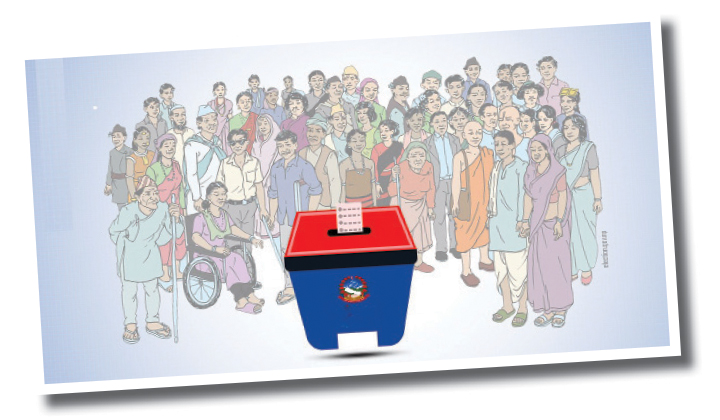
Elections, which facilitate the smooth transition of power among political parties, are oxygen for democracy. They are more so for the nascent federal republic of Nepal. After the successful local government elections in May 2022, Nepal is all set to hold federal and provincial elections this November. The polls will surely strengthen the democratic set-up, but the question remains: is this a step towards democratic consolidation
No doubt, 2022 elections will have a positive impact in terms of consolidation of democracy in the mountainous state, which has a history of tumult and conflict. The elections will strengthen the flickering candle of democracy which has often been put out by undemocratic forces.
In his address to the 77th session of United Nations General Debate Nepal foreign secretary Bharat Raj Paudyal talked in detail about provincial and federal elections in Nepal. He said: “For a democracy like Nepal, these are much more than just periodic elections. They are the testament to our ability of ensuring peaceful transfer of power.” He further added, “They are the means to enhance people’s trust in democracy, promote legitimacy and accountability and strengthen the rule of law”.
Local government polls held in May 2022 were a spectacular success. People eagerly participated in them and were quite satisfied with the results they got, as they managed to elect their true representatives who try to deliver what they promise.
The May elections had some positive outcomes as well. For example, the results revealed that in four of thirteen major cities, independent candidates swept the polls, thereby putting a full stop to conventional politics wherein the major political parties and the male- dominated elite determine the fate of the elections. Encouraged by these results, many independent candidates have decided to take part in the federal and provincial elections.
Nepal’s local government is considered one of the best institutions in the country. It has earned this respect through its effective public service delivery. For instance, during the peak of Covid-19 pandemic when the provincial and federal governments were seen struggling to efficiently respond to the health crisis, this institution’s performance was quite effective.
Election will surely help representative government become mature. Democracy in a country like Nepal is still in its budding phase, because it was only in September 2015 when the country had promulgated its first constitution, thereby laying the foundations for the present political system, which is federalism. It had taken two constituent assemblies about 7 years to reach consensus on the formulation of the constitution.
Democracy has a chequered history in Nepal as the country has seen changes of government for over 50 times. The very first attempts at democracy date back to early 1950s when the people had overthrown the monarchy of the Ranas who had reigned the country for more than a hundred years. In this movement of democracy, people had sought help from the then monarch of Nepal, King Tribhuvan. So, after they succeeded in getting rid of the hundred-year old monarchy, they re-instated the king as the Head of the State and established a constitutional monarchy.


The writer is a freelance columnist based in Larkana. He can be reached at sjatoi831@gmail.com
Leave a Reply