



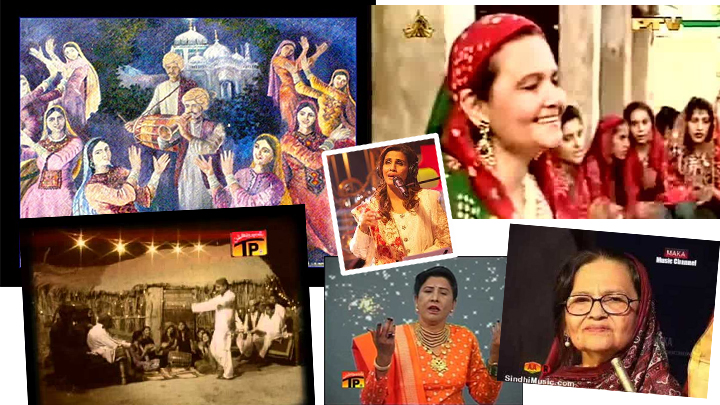
The province of Sindh has its own, unique culture and the people of Sindh commemorate every family event or social occasion with great excitement and fervour. The people of Sindh, commonly referred to as Sindhis, tend to be the most high-spirited, lively and exuberant individuals who make the most of festive occasions and enjoy them in every way, adding colours of life to these memorable moments.
Therefore, attending a full-fledged Sindhi cultural festival, especially a wedding function, is always a unique, fun-filled experience, particularly for non-Sindhis who don't know much about the Sindhi culture or have yet to explore the razzmatazz offered by a traditional Sindhi wedding. Making no bones about it, they'll of course not regret it.
What makes a Sindhi wedding as one of the most fascinating and memorable experiences of one's life, are such unique attributes as its rituals, ingenuity, traditions, outfits and scrumptious cuisine as well as the Sindh's folk wedding songs known as 'Sehra.'
Sehra, in the Sindhi culture, is the most essential part of the wedding functions. In every wedding, Sindhi women get together, beat the drum locally called 'dhol' and sing 'Sindhi Sehra' in chorus while dancing in a particular rhythm that prompts the rest of the women to join the celebration. Mostly, the relatives of the groom come forward to become part of the shindy, followed by the other guests.
The tradition of singing 'sehras' in a Sindhi wedding is a centuries old tradition which became quite popular during the 20th century after the emergence of several folk singers in Sindh. The lyrics of every sehra describe the Sindh's traditions and rituals, show the real side of the Sindhi culture and thus are very entertaining and thoughtful. While listening to a sehra, one cannot stop oneself from shaking a leg on the song.
The reason why we revel in sehras is the fact that the singers, songwriters and musicians together have formed an amazing music genre, which has its historical roots and is still practised by the crème de la crème of contemporary artists such Zarina Bloch, Fozia Soomro, Sanam Marvi, Sarmand Sindhi, Shazia Khushk, Ahmed Mugal, Ameera Begum, Humaira Channa, Samina Kanwal and Shaman Ali Mirali. Sindh's leading folk singer Abida Parveen had also tried her hand at singing sehras during early days of her career. The most popular and classic sehras include 'Hath Gul Mehndi', 'Mor Tho Tily', 'Phota Thali Mein, and lots more, making one feel delighted whether one understands the language or not.
'Hathy Layo Mehndi' and ' Hathan Ty Hiye Mehndi, two of the famous sehras of Fozia Soomro and Ahmed Mughal, talk about the ritual of mehndi (henna) in which the family members apply mehndi on the hands of the bride and groom.
A couple of sehras sung by Fozia Soomro, such as 'Lakh Mubarak Lada' and 'Goth Ji Maa Tukhy Lakh Mubarkon,' highlight the way the people tend to congratulate and felicitate the family members on the marriage of their loved ones. There is another ritual of (Laaon) in which the women belonging to the families of the bride and groom, give blessings to the newly-wed couple by putting their heads together.
Describing such a beautiful moment, the great Fozia Soomro had also sung 'Laaon Diyo, Laaon Diyo.' Samina Kanwal admires the beauty of the groom in her most famous sehra 'Ladal Munjo Chodaien Jo Chand' and in the same way, Shaman Mirali draws a comparison between the groom and moon in his most celebrated songs such as 'Chand Jo Tukro Lagy Tho Aaj Ta Tun.' No doubt, there are plenty of sehras which make you feel delighted whether there is a wedding or not.
Today, when the new generation is mostly prone to listening to modern music, the people in the province of Sindh still love their Sindhi folk songs since the Sindhi folk music is classic, special and unique, beautifully connecting the people with their roots. 

Based in District Thatta in Sindh, Urooj Sultan is an Early Childhood Development trainer. Keenly interested in writing and exploring history, Urooj Sultan regularly writes for such leading publications as The Pakistan Daily, Express Tribune and Daily Parliament Times. She can be reached at uroojsultanali@gmail.com
Leave a Reply