



A Democratic ‘Change’?
 Pakistan is a democracy that is completing 75 years of its existence this year. Like other democracies, it functions on the principle of ‘one man, one vote’ and its government is elected for 5 years. This is apart from the periods that have been subject to military rule. However, it is a pity that no prime minister in the 75 years of the country’s existence has been able to complete his government’s rule.
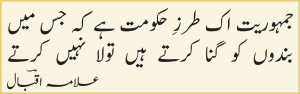
The same has happened in the case of Imran Khan who was trudging alone fine, despite all the serious difficulties his government faced, but was thrown out of power by a No Confidence Motion. Incidentally, this was the first time in the country’s history, that a prime minister lost support of the majority of parliamentarians. Since democracy is pursued in Pakistan on the ‘one man, one vote’ principle, the total votes amassed by each contestant is determined by the number of people who vote for him or her in a particular constituency. Since the majority of Pakistan’s population is illiterate, they simply vote for the person they are told to vote for and never consider the good or bad the person has done for the constituency. This does not matter to the people as they are mostly uneducated, poor and weak and simply perform the mechanical function of casting their vote – because that is the system.
It is a good omen that Pakistan’s apex court intervened in time to set aside the Deputy Speaker’s ruling to dismiss the no-trust motion and the subsequent dissolution of the National Assembly. However, the prevailing uncertainty in the political climate is not over yet. The environment is still ripe with allegations of political horse-trading and foreign intervention and the leading political parties are accusing each other of conspiring against the country and state institutions by becoming agents of foreign powers. In place of indulging in a blame game or exhibiting undemocratic behaviour, all political forces need to show political maturity and farsightedness towards achieving long-term stability and democratic consensus. Whoever rules the roost, sanity must prevail at this crucial juncture.
At present, it seems the country is in a shambles and does not seem to have a concrete direction. Governance is in serious jeopardy and the state of affairs seems to be caught in a profound state of confusion. This is affecting Pakistan’s economy and international fidelity with high-impact consequences. No time should be lost in steering the country towards a coherent path because this is very important for its future well-being. Some basically significant measures must be taken and the reins of expediency must be kept in check.

Syed Jawaid Iqbal
President & Editor in Chief