



After the onset of the Coronavirus Disease (Covid-19) pandemic, Sri Lanka faced numerous challenges such as health and socio-economic crises. The economic growth and livelihoods were affected due to less trading activities while the lockdown restrictions severely affected the tourism sector.
The year 2022 will also pose challenges for the domestic economy as the island country is still recovering . For the Sri Lankan government, the foremost challenge is debt repayment, as it has to manage a foreign debt service of over $4 billion. Recently, the President of Sri Lanka has asked China to restructure its debt repayments as part of China’s efforts to assist the country to address its financial crisis. In addition to that, Sri Lanka and Iran have made a barter trade deal through which Sri Lanka will repay its oil imports bill in the form of Ceylon tea.
Depleting foreign exchange reserves is also a key concern for Sri Lanka as the country’s reserves dropped critically to $2.27 billion at the end of October 2021. It is projected that the foreign reserves may exhaust further and the country needs more borrowing to make necessary payments. The Sri Lankan Central Bank took measures to control dollars to finance essential imports and the country has also announced the closure of three foreign diplomatic missions to save foreign currency reserves.
Remittances inflows decreased considerably while the tourism sector also got affected after the pandemic, which has further deteriorated the foreign exchange earnings.
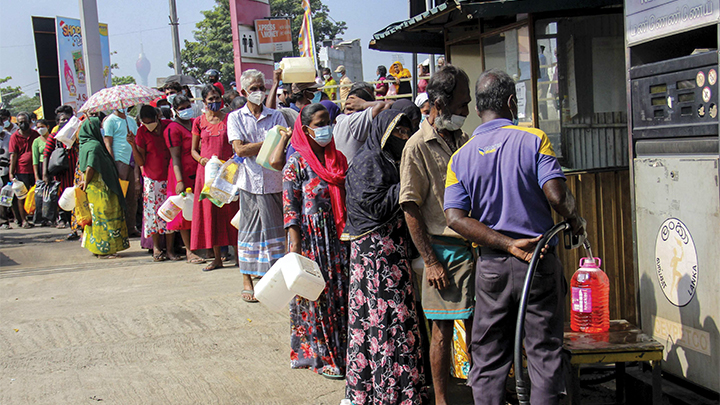
The Sri Lankan Rupee has lost its value against the U.S. Dollar since 2019 by more than 20%, which has compelled the Central Bank to increase interest rate to support the domestic currency. A national financial emergency was announced by the Sri Lankan government in August 2021 to avoid further weakening in the value of domestic currency. The decline in currency value caused a surge in food prices and the overall inflation also increased significantly. Skyrocketing inflation will be a major concern for the government in 2022 as basic items are becoming unaffordable for common people. Last year, Sri Lanka also faced a food emergency when shortage of basic items was observed. To tackle the crisis, the government imposed a ban on imports to save the foreign exchange reserves.
 The Sri Lankan government is likely to bring structural reforms to support and strengthen the growth process and improve the fiscal position. The government is keen to reduce the budget deficit to around 8.8% of GDP in 2022. The government is also committed to increase reserves and manage debt in a sustainable way. The World Bank has projected that the domestic economy may grow by 2.1% in 2022.


The writer is a senior research associate at the Sustainable Development Policy Institute (SDPI) in Islamabad. He can be reached at asifjaved@sdpi.org
Leave a Reply