


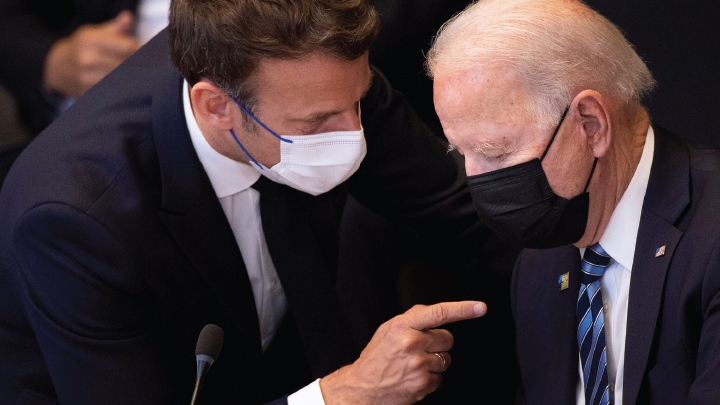
French President Emmanuel Macron and U.S. President Joe Biden talk at the NATO summit in Brussels.
The recently announced defence deal by President Joe Biden, AUKUS (trilateral security pact between Australia, the United Kingdom and the United States,) has strained the cordial alliance among Western countries, particularly France. The group is essentially an Anglo-Saxon pact. Countering the growing China threat in the Pacific and sharing advanced technology among the big three countries has been listed as the key reason for the trilateral effort.
France and Australia had a submarine deal in process for years, as Australia recently entered a partnership with the United States and the United Kingdom for nuclear submarines. France has declared it as treachery and a stab in the back. On the other hand, the Australian Prime Minister has said that Canberra already had its reservations over French submarines, and they also had raised issues beforehand. However, America insisted that informing Paris of the partnership had purely been Australia’s responsibility. The new partnership involves the supply of nuclear submarine fleet by the United States to Australia and simultaneously ending Australia’s 40 to 60 billion dollars contract to buy French submarines. France has also claimed that they offered Australia to supply nuclear-powered submarines instead of diesel submarines but didn’t get any response.
In the spur of the moment, France called its ambassadors from Canberra and Washington, sparing the United Kingdom as France doesn’t consider it a key player in the Indo-Pacific region. Matters have cooled down between France and the United States since then, but not with Australia.
It’s not only the monetary loss France is enraged about, but being kept in the dark regarding the strategic partnership among France’s allies is another major reason to be furious about. Being a close European ally, France felt neglected as not even a hint was given to Paris when the deal was negotiated between the United States, Australia, and the United Kingdom. France has historically remained America’s earliest ally from the American Revolution period. China has termed the trilateral pact as “cold war zero-sum mentality” and China’s largest official media “Global times” mentioned that ‘Australia has now turned itself into a rival of China’. It has to face an increasingly assertive and rising China which is already posing geopolitical uncertainty in the region.
 In the past, Australia had declared China as its biggest trading partner and also acknowledged that it was because of China’s help that the Australian continent was able to recover from a global financial crisis in 2008. Nevertheless, over the past few years, Australia has become wary of China’s growing maritime military expansion, aggressive foreign policy and, political interference. The Australian government has banned China’s investment in various sectors and also banned Huawei in 2017. Australia isn’t the only country concerned with China’s intentions and maritime claims in the South China Sea. An earlier established Quad (Quadrilateral Security Dialogue) comprising the U.S, Japan, Australia, and India, aims to check China’s maritime claims in the South China Sea.
The AUKUS partnership has received criticism on an international level, especially from Southeast Asian countries; Malaysia and Indonesia have expressed serious concerns regarding the new partnership. The Malaysian Prime Minister has said that this partnership could potentially lead to a nuclear arms race in the Indo-Pacific region. Moreover, it could also cause powers like China to act more aggressively in the South China Sea. ASEAN countries are concerned about China’s expansion of military bases on disputed islands, as they are committed to a nuclear weapon-free region. They fear that the new trilateral partnership and Australia’s acquisition of nuclear submarines is going to further aggravate the situation in the Southeast Asian region. This new troika has created an uncertain future for the relationship between China and the West, and equally uncertain implications for the whole world, particularly Asia.
The trilateral partnership isn’t exclusively about countering China’s technological and military rise, but it seeks to make technological information sharing among the three countries easier. However, the new geopolitical environment foretells a ‘tough period’ in the old cordial ties between the United States and France. It can also change the relationship between Australia and China; the two nations have remained strong trade partners in the past. But Australia’s inquiry into the coronavirus origin in Wuhan, China, has deteriorated political relations among them. The trilateral pact shows that Australia is going to play an active role in Asia.
A major split of a key European ally, France, poses a great challenge to three AUKUS countries. Sincere efforts must be made by the trio to mitigate the damage done. Another challenge that the United States needs to tackle is concerning its foreign policy, as the U.S has been criticized for placing more emphasis on the military dimension rather than the negotiation and diplomacy aspect. The nuclear submarine initiative is also a huge move on the defence front; nonetheless, China holds great economic influence in the region. Now Australia’s acquisition of stealthy nuclear submarines could potentially lead to a complex naval competition in the Indo-Pacific region. South Korea, India, and North Korea also have plans to develop nuclear submarines; hence China isn’t the only potential opposition regarding the AUKUS partnership. Many other countries are also keen on expanding their submarine strength. 
Leave a Reply