


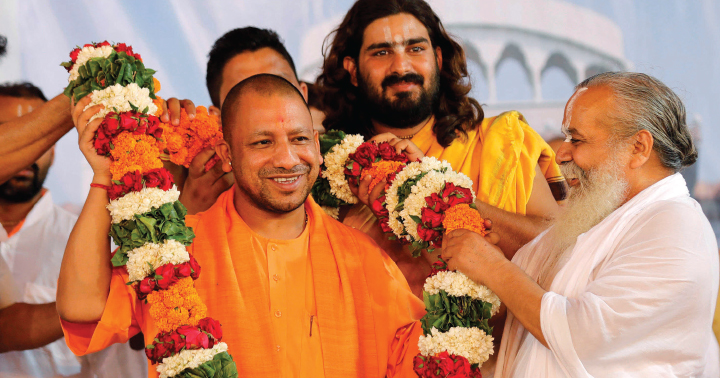
If Narendra Modi has any competition for national headlines, it comes from his party’s chief minister in Uttar Pradesh, Yogi Adityanath. First, it was Prime Minister Narendra Modi who said the chief minister’s handling of the Covid-19 crisis was “unparalleled”. Days later, party president JP Nadda commended Adityanath for turning Uttar Pradesh into one of India’s “leading states”. Of late, it was the turn of Amit Shah: the Union home minister declared Uttar Pradesh under Adityanath was the “top” state in the country on the law and order front.
Against this backdrop, the unequivocal endorsement of Adityanath in the last couple of weeks by all those who matter in the BJP is somewhat intriguing. Central leaders, for their part, say the party feels no need to change the status quo. “The party is doing extremely well under the leadership of Yogi Ji,” said Y Satya Kumar, the BJP’s co-in charge for Uttar Pradesh, referring to Adityanath as he is popularly known. “He has a proven track record.” But few political observers are willing to buy the claim that it is Yogi’s governance record that has made the BJP lean on him again.
The decision to hoist Adityanath, they say, is primarily the BJP falling back upon the muscular brand of Hindutva politics to save the day as the country’s economy lies in shambles. “The economy is bad, there is no employment, farmers are upset, and Covid has destroyed the rural economy,” said Satendra Kumar, who teaches at Allahabad University’s GB Pant Social Science Institute, listing out the grievances frequently aired in rural Uttar Pradesh. “So what do you do? You say you are building temples, protecting Hindus from Muslims,” he said, attempting to explain why the BJP was banking on Adityanath. “The more Hindutva you project, the better for you.” In an early sign of this strategy, Kumar pointed out, the Uttar Pradesh government in July announced plans to put in place population control measures, drawing on an enduring – and mythical – Hindutva trope of a demographic threat posed by higher Muslim fertility rates.
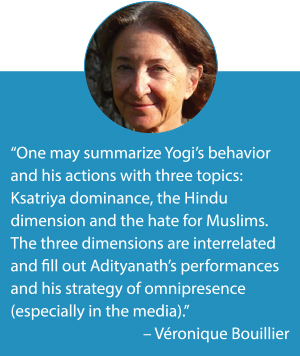 “Things like that tantalize and stimulate Hindu voters because it is seen as an anti-Muslim move,” he said. “These elections are going to be a lot about that and so projecting a Hindu hardliner helps sends a clear message that helps bring together upper-caste Hindu votes – a formidable number in UP. ”


The writer is a legal practitioner and columnist. He tweets @legal_bias and can be reached at shahrukhmehboob4@gmail.com
Leave a Reply