


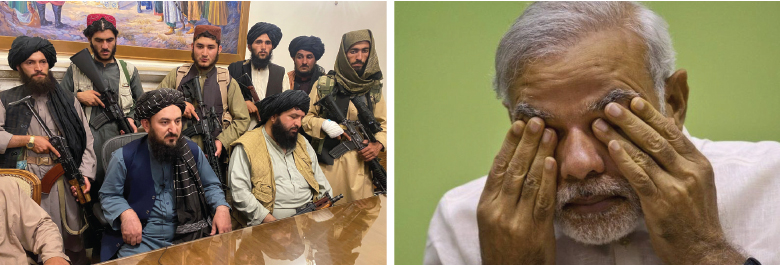
The arrival of the Taliban government in Afghanistan has created a severe threat to Indian trade, as millions of dollars worth of its products were exported there, whereas large quantities of different products were also smuggled into Pakistan through the border or via Dubai. These included silk cloth, betel leaf, tea, hardware, medicines, spices, auto parts, tyres, electronic products, etc. Apart from losing the market by Indian traders, their billions of rupees debit amounts had been stuck there because most of the exports transactions were based on borrowed contract i.e., at sight payment.
In today’s world, the development of any country is not possible just by improving internal affairs. Improving external affairs is also a matter of time. The most important aspect in foreign affairs is relations with neighbouring countries. If we talk about Pakistan, on the one side it is Afghanistan, a war-torn country, and on the other it is China, the world’s largest trading power.
Due to changing geopolitical and regional dynamics, it is important the government should re-set its priorities and focus on emerging regional economies for trade and exports. Presently, through CPEC, China, the Central Asian States and East Asian countries have immense business potential for Pakistan and they should be given more focus for trade relations.
Afghanistan is a landlocked country and has always depended on the cooperation of Iran, India and Pakistan to develop its international trade links with the world through the Pakistan’s economic relations with Afghanistan passed through various stages after the creation of Pakistan. From 1947 to 1965 their economic relations witnessed ups and downs owing to political reasons but once it concluded the Transit Trade Agreement of 1965, their economic ties solidified despite all odds.
By concluding the Transit Trade Agreement of 2010, ties between Pakistan and Afghanistan further consolidated because now they became international trade partners. After 9/11, Pakistan provided financial and technical assistance to Afghanistan for its reconstruction, rehabilitation and development. It is a fact that Afghanistan is a fast up-and-coming market of strategic importance, and it is close to some of the fastest-growing and largest markets in the world. Strategically, it is located between the energy-rich, republics of Central Asia, and the major seaports in South Asia, providing a key transit route, for Central Asian oil and gas to markets in South Asia and elsewhee.
 Many national and international companies are investing in Afghanistan right now and two major international hotels (Hyatt and Serena) have invested in the counrry. Leading international banks have opened their offices such as Afghanistan International Bank (AIB), the National Bank of Pakistan Jalalabad Branch, the Standard Chartered Bank and the Habib Bank Ltd.


The writer is a socio-economic analyst and can be reached at hamiddawoodi@gmail.com
Leave a Reply