



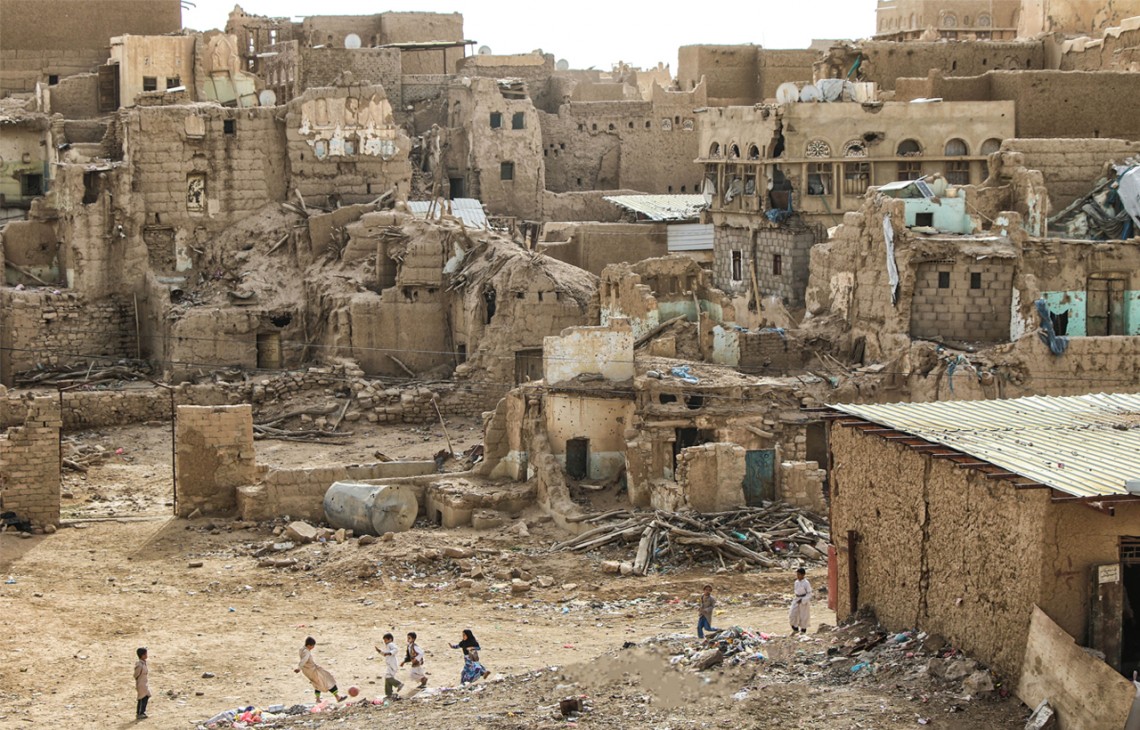
Having witnessed a wave of disruption and turmoil last year, the world is suffering from almost the same flurry of troubles this year too. Some countries, however, have been living that nightmare for years. One such instance is Yemen, the most impoverished nation of the Middle East. For years Yemen has been housing a full-fledged civil war and has been at the brink of collapse several times over the past decade. What started as the rooted rebellion following the so-called Arab Spring, while some countries saw the light at the end of chaos, Yemen has been deprived of every glimmer of hope, more is the pity.
The Arab Spring is arguably the wider-spread surge of political anarchy and civil uprising against the long-run dynastic regimes in the modern history of the Middle East: be it the Syrian War, Iraq’s dismal affairs and even the complex, multi-pronged power game between Iran and Saudi Arabia, the list is endless. However, with the passing time, the effects seem to have diluted to a considerable extent. However, such is not the case for Yemen. Diplomatically known as the ‘Republic of Yemen’, the country is nudged in the southern periphery of the Arabian Peninsula. It shares a border with Saudi Arabia in the northern edge and connects Oman to the Far East, stretching a 2000 km coastline in the South.
Despite the enormous size of the state that happens to be the second largest in size amongst the Arab sovereign states, living conditions of present-day Yemen could not be more abysmal. In the region denominated by oil rich Gulf, for instance, Yemen ranks second worst on the Global Hunger Index and is also the world's lowest on the Human Development Index.
This deteriorating order of the disaster-hit state is attributed to the shocks of the Arab Spring of 2011; the uprisings coupled with ineffective political transition leading to a diplomatic chaos that lasts to this day. The divisions were sowed when the uprisings led to the downfall of president, Ali Abdullah Saleh. The end to the 34-year legacy of Saleh, the first President of Yemen, wreaked a political havoc, since his successor and former deputy, Abdrabbuh Mansoor Hadi failed to deal with the iteration of problems. His struggle only worsened and later turned shockingly monochromatic; guided only to fix issues of the teetering economy, rampant corruption and food scarcity. Amidst his fixation to state fundamentals, however, he bypassed the brewing separatist movement in the south, pledging loyalty to Saleh.
The champions of the movement, also known as the Houthis (formerly rooted from the “Ansar Allah”), capitalised the inexperience and divided attention of incompetent President Hadi and started to launch armed rebellions all over Yemen. By late 2014, the Houthi movement had garnered a broad Shiite majority in support while holding key regions in the north of Yemen including the capital city of Sanaa, annexed in early 2015. The conquest could have expedited more if it were left to internal affairs of Yemen. However, with Iran’s alleged support to the Houthis arguably driving President Hadi to flee the country, Arab nations feared Iran’s dominance boiling right around their borders. This resulted in the Saudi-led coalition of Sunni majority Arab nations to launch a crippling series of air strikes against the Houthis, while restoring Hadi’s government in the process.
The day Saudi Arabia decided to enter the proxy war in Yemen, the power game between Iran and Saudi Arabia shifted into its high gear. Despite countless efforts towards a ceasefire, the never-ending war seemed to escalate in the region. In 2017, a ballistic missile attack towards Saudi Arabia further tightened the US-backed alliance against the Iran-backed Houthis, while the accusations against Iran for its pivotal role in sponsoring terrorism in Yemen kept pilling and repeatedly met denial of Tehran. The killing of Saleh in the missile attack by the Houthis in an attempt to regain the Capital city of Sanaa erased all hope of peace since the motive of the conflict turned more complex than ever. In late 2019, the most destructive attack on the Saudi oil fields resulted in the loss of half of the kingdom’s oil supply, culminating to 5% of the total world output.
The surge of the pandemic and the subsequent ceasefire offers by Saudi Arabia cast the desperation of the Arab nations to reach a resolution, especially after the withdrawal of Qatar. Houthis, by contrast, rejected the peace offering and continue to transition to a gory rebellion. The year 2020 ended with a roar of further destruction when the Saudi-backed cabinet of Yemen was welcomed with several bomb explosions right off their arrival at the Aden airport, leaving 26 dead. The New Year could not possibly fathom the sinister possibilities at a crossroads. Thousands of lives lost, hunger, desperation looming and crumbling humanity within the gullies of Yemen; the message of the present-day Houthis could not be any simpler: ‘No Saudi involvement within Yemen!’

The writer studies at the Institute of Business Administration, Karachi. He can be reached at szainabbasrizvi.14122@khi.iba.edu.pk |
|
Cover Story
|
|
News Buzz
|
Update |
Leave a Reply