
Region
Miscalculation
“Strategy without tactics is the slowest route to victory.
Tactics without strategy is the noise before defeat.”
- Sun Tzu, Chinese military general and strategist. 5th century BC

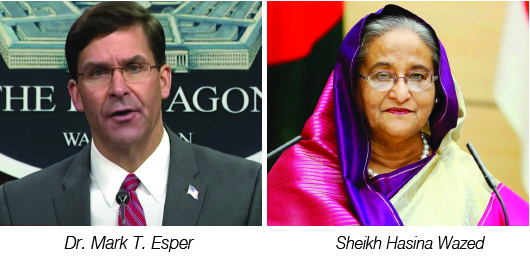
On September 11, 2020 the US Secretary of Defence, Dr. Mark T. Esper spoke with Bangladesh Prime Minister and Minister of Defence, Sheikh Hasina over the phone. It is reported that during the call, Secretary Esper commended Sheikh Hasina on the manner in which she has handled the Covid-19 crisis. They also discussed, according to the US Embassy in Bangladesh, “their shared commitment to a free and open Indo-Pacific that ensures the sovereignty of all nations”. This commitment includes maritime and regional security, modernizing the Bangladesh military and global peacekeeping. It is also said that “both leaders expressed their commitment to continue building closer bilateral defence relations in support of shared values and interests.”
The timing of the decision of the US Department of Defence to call Sheikh Hasina is interesting and crucial. The backdrop of the story lies in the US foreign policy, or absence of, towards Bangladesh in recent years.
The US has spent the last couple of decades entirely basing its foreign policy and strategies on wars in the Middle East, fortifying Israel. In the process, it has implemented policies in South Asia which have been, it is safe to say, failed ones. President Obama’s “pivot to Asia”, or Asia-Pacific Rebalancing did not work. It neither fortified ties with China, nor did it help the Middle East. It was, for the most part, more political rhetoric and little to no substance.
The Quad
Then came President Trump’s Quadrilateral Security Dialogue, more commonly known as the Quad. This is an alliance of four nations, the United States, Australia, Japan and India. The essential philosophy behind the Quad is establishing a tangible counterbalance to China’s remarkable growth and dynamism. The Trump administration, for obvious reasons, did not like the idea of an Asia, dominated entirely by an ambitious China, pushing forward with its Belt and Road Initiative (BRI) and with its constructed South Asia islands. The US felt that trade with China is fine but there was always the looming threat that China’s ever growing presence will lead to domination of the region.
Thus, a secure and safe Asia needed to have a counterbalance to China. Therefore, the Quad coordinated a security strategy, particularly in the maritime sphere.
This led to the US thinking that India, as the world’s fifth largest industrial power, must be befriended and supported heavily. The Trump administration’s logic was that to prop up India as a counterbalancing act to China will lead to the Indian domination over the smaller South Asian nations.
The significance of Bangladesh
This is where Bangladesh comes into play. It is undeniable that India and Bangladesh have cultural ties. Furthermore, India helped Bangladesh (formerly East Pakistan) in its secession with Pakistan in 1971, a development for which, in realistic terms, Bangladesh has paid its due many times over.
In the last 12 years, since the beginning of the Awami League government’s tenure led by Sheikh Hasina, India has become for its smaller neighbour an intrusive, hegemonic and opportunistic force, leading to a vastly unequal trade imbalance, water sharing, border killings of innocent Bangladeshis, false flag terrorist operations, etc.
While India is heavily involved in Bangladesh for reaping its own benefits, it has its share of countless problems.
To add to this, Indian dominance and hegemony is hardly an asset to what Bangladesh truly needs. To the vast majority of Bangladeshis, the relationship with India is predominantly a one-way street, with India taking much more than it gives, despite reserving the rights to intervene and meddle in each and every policy decision in Bangladeshi governance.
China’s role
China’s investment plans for Bangladesh, which were announced in October 2016, were a game changer. China and Bangladesh signed 27 memoranda of understanding (MoUs), valued at $24 billion as investment for Bangladesh. Additionally, Chinese and Bangladeshi companies formed 13 joint ventures (JVs), valued at $13.6 billion.
One of the main points of contention between the governments of Bangladesh and India has been the Teesta River. For years, negotiations have been going on between the two countries, with Bangladesh always hopeful, while India has been noncommittal and dishonest about its intentions.
In essence, Bangladesh has been suffering for years because the water levels of the Teesta in the country have drastically decreased due to India’s failure to implement its side of a water-sharing discussion. Successive governments in India have failed to honour their part as well.
China has agreed to invest nearly $1 billion to build, among other things, a reservoir in Bangladesh, which will allow the country to store water for use in the dry season.
This is an example of the manner in which India has, over the years, consistently and intentionally, undermined the interest, sovereignty and national integrity of Bangladesh. China thus shines in a very positive light for Bangladeshis because it does not interfere in political matters of a country while helping construct infrastructure.
Problems with India
While India is heavily involved in Bangladesh for reaping its own benefits, it has its share of countless problems. These problems have come to the forefront rapidly, within the last 6 years under the governance of the Bharatiya Janata Party (BJP) and Prime Minister Narendra Modi.
The right-wing, extremist HIndu and Islamophobic aspects of the BJP, endorses extreme violence, including lynching of Muslims and other minorities such as Christians and Dalits. In 6 years, Modi has managed to demolish the economy of India and unemployment is at its peak. India has continually tried to lure Bangladesh away from China, threatening the “Chinese debt trap”, but has itself signed a $750 loan agreement from a bank in which China is the largest shareholder. Furthermore, it is sorely being defeated by China in the border dispute in Ladakh.
Furthermore, India’s intolerant extremist Hindu massacre of Muslims and the BJP’s insults calling the Bangladeshis ”termites,” do not, needless to say, sit well with Bangladeshis.
The US
To come back to the phone call between Secretary Esper and Sheikh Hasina, it seems evident that the US is now realizing, hopefully, that it has placed its bet on the wrong horse and adopted the wrong strategies in South Asia. India is hardly the counterbalance to China. All the small nations in the region, be it Nepal, Bhutan, Sri Lanka or Bangladesh, have significant ties with China.
Therefore, the US may be waking up to taking matters in its own hands, seeing India’s failures and reassuring Bangladesh that both countries should be working towards the security of the region and mutual cooperation. This is simply political jargon for “don’t stray away and get too close to China.”
Sun Tzu’s quote, as always, rings true even after 5,000 years. The US has utilized neither strategy nor tactics in South Asia, placing all its eggs in one basket, that is India, in order to manage smaller nations in the region. It is mistakenly and rather foolishly thinking that this could possibly be a counterbalancing maneuver to restrain China.![]()
The writer is a teacher, political columnist and member of the US Democratic Party. She can be reached at sabriacballand |
|
Cover Story
|
|
Special Editorial Feature
|
|
News Buzz
|
Update |


Leave a Reply