
Region
No Country for Muslims
Modi’s time in power will undoubtedly be considered as one of the
darkest periods in the annals of Indian history.

India’s shrinking minority space has been the subject of controversy since the Narendra Modi-led Bharatiya Janata Party assumed public office in 2014. The re-election of the right-wing party has emboldened Hindutva activists to flout the secular principles of the Indian Constitution and discriminate against Muslims with impunity.
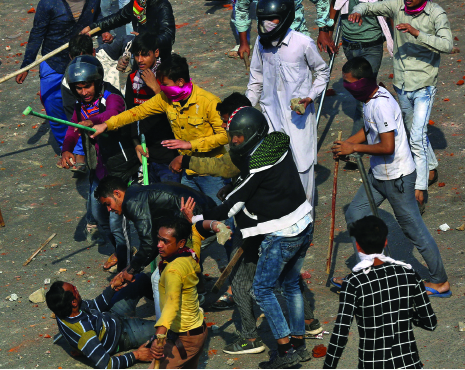
Policy initiatives have been weighted against the country’s 200 million-strong Muslim community and BJP leaders haven’t shied away from making anti-Muslim speeches. Fuelled by these fascist sensibilities, party supporters and self-styled vigilantes have carried out violent attacks against the Muslims. More often than not, these unscrupulous elements have been granted political protection and their conduct is frequently endorsed by the RSS-backed ruling party.
Analysts believe that the eruption of violence against Muslims during Modi’s tenure is linked to India’s turbulent relations with Pakistan and the misguided belief that the allegiance of Indian Muslims lies across the border. However, the surge in anti-Muslim sentiment can also be attributed to efforts to expunge the public memory of India’s Mughal past and colonial policies of ‘divide and rule’. Conventional wisdom would have us believe that communal conflicts between both communities were heightened after the demolition of the Babri Masjid. As a result, sectarian violence against Muslims morphed into systematic, state-sponsored massacres, such as those witnessed in Gujarat and Muzaffarnagar.
While it would be wrong to assume that all Muslims have been shortchanged by politically-motivated attacks, the search for a silver lining cannot disguise the fact that India’s largest minority is under threat. The progress of Indian Muslims has been hampered by four critical factors that ought to be addressed by the relevant authorities.
First, a large segment of the Muslim population in India is believed to be economically disadvantaged. Statistics indicate that Muslims are more likely than the rest of the country’s population to live below the poverty line. Interestingly,the literacy rate among Muslim has grown exponentially between 2001 and 2011. This could pave the way for the community to improve its socioeconomic status and stave off attempts to radicalize the Muslim youth. According to a report published on the website of the Observer Research Foundation, literacy has been one of the key reasons to explain the failure of the Islamic State and the Al-Qaeda in the Indian subcontinent to recruit Muslims in India. Be that as it may, the hammer strokes of Hindutva politics and the popularity of this right-wing ideology has made it increasingly difficult for the community to achieve social progress.
Second, self-fashioned cow protectors have repeatedly lynched Muslims for slaughtering the sacred animal. Driven by the passion to pursue vigilante justice against those who disrespect the sacred cow, many of these so-called protectors have even established informal checkpoints across the country to clamp down on cattle smuggling and slaughtering. These tactics often receive the blanket support of law-enforcement agencies and politicians. This form of misguided vigilantism and mob justice is often quite arbitrary. In some instances, Muslims have also been arrested on the suspicion of eating beef, even though there was a dearth of evidence to substantiate these claims. At this core, this issue highlights how efforts to keep the state “equidistant” from all religions in India are often difficult to implement.
The annexation of Indian Occupied Kashmir on August 5, 2019 has also been billed as a tactic to erase the country’s Muslim past.
Third, the perceived prevalence of ‘love jihad’ – a euphemism for interfaith marriages – has led many to suspect that Muslim men are involved in furtive attempts to forcibly convert women from other religions to Islam. Under the circumstances, the relevant authorities should assess the merits of individual cases rather than make sweeping generalizations. Absence of consent is a useful gauge to determine whether a case pertaining to ‘love jihad’ is genuine or not. Furthermore, the controversy surrounding these interfaith marriages is usually motivated by political factors and enables right-wing, anti-Muslim parties to perform well in elections. The debate surrounding these interfaith marriages appears to be aggravated by moral panic and is seldom rooted in reality.
Fourth, there have been flagrant attempts to distort history and downplay the contributions of Muslims in shaping India’s centuries-old civilization. The process of erasure hasn’t been restricted to rewriting textbooks. The BJP government has unabashedly ‘saffronized’ the public sphere by renaming Indian cities to systematically undermine their Muslim heritage. The final judgment in the Ayodhya dispute has deepened this malaise because it justifies the much-condemned demolition of the Babri Masjid in favour of a Ram temple.
The annexation of Indian Occupied Kashmir on August 5, 2019 has also been billed as a tactic to erase the country’s Muslim past. By revoking Article 370 of the Indian Constitution, which granted autonomy to the Muslim-majority state of Jammu and Kashmir, the BJP government aims to change the Muslim demographics in the troubled region.
While these policies have added to the insecurity of Indian Muslims in their own country, the Indian parliament’s decision to pass the Citizenship (Amendment) Act 2019 has added fuel to fire. The act has amended existing laws to provide an opportunity for illegal migrants of Hindu, Sikh, Parsi, Buddhist, Jain and Christian faiths who have fled persecution from Pakistan, Bangladesh and Afghanistan, to secure Indian citizenship. The legislation has been trenchantly criticized for excluding Muslims and subjecting them to religious discrimination, and has sparked widespread protests. The citizenship law seems all the more brazen because the Indian authorities have previously disregarded the plight of Rohingya Muslims and deported them to Myanmar. Since the controversial citizenship act was passed, Muslims have raised doubts that it will impact the extent to which Muslims are included within a proposed nationwide National Register of Citizens.
Bolstered by the RSS and its aggressive Hindutva ideology, the BJP government has adopted an intolerant attitude towards India’s Muslim populace. The world’s largest democracy is steadily losing sight of its secular moorings and has brazenly endorsed communal strife. Modi’s stints in power will undoubtedly be considered one of the darkest periods in the annals of Indian history, especially for a marginalized Muslim minority. ![]()
The writer is a journalist and author. He analyses international issues and can be reached at tahakehar2@gmail.com |
|
Cover Story
|
|
Special Editorial Feature
|
|
News Buzz
|
Update |


Leave a Reply