



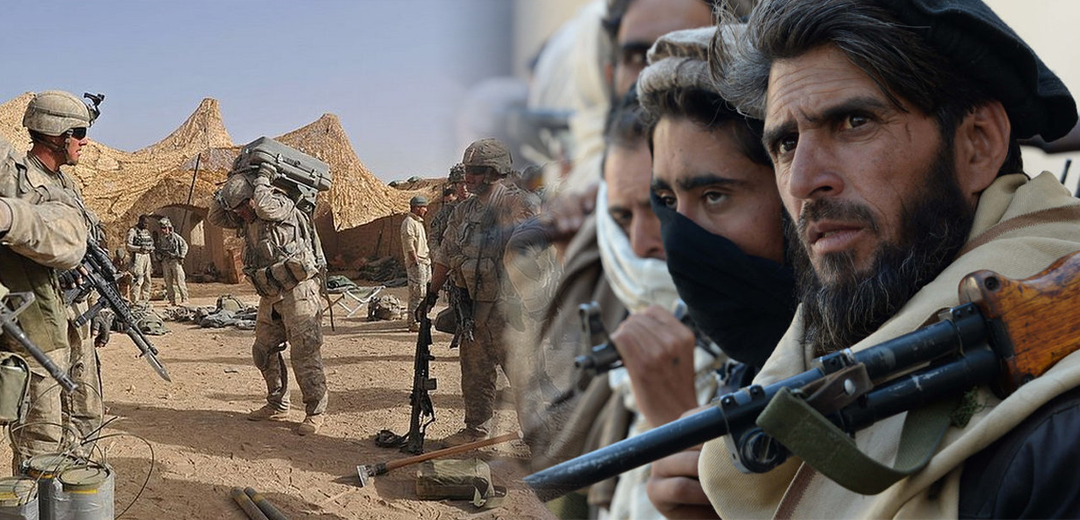
The much-awaited exit of the US forces from Afghanistan has stretched a bit further than the set deadline. While President Joe Biden has always purported a safe withdrawal of the US troops, lack of adherence and reverence to the pact, by the Afghan Taliban, has been one of the core facets that has fueled this unconditional deadline extension. Now the US forces, along with the NATO troops, are expected to initiate redeployment back to the United States starting 1st May and completely pulling out by 11th September: the 20th anniversary of the ghastly Twin Tower attacks. No matter how graceful the plan sounds, however, it lacks bilateral coherence.
For starters, the Afghan Taliban have continuously shown hostility to the Afghan security forces ever since the agreement was forged with former US President Donald Trump in February 2020. The Doha Agreement had bound the Taliban to refrain from attacking the US and NATO forces in exchange for a systematic withdrawal of the Troops by May 2021. However, the agreement never expanded its jurisdiction over the protection of the Afghan security forces and the citizenry of Afghanistan. The resultant was the misery of the government forces and Afghan civilians; a brunt faced in the aftermath of a poorly leveraged deal. Clearly, the Taliban enjoy the edge over the US coalition and negotiations were never equitable to begin with: US being in a dilemma of exiting while Taliban gaining influence and subsequently, an upper hand.
The concerning absence of the Taliban’s council from the recent Istanbul summit, arranged to discuss and negotiate the withdrawal systems and measures, created a vortex of doubt: would the Taliban agree to the delayed withdrawal plan? Their position could be gauged by the untimely refusal to be part of any negotiations prior to the US withdrawal. Before the revised withdrawal plan was even announced, the Taliban Spokesperson Mohammad Naeem made the group’s position very clear, stating: “Until all foreign forces completely withdraw from our homeland, the Islamic Emirate will not participate in any conference that shall make decisions about Afghanistan”.
The Ghani regime welcomed the series of events in his tweets, stating: “Afghanistan’s proud security and defense forces are fully capable of defending its people and country, which they have been doing all along, and for which the Afghan nation will forever remain grateful”. However, the Taliban representation spared no time to cast their dejection. The Taliban representation projected its dismay: “As the withdrawal of [foreign] forces is being delayed by several months and will be completed before September…This decision is a clear violation of the Doha Agreement and non-compliance with its commitments. The Islamic Emirate [Taliban] urges America and all occupying countries to stop making excuses for prolonging the war and to withdraw all their forces from Afghanistan immediately”. The clear position laced with threats shows that although the withdrawal is unconditionally on cards, the foreign forces would not be safe for a very long time. The Taliban have eyed the extension as an excuse rather than a gateway to further negotiations: a prospect that President Biden vied even before ascending to the office.
Now, with 9592 troops from 36 countries still serving in Afghanistan, the grim reality looms over the military as it seeks a peaceful exit. With 573 killed and 1210 injured, a 29% increase compared with the same period last year, in just the first quarter of 2021, an establishment of a stable government along with a processing democracy seems fanatically optimistic at best. A fragile government, retreating foreign forces, and a surging bout of the Islamist groups being uprooted in the Middle East, the rule of Taliban, taking over swatches of Afghanistan like in the 90s, seems like a real possibility again. Analytically gauging the ground reality, the prospect of a revived Shariah rule post the US withdrawal could be extracted from the words of finality by the Afghan government: “The Taliban have committed this ‘miscalculation’ in the past…It would be wrong if the group thinks that they will reach their demands through force with the withdrawal of international forces from Afghanistan”. 

The writer studies at the Institute of Business Administration, Karachi. He can be reached at szainabbasrizvi.14122 |
|
Cover Story
|
|
News Buzz
|
Update |
Leave a Reply