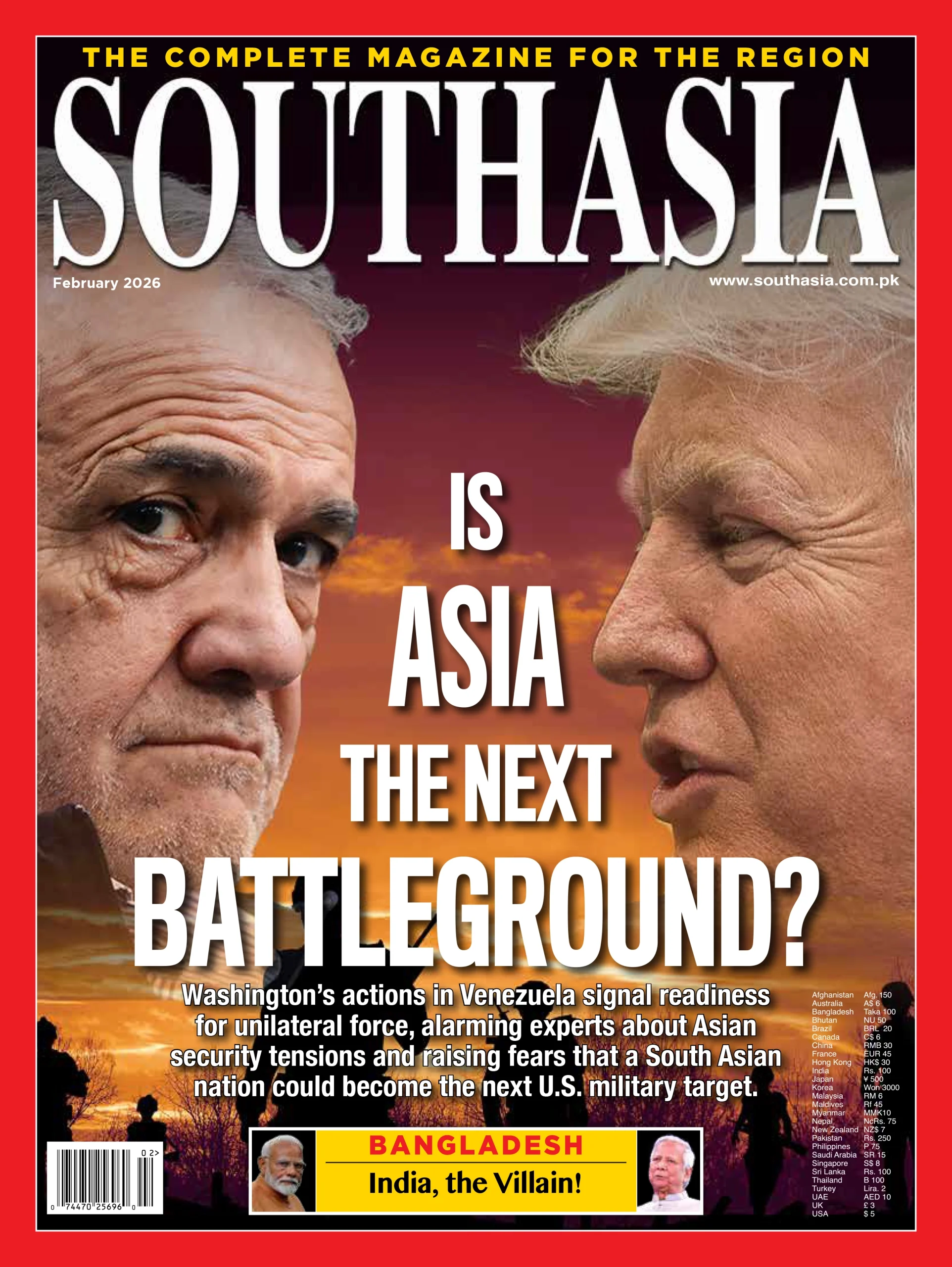




John Quincy Adams, who helped draft the “Monroe” Doctrine and James Monroe himself who expounded the Doctrine in 1823 which was the guiding principle of American foreign policy during late nineteenth and early twentieth century aimed towards expansion of American state, must be turning in their graves seeing Monroe Doctrine converted into Don-roe Doctrine in 21st century aiming to dominate the region in the style of “Bully on the Block” through machinations of U.S. President Donald Trump rather than through dexterous use of diplomatic tools adequately supported by use of force.
Trump’s dictatorial ways, exhibited in the kidnapping of President Nicolás Maduro of Venezuela, from his presidential place and presenting him before a court in New York to face charges of election fraud in his own country, and dealing in drugs, have changed the ways of diplomacy that prevailed hereto. So far, after the end of the Cold War, the principle in international politics came to be non-interference in other countries’ internal affairs. The days of gunboat diplomacy that prevailed in the nineteenth and early twentieth centuries, when America, because of its vast resources and military power, could interfere in the affairs of other countries in its region at will, have been replaced by economic blackmail through tariff diplomacy backed by enormous military might.
The question is how and why this has happened. The answer lies in the enormous transformation of China, which has, in the last two decades, emerged as a credible military as well as an economic power and is not interested in increasing its influence as did America through browbeating smaller countries by projecting its military power, but by supporting and assisting smaller South Asian nations militarily as well as economically. It has thus given up its earlier jingoistic attitudes with countries with which it did not see eye to eye, such as India. China has, therefore, increased its influence not only in South Asian Countries but even in Africa, and is poised to extend it to other countries with relatively little influence in the world, such as countries of South America and the Middle East.
It is the perception of this threat from China and also China’s steps to replace the US Dollar with the Yuan as the currency of trade with smaller countries that has caused the USA to suddenly show and assert its might, even to its long-standing allies in Europe. Ordinarily, it would have been difficult for China to do so and compete with the USA, but the phenomenal increase in its ability to use Technology without resorting to Jingoism has made it possible for it to do so. Not only that, but China has also shown its willingness to export its expertise in technology to other smaller countries with a view to increasing its influence.


The writer is a former judge of the Sindh High Court. He has been actively involved in human and women’s rights causes.
Leave a Reply