Independent nations establish federations through political, economic, and strategic associations for a bigger purpose. This association is sustained by shared ideological, cultural, linguistic, and ethnic affinities or fear of a powerful neighbor. Contrasted with this, a union of states is created by a central authority in a unitary state by dividing the territory into manageable administrative units. In the former case, the federation owes its existence to the nations that established it by voluntary association or the modus vivendi prescribed by the Constitution that governs it. In the latter case, the administrative units owe their lives to the central authority.
The size of a province does not pose any challenge to governance
It was clearly understood that the western part of Pakistan would be a Federation consisting of the North-Western Muslim majority states, including Kashmir. Bengal was generally conceived to be a separate and independent state comprising West Bengal, East Bengal, and Assam. The Pakistan Resolution of 1940 also insinuated the idea of states. This dream was shattered by the Radcliffe Boundary Commissions to divide Bengal and Punjab.
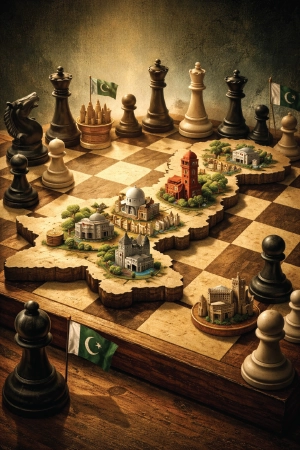
Pakistan’s central authorities did not respect the federal principles and the willing loyalty of the federal units that existed as sovereign states for centuries before the advent of the British India Empire. The suggestion to divide the Federation of Pakistan into over a dozen units, mostly on ethnic and linguistic bases, therefore, is not politically, historically, economically, or constitutionally sustainable. The federal units are very sensitive about their geographical boundaries. We recall that the One-Unit, imposed in 1955, was dissolved and provinces restored in 1970 owing to a sustained public movement against the territorial amalgamation of the federal units.
While overturning the unanimous parliamentary form of government and suspending the 1973 Constitution, dictator Zia-ul-Haq exploited the political uncertainty prevailing in the Urdu-speaking community of Karachi and Hyderabad and helped establish the Mohajir Qaumi Movement (MQM) to weaken the movement for the restoration of democracy in 1984. The MQM turned into a fascist organization playing havoc with the peace and tranquility of the megacities in 1988, 1991, 2002 to 2008. The MQM, toeing the establishment’s line, demanded the division of Sindh, separating Karachi and Hyderabad from it.
Sindhis cannot figure out their land without Karachi and Hyderabad – a land dispossessed of its historical heritage, of its centuries-old links with the Arabian Sea and Sindh Delta, of its coastal area of 350 kilometers and seaports, of its economic, financial, and industrial hub, of its health, educational, literary, and intellectual centres. Sindhis simply cannot accept this, nor would they like to revert to the bloodletting of the past. History is witness to their resilient and successful struggles against the annexation of Sindh to the Bombay Presidency, the federalization of Karachi, and the building of Kalabagh Dam. They would valiantly resist any scheme aimed at the territorial division of their land.
Many know that a tripartite Standby agreement was signed between the representatives of the All-India Muslim League (AIML), Khanate of Kalat, and British India on 3rd June 1947. It was agreed that Balochistan, being out of the Indian possessions of the Empire, would maintain its independence as it stood in 1838. Nevertheless, the Khan was apprehensive about Pakistan’s direct contacts with his semi-autonomous regions of Las Bella and Kharan to secede from the Khanate. These differences intensified and resulted in the siege and takeover of Kalat in April 1948. The province has since witnessed four insurgencies in 1948, 1955, 1973, and 2006. The latest is aglow.
There are suggestions to divide the Baloch land into four provinces on an ethnic basis. This would be stirring the hornet’s nest. How would it be sustainable to divide such a volatile province on ethnic basis - to favour some pro-establishment dynasties in Sahili Balochistan (Jam, Bhutani and Lasi), and East Balochistan (Jamali, Magsi, Rind), and restrain and restrict the perceived anti-establishment Brohis and Pathans respectively in the Wasti Balochistan, and Shumali Balochistan? This balkanization of Balochistan will engender ethnic conflicts of greater intensity, leading to lasting strife, chaos, and anarchy.
Sindhis cannot figure out their land without Karachi and Hyderabad
For the past four years, the KPK has not been able to overcome the adverse political, economic, and administrative repercussions of the merger of the erstwhile Federally Administered Tribal Agencies (FATA) into it. Broadly, the people of KPK, like their fellow Pakistanis from the other small provinces, have resisted sham and deceptive reforms driven by a hidden agenda of tightening the central control on the federating provinces. The people of smaller provinces are well aware of the political and administrative jugglery of the ruling establishment and their collaborators.
These anti-democratic forces have always been ready to advance any proposal found useful for the promotion of their political, economic, and financial interests, and kill those that conflict with their unjustified privileges. They have successfully thwarted vital political and economic reforms, including the promotion of a plural and democratic way of governance and the redistribution of state resources that could have adversely affected their privileges. The UNDP’s National Development Report of 2021 found that the economic privileges given to Pakistan’s elite groups, including the political class, corporate sectors, landlords, and the military, amounted to around $17.5 billion or about six percent of GDP.
The constitutional barrier against the creation of new provinces may not be strong enough to stop the ruling elite from implementing their scheme. Nevertheless, the economic, financial and administrative issues caused by the creation of so many new provinces including distribution of NFC and irrigation waters, assets and liabilities, defraying additional costs on secretariats and ministries and ministers, addressing legal disputes, restructuring administration, reassigning civil servants, delimiting constituencies and redrawing boundaries would be unsustainable for Pakistan with chronically weak federal bonds, broken institutional systems of governance and weak economy.
The proposition of new federal units represents the perverse and insatiable hunger of this privileged class for absolute control over the federation. This would aggravate the fault lines in the Federation, fuelling centrifugal forces. Our problems arise out of dysfunctional political, economic, and administrative systems. We have been shy of promoting democratic, representative, and good governance with the state institutions working within their constitutional boundaries. What we need is to free our electoral exercise from the executive’s strong clutches and strengthen the independence of the Election Commission of Pakistan. The size of a province does not pose any challenge to governance. For instance, with a population of 230 million and 31 million, the Indian states of Uttar Pradesh and Bihar, respectively, have posed no governance challenge to New Delhi.
We should have strong and independent local governments and city councils to deliver services at doorsteps instead of indulging in a new experiment of having over a dozen administrative units overburdening our exchequer and opening a Pandora’s box of new controversies.



 A constitution is a social contract between the people and the state. Matured nations don’t crucify their constitutions at the altar of the elite’s political and administrative impulses. The sanctity of this basic document is no less than a gospel. The amendments to it are rarely undertaken, and are subjected to a long deliberative process involving, in some cases, the entire nation. The leaders don’t dare to toy with their Constitution, given the difficulty involved in rewriting a consensus document that goes well with the aspirations of their people.
Leave a Reply