
Cover Story
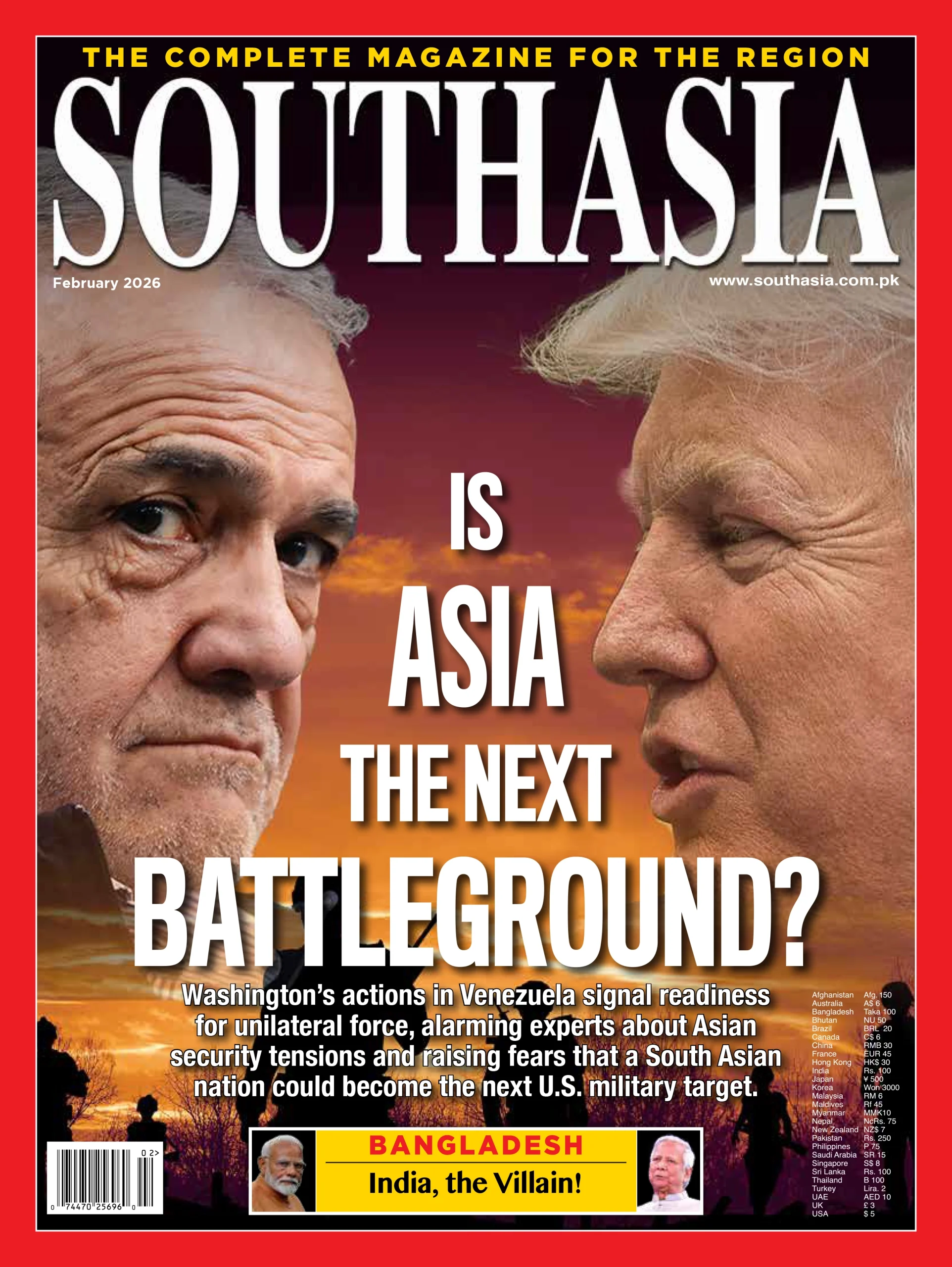
Asia, the Next Flashpoint?
The United States remains influential in Asia, but it is no longer the uncontested center around which everything revolves

On January 3, 2026, United States special operations forces conducted a coordinated operation inside Venezuela that resulted in the detention and removal of President Nicolás Maduro from Caracas. Transported to the United States to face federal narcotics charges, Maduro became the first sitting head of state forcibly removed by Washington without multilateral authorization in the postwar era. While the White House framed the action as a law-enforcement mission, the absence of United Nations Security Council approval or congressional authorization placed it outside established international norms. More than the legality of the operation itself, the episode signaled something deeper: a shift in U.S. behavior that is accelerating global fragmentation, unsettling alliances, and forcing Asia to recalibrate its position in an increasingly multipolar world.
The global response was swift. Russia and China condemned the operation as a violation of international law and a destabilizing precedent. European governments expressed alarm at the erosion of sovereignty norms and the sidelining of collective decision-making mechanisms. In Asia, reactions were cautious but unmistakably concerned. Governments across Southeast Asia reaffirmed their commitment to non-intervention and international law, not because Venezuela itself posed a strategic concern, but because the incident demonstrated how quickly established rules could be bypassed. The lesson absorbed across Asian capitals was clear: if norms could be disregarded in Latin America, they could be disregarded anywhere.
This unease deepened days later when President Donald Trump escalated rhetoric surrounding Greenland. On January 9 and 10, he publicly stated that U.S. control of Greenland was essential to American national security and suggested that diplomatic avenues might not be sufficient to secure it. Greenland is an autonomous territory within the Kingdom of Denmark and a member of the NATO alliance. Although the United States already maintains military facilities there under existing agreements, the implication that Washington might seek control without consent triggered immediate backlash. Greenland’s leadership rejected any notion of annexation, while Denmark’s prime minister warned that a unilateral U.S. move would fundamentally undermine NATO by violating the alliance’s core principle of territorial integrity among its members.
Coming on the heels of the Maduro operation, the Greenland episode carried consequences far beyond the Arctic. NATO has long functioned as the institutional backbone of Western security, grounded in the idea that alliances constrain power rather than enable unilateral ambition. The suggestion that the alliance’s most powerful member might disregard those constraints raised questions about its durability. European leaders openly questioned whether collective defense could survive if alliance commitments became subordinate to transactional calculations. For Asian partners who rely on American security guarantees, the signal was equally unsettling: if NATO’s cohesion could be shaken, then other alliance structures might prove similarly fragile.
Together, Venezuela and Greenland have prompted a broader reassessment of American leadership. For decades, U.S. influence rested not only on military strength, but on its role as a steward of the rules-based international order. Increasing reliance on unilateral force, combined with alliance friction and coercive rhetoric, has led allies and rivals alike to question whether the United States still serves as a stabilizing anchor or is entering a more erratic phase driven by short-term imperatives. This reassessment extends beyond diplomacy into the foundations of global finance and trade. Confidence in the U.S. dollar, long underwritten by perceptions of American institutional stability and leadership, is increasingly under scrutiny.
This shift is most visible in Asia’s evolving economic posture. While many Asian states continue to maintain security arrangements with the United States, they are simultaneously deepening economic ties with China and strengthening regional integration. Trade flows, infrastructure investment, and financial cooperation are reshaping Asia’s economic landscape in ways that reduce dependence on U.S.-dominated systems. China remains the largest trading partner for much of the region, and even close U.S. allies such as Japan and South Korea continue to expand commercial engagement with Beijing despite ongoing strategic rivalry.
China, India, Russia, and Iran have made this clear through coordinated diplomacy, alternative financial arrangements, and resistance to U.S. pressure
Beyond bilateral trade, the expanding role of the BRICS grouping reflects a broader trend. Over the past year, BRICS members—including China, India, and Russia—have accelerated efforts to conduct trade in their own currencies rather than the U.S. dollar. By late 2025, Russian officials reported that approximately ninety percent of Russia’s trade with China and India was settled in local currencies, including the yuan, ruble, and rupee. These arrangements span energy exports, industrial goods, and large-scale commodity transactions that once flowed almost exclusively through dollar-based systems. Throughout 2025, BRICS summits and ministerial meetings expanded bilateral currency swap agreements and advanced alternative payment mechanisms designed to bypass Western financial infrastructure.
For participating states, these measures are framed as pragmatic responses to sanctions exposure and financial volatility. For Washington, however, they represent a more troubling development. Even partial de-dollarization challenges a central pillar of U.S. power. Dollar dominance has enabled the United States to finance persistent deficits, impose sanctions, and exert influence at relatively low cost. As major economies experiment with alternatives, that leverage weakens. The timing is significant. Economic decoupling, alliance uncertainty, and unilateral military action are unfolding simultaneously, reinforcing the perception that American power is increasingly contested.
Unrest in Iran further amplifies this perception. In late December 2025, protests erupted across Iran in response to economic collapse and currency depreciation, rapidly spreading to major cities including Tehran, Isfahan, and Shiraz. By mid-January 2026, human rights organizations estimated that thousands of protesters had been killed following a severe government crackdown. The United States publicly expressed support for demonstrators while intensifying economic pressure through sanctions enforcement.
While Western discourse often frames these protests primarily as a women’s rights movement, the crisis extends beyond gender-based grievances. Iran’s nuclear ambitions remain a core strategic concern for Washington, and the current instability has revived long-standing discussions of regime change. The reemergence of figures associated with the former Pahlavi monarchy in international political circles has fueled speculation that the United States may view the unrest as an opportunity to reshape Iran’s political future. Whether or not such intentions exist, the prevailing perception within Iran and across the region is that Washington is once again positioning itself to exert influence over a sovereign state during a moment of vulnerability.
Viewed collectively, Venezuela, Greenland, and Iran suggest a pattern that many states find deeply unsettling. The United States appears increasingly willing to test boundaries, reinterpret norms, and exert pressure across multiple regions without broad international consent. This has altered how American power is understood. Allies are no longer confident that partnership guarantees restraint, adversaries see opportunity in fragmentation, and neutral states accelerate hedging strategies that prioritize autonomy over alignment.
Although these developments are occurring largely outside Asia, it is Asian states that are responding most actively. Across the region, governments are strengthening regional institutions, expanding intra-Asian trade, and investing in diplomatic frameworks that reduce dependence on any single power. Even as security ties with the United States persist, economic and political agency within Asia continues to grow.
The significance of the current moment lies less in the prospect of direct conflict than in the transformation of the international system itself. Asia’s strength increasingly derives from its diversity, economic integration, and capacity to navigate great-power competition without becoming subsumed by it. The United States remains influential in Asia, but it is no longer the uncontested center around which everything revolves. China, India, Russia, and Iran have made this clear through coordinated diplomacy, alternative financial arrangements, and resistance to U.S. pressure.
What the new year reveals is a world moving towards a more fragmented and multipolar order. American power remains formidable, but its credibility is under strain. When force is applied without consensus and alliances are treated as conditional, trust erodes. Asia is watching closely—not as a passive observer or a future battlefield, but as an active participant shaping what comes next. The question is no longer whether Asia will be the next front, but whether the United States can adapt to a world in which dominance is no longer assumed, and leadership must be earned anew.
Based in Islamabad, the writer holds an undergraduate degree in Literary Studies from Eugene Lang College of Liberal Arts at The New School and an MPhil in South Asian Studies from the University of Cambridge. She can be reached at fathimahsheikh@gmail.com


What a refreshing read! US is not at the top anymore and we can see that with the crash