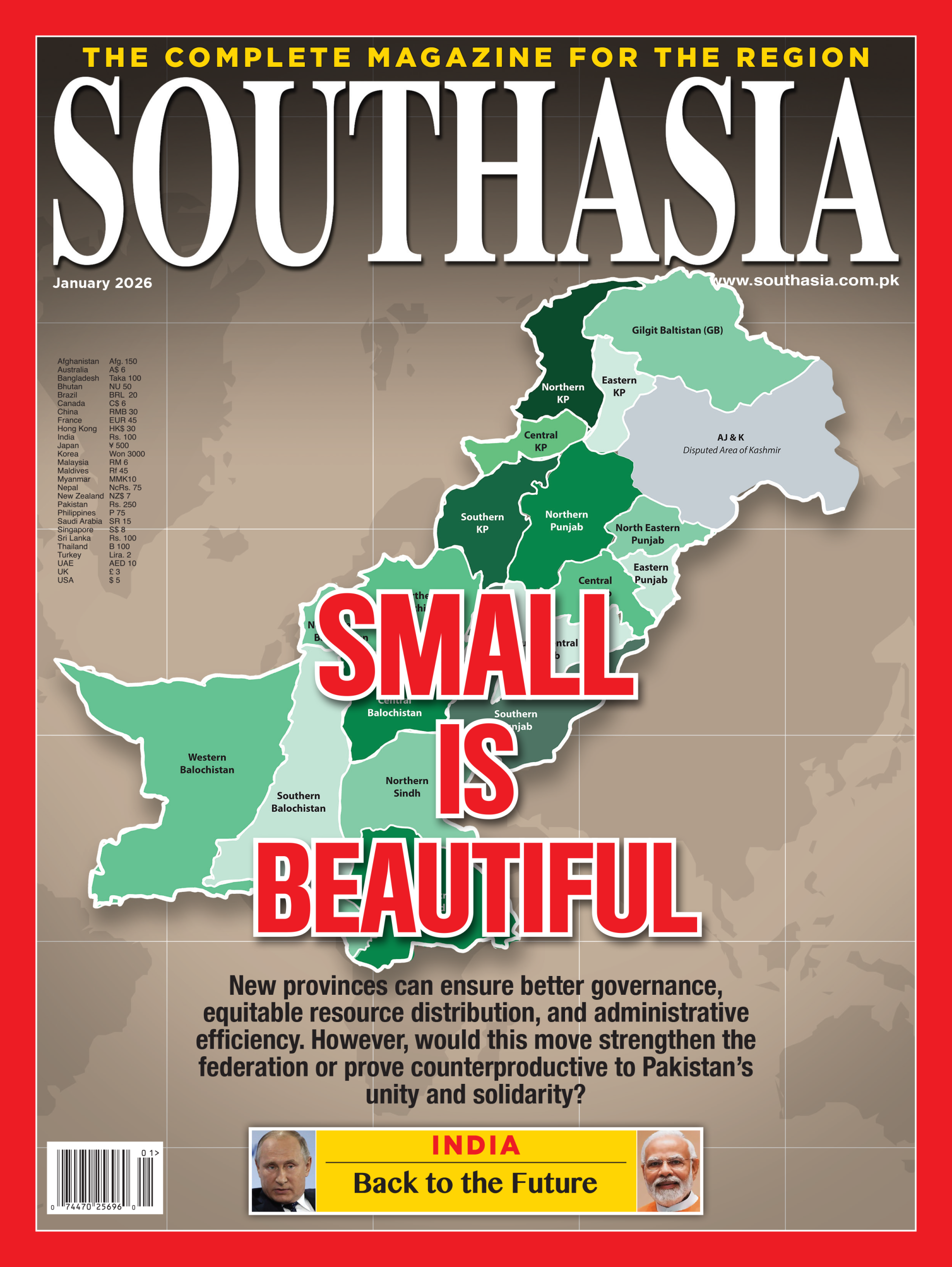




Since its creation as an independent country, the present-day Pakistan, although divided into four provinces, has been, in practice, a unitary state, with the federal government exercising primary control. In 1954, when all the provinces were merged into West Pakistan, it became, in a true sense, a unitary state. The situation remained the same even after the breakup of the one unit in 1970, regardless of whether the government was elected or unelected.
The country has been governed mainly by the bureaucracy from Punjab, Pakistan’s largest province, which accounts for more than half of the country’s population. This is a typical example of what development sociologists call “internal colonialism,” as was the case in Great Britain, where for centuries, Northern Ireland and Scotland were virtually treated as colonies of England. However, while in the latter part of the 20th century, that situation changed in Britain.
In Pakistan, provincial assemblies have limited powers, with little say in the appointment of Chief Ministers, who are appointed or removed at the discretion of the central party leader, the Prime Minister, or the President. Following the 1970 elections, when in the two smaller provinces, namely NWFP and Balochistan, different political parties formed the governments than in Islamabad, after the adoption of the 1973 Constitution, the Federal Government dismissed both the provincial governments, and leaders of the National Awami Party (NAP) and the Jamiat Ulema-e-Islam (JUI), the two coalition partners in the two provinces, were jailed.
The situation changed in the 1990s, when the ruling parties in the National Assembly differed from those in the provinces. The Prime Minister and Chief Minister, belonging to various parties, remained at odds with each other until the takeover by Gen. Pervez Musharraf, when the country was again under direct rule from Islamabad for about a decade.
The results of the 2013 elections, for the first time, gave a majority to three different parties in the provincial assemblies: the PML-N in Punjab, the PPP in Sindh, and the PTI in KP. In Balochistan, the majority party in the National Assembly maneuvered to choose a chief minister loyal to the Prime Minister. Even with the passage of the 18th Amendment, which allowed for substantial provincial autonomy, the same situation persists: the Chief Ministers are not chosen by the members of the Provincial Assemblies.
Usually, the provincial legislatures are unable to decide who should lead the province, as decisions are made by a person who is not even a member of the respective assembly. Perhaps, along with the absence of devolving power to provincial and locally elected governments, this is one of the significant reasons for governance failure in Pakistan, as the Chief Ministers and their cabinets are not answerable to the people.
There is a general perception in Pakistan that the country is not governable, given its population of over 255 million today, and at least the three largest provinces exceed the populations of most countries in the world.
Pakistan’s rapidly growing population is projected by the National Institute of Population Studies (NIPS) to reach between 372 million and 390 million by 2050. While all four provinces, as well as the country, are already confronted with multifaceted problems due to governance failures at both the provincial and federal levels, the country may face substantial governance issues in the coming decades.
Several individuals have advocated for either dividing Punjab, KP, and Balochistan into two units or declaring each of the country’s 32 administrative divisions a province. Both options may have some validity, but Punjab is likely to retain its majority status, with approximately 100 million people. When the Administrative Divisions are declared as provinces, there is expected to be resentment in at least Sindh, as many people are not in favour of losing their cultural identity.
Besides, within each of the present provinces, the population size of the Administrative Divisions varies substantially: from 6 million to 24 million in Punjab, from 4 million to 20 million in Sindh, from 3 million to 10 million in Khyber Pakhtunkhwa, and from 0.9 million to 4 million in Balochistan. Such an uneven population distribution may further complicate the situation when NFC awards are to be distributed among 32 provinces. Additionally, a decision needs to be made regarding two areas under the Federal Government’s direct control: Islamabad Capital Territory and Gilgit-Baltistan.
In this context, a more effective solution is to group various adjoining districts, creating 18 provinces: six in Punjab, three in Sindh, four in Khyber Pakhtunkhwa, and five in Balochistan, as outlined below. Additionally, Gilgit-Baltistan and Islamabad Capital Territory should also be declared provinces.
Proposed Breakup of the Present Provinces into 20 Smaller Units
Punjab, with a population of 127.7 million, as reported in the 2023 census, accounts for 53% of Pakistan’s population. NIPS projects its population to reach between 190 million and 200 million in 25 years. Today, its population exceeds that of all countries in the Middle East and North Africa, as well as all European, African, and Latin American countries (except Russia, Nigeria, and Brazil), and most Asian countries (except India, China, Indonesia, and Bangladesh).
Sindh had a population of 55.7 million in 2023. Due to the constant inflow of migrants from other provinces, Sindh’s share in Pakistan’s population has increased from 17.6% in 1951 to 23% in 2023. Its population exceeds that of all countries in the Middle East and North Africa (except Iran, Turkey, and Egypt), as well as several European, African, and Latin American countries. According to NIPS, the population is projected to reach between 87 million and 91 million in the next 25 years.


Based in Karachi, the author has a PhD in Demography. Currently, he serves as the President of the Population Association of Pakistan and is a Professor Emeritus at the Aga Khan University in Karachi. He also served as an advisor to the Pakistan Bureau of Statistics on behalf of UNFPA for the 2023 Census. He can be reached at mehtabkarim@gmail.com
Leave a Reply