



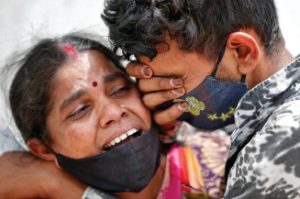
The month of May has been the deadliest in the pandemic in India. Heartbreaking images keep coming out of India of desperate family members trying to find hospital beds and oxygen for their dying relatives as they gasp for air and these are difficult to see. Hundreds of bodies have been found floating in the Ganges River or buried near its banks. It is evidence that the official numbers of over 283,000 deaths is much higher. Many of India’s poor cannot afford to bury their dead and others may be practicing “Jal Pravah”, the practice of dumping infected bodies or those of unwed girls, as a traditional practice.
The World Health Organization calls the triple-mutant India variant, as B.1.167. It is said to be “a variant of concern at a global level” as preliminary studies show it may spread 50% faster and may be a potential global health risk, especially if it evades some of the protections offered by the vaccines. The variant has already made its way to countries like the United States, the United Kingdom, and over 40 others. Dr. Anthony Fauci, America’s chief medical advisor to President Biden and top infectious disease expert, has said the vaccines used in the United States, both Pfizer and Moderna, are “at least partially and probably quite protective” but has recommended a lockdown for India to contain the escalating Covid crisis.
At the beginning of the pandemic, Prime Minister Modi ordered an extensive lockdown shutting down businesses and closing state borders. He was criticized for being too strict. The lockdown prompted a mass exodus of migrant workers and sent many of its poor even deeper into poverty. Modi stated in a speech on April 20 that the country must do all it can to avoid another lockdown. Perhaps the public and government fears of another lockdown prompted India to go to another extreme where restrictions were eased too quickly instead of continuing to move ahead slowly with ample caution.
One of the other keys in the fight against Covid is to vaccinate as many people as soon as possible. India is the world’s largest producer of vaccines, even known as the ‘pharmacy of the world’, but they exported over 60.5 million doses, more than the vaccinations administered within the country itself.
 India did not plan ahead of time to make domestic inoculations a priority for its large population. In the United States President Donald Trump signed an executive order back in December 2020 making vaccinations to the American people a priority before it started helping other nations around the world. Had that not happened, the United States had initially bought 100 million doses of Pfizer, only enough to fully vaccinate 50 million Americans and may not have had access to more of Pfizer’s vaccines until after June. Instead, today over 124 million Americans are already fully vaccinated and over 158 million have had at least one dose.


The author is a columnist and former contributor to Al-Jazeera America. She has a Masters degree in Political Science and can be reached at twitter @meriamsabih or Meriam.Sabih@gmail.com
Leave a Reply