



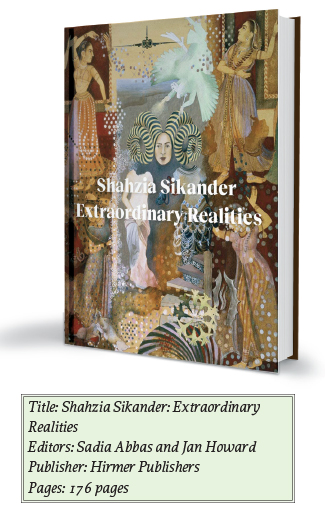
 It would be a disservice to view Shahzia Sikander: Extraordinary Realities as yet another monographic study on the rich oeuvre of a path-breaking artist. In a broader sense, the publication marks a significant scholarly intervention into the work of Pakistani-American artist Shahzia Sikander that foregrounds her contribution in bringing miniature painting within the realm of contemporary art.
The Lahore-born Sikander is globally recognized for re-invigorating Indo-Persian miniature painting through contemporary conceptual practices and infusing it with modern-day “South Asian, American, feminist and Muslim perspectives”. Steeped in this creative dialogue, Sikander has laid down the roots of an art form that has come to be known as ‘neo-miniature’ and vigorously resisted the stultifying politics of nationalism. Defying the blinkers imposed by national boundaries, Sikander has used neo-miniature painting to produce breathtaking meditations on questions of gender, class, cultural identity, sexuality and colonial history. This has come at a great cost as she has been flagrantly vilified and her contributions have been subjected to erasure.
The book is fuelled by the spirit of reclaiming the artist’s pivotal role in situating miniature painting with global contemporary art through an emphasis on her early work. Co-edited by scholar and DSC Prize-shortlisted author Sadia Abbas and RISD Museum curator Jan Howard, Extraordinary Realities provides a comprehensive overview of an eponymous museum exhibit. As per Sikander’s website, the exhibit will be displayed in Houston and New York.
The essays and transcribed conversations that have been included in this book condemn the attacks on Sikander’s work in Pakistan. In her essay, titled ‘Not a Breach But an Expansion’, Abbas states that efforts to discredit the Pakistani-American artist aren’t entirely surprising and expose “the imbrication of hostility to women within the contradictions of globalization”.
However, skeptics are warned against viewing the publication as little more than an impassioned defence against the criticism levelled by Sikander’s detractors. The scholarly reflections in the book are steered by well-conceived arguments and insights on Sikander’s work. For instance, Abbas’ essay examines how the artist’s acclaimed college thesis has given origin to key trajectories in her work and enabled her to create a unique visual idiom. Kishwar Rizvi’s piece for the publication categorically states that the subject of Sikander’s art defies “historical precedent” and an idealistic notion of the past. Rizvi lauds the Pakistani-American artist’s consistent attempts to use the female figure as a symbol of critique instead of a “decorative flourish”. Gayatri Gopinath’s essay posits the pressing need to situate Sikander’s work within the sphere of queer studies. In addition, Jan Howard traces the artist’s creative journey at RISD while Faisal Devji demonstrates how Sikander liberated the miniature from its national and religious roots and used it as a “sophisticated conceptual tool”.
The most significant achievement of the publication is the dialogue between Sikander’s teachers Bashir Ahmad and Dennis Congdon. Ahmad taught the artist miniature painting at Lahore’s National College of Arts before she moved to the US. Congdon, who teaches painting at RISD, has consistently supported Sikander’s work. As a result, the decision to engage the Pakistani-American artist’s mentors in a conversation about her work serves as a testament to the fact that Sikander’s artistic training precedes her encounter with the West. At this critical juncture, America is recovering from a long spell of right-wing populism that undermined the status of immigrants. A conversation between Congdon and Ahmad illustrates the need for a wider discourse through which America can recognize what it has gained and absorbed from migrant communities.
Extraordinary Realities is a valuable archival document that presents scholarly observations on the body of work produced by one of the most significant artists of our times. 
Leave a Reply