
Cover Story
Road to Peace
Pakistan only has to tap into India’s tremendous powerhouse of economic growth. New vistas of peace and trust would follow in its wake.

Geopolitically, unfolding perspectives in 2021 strongly indicate that greater geopolitical imperatives exist for Pakistan to opt for peace with India than Indian geopolitical imperatives to seek peace with Pakistan.
It goes beyond emphasis that sustainable peace between Pakistan and India is eminently desirable and that India values peace that much more with its neighbours as its foreign policy objectives followed in the last 70 years amply prove.
Sustainable peace between Pakistan and India would have evolved naturally and logically in the decades following 1947 after the initial bitterness of the Partition of the Indian Subcontinent by British colonial masters would have lapsed into history.
The two major determinants of Pakistan’s policies which have impeded Pakistan-India normalisation of relations in the decades since 1947 have been (1) Pakistan Army’s obsessive mindset on detaching Kashmir from India by war, proxy war and terrorism and (2) the burning ambition to achieve ‘Strategic Equivalence’ with India.
Addressing Pakistan’s obsession to achieve ‘Strategic Equivalence’ with India first, since this has a crucial bearing on regional and global geopolitics, a reality check in 2021 and perspectives beyond, do not suggest that Pakistan can ever achieve this policy objective, even despite a nuclear weapons arsenal at its disposal.
Globally, geopolitical weightage in 2021 is heavily stacked in favour of India and not in favour of Pakistan nor in favour of China which is Pakistan’s current strategic patron and underwrites Pakistan’s foreign policy.
Geopolitics was evidently in play in 2021 when China, after nine months of aggressive military confrontation in Eastern Ladakh with India, opted for disengagement and talks with Pakistan after four weeks, adopting reconciliatory approaches with India in terms of ceasefire on LoC after years of escalation.

Flowing from these developments would be the logical surmise that neither the United States nor China, beyond notional rhetoric, would stamp on India’s sensitive toes on Kashmir. It would endanger their respective national security interests which spin on the axis of a global power-play rather than Pakistan-centric calculations.
Pakistan’s policy establishment has to recognise that India today enjoys the geopolitical status of a “Swing State” in global power play, which neither the United States nor China or Russia can ignore.
Comparatively, this reality bestows greater leverages to India as opposed to Pakistan’s strategic utility to the United States or China.
Contextually then, in light of the strategic reality check, Pakistan’s national interest lies in the Pakistan Army’s hierarchy jettisoning its twin fixative obsessions and mindsets of ‘Strategic Equivalence’ with India and annexing ‘Kashmir’ for Pakistan.
Pakistan’s Peace Dialogues with India, commencing with the Neemrana Dialogues and the follow-ups over seven decades have all floundered on the two mindsets. This has resulted in Pakistan’s economic under-development and the country not attaining its full potential as a politically viable nation state.
Logically, therefore, after meandering aimlessly for seven decades as a ‘rentier state’, first with the United States and now more sinisterly with China, and failingly internationalising the Kashmir issue, and after four wars with India to no avail, the Pakistan Army must deeply introspect in 2021 on the credibility of its conflictual approaches to India and the value of sustainable peace with India.
Pakistan in 2021 for the Security, Welfare and Honour of 200 million Pakistanis and a bright future for Pakistan, should traverse on the ‘Road to Peace’ with India - the road less taken by Pakistan in the last 70 years of its existence.
Contentious issues need to be put aside for history to solve as Pakistan’s ‘Iron Brother’ ---China puts to India. Mindsets long blinkered by hatred and deep mistrust need to be replaced.
Notably, while on this aspect it needs to be recorded that only once a Pakistani PM won general elections on an election plank of Indo-Pak peace and that was former Pakistan prime minister Nawaz Sharif of PML-N. But as he was approaching the end of his second back-to-back prime ministership and was ousted by the Establishment by what I then termed as a ‘Judicial Coup.’
The people of India have deep friendship and affection for the Pakistani people as the Indians view them as like their own. One can daresay that the average right-thinking Pakistani shares the same sentiment as evident from political events outlined in the foregoing. Then why do the chasms persist?
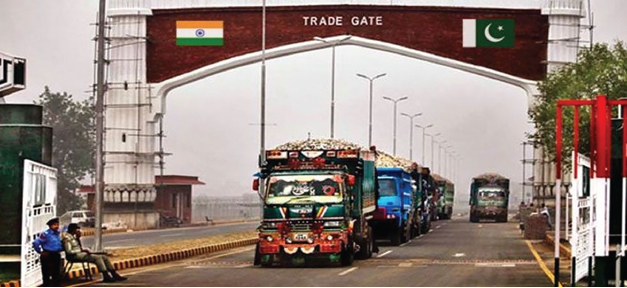
In brief, the ‘Road to Peace’ with India can be sustainably journeyed by Pakistan when it allows ‘Geoeconomics’ to prevail over “Geopolitics’ for which India would be ever-willing to underwrite and contribute. Pakistan only has to tap into India’s tremendous powerhouse of economic growth and new vistas of peace and trust would follow in its wake.
Once the Pakistani policy establishment recognises the value of ‘Geoeconomics’ being the predominant determinant of its India-policy approaches and over-riding ‘Geopolitics’ and its attendant conflictual appendages, the resultant spin-off in its wake would be increasing Pakistan-India economic interdependence and widening and intensified economic, social and cultural exchanges between the peoples of India and Pakistan.
Also, needing highlighting is that Pakistan must shed its obsessions that it can enlist the United States or China or the Islamic Ummah to prevail over India to arrive at peace arrangements with Pakistan as per past Pakistan Establishment blueprints.
Peace between India and Pakistan necessarily has to be a bilateral process without any external interventions.
Concluding, one would like to stress that the first steps towards sustainable peace between two nations like Pakistan and India, with a conflictual history, are the most difficult to take. But then history is replete with examples where visionary leaders have sprung up at crucial moments in a nation’s history to alter the conflictual courses long adopted.
India patiently awaits for that moment in Pakistan’s history where a visionary Pakistani leader emerges in Pakistan to drastically alter the directions of Pakistan’s policy approaches to India and transform Pakistan from a “Garrison State’ with a ‘siege mentality’ and impel Pakistan towards a genuine democratic future at peace with itself and at peace with India. ![]()
Dr Subhash Kapila is a graduate of the Royal British Army Staff College, Camberley and combines rich professional experience as an Indian Army Brigadier, Cabinet Secretary and has completed diplomatic/official assignments in the UK, USA, Japan, South Korea, and Bhutan. He ha authored two books---‘China-India Military Confrontation: 21st Century Perspectives” and “India’s Defence Policies & Strategic Thought: A Comparative Analysis”. |
|
Cover Story
|
|
News Buzz
|
Update |


Leave a Reply