When I served as India’s last Consul-General in Karachi during 1994-95, leading businessmen told me quite openly that they imported Indian machinery and goods via Dubai, because these items were not on the approved list. Such imports were shown as made in other countries. This modus operandi must still be in vogue because the volume of India-UAE trade is an indicator that Dubai functions as an entrepot, just as Singapore in South East Asia. I also discovered that most people in Pakistan favoured normal relations with India and remain keen on visiting India. Bollywood remains the staple of movie watchers and other cultural bonds remain reasonably vibrant. No amount of Islamist indoctrination and projecting India as the enemy has erased these cultural bonds, except among Islamist extremists and terrorist groups whose members are fed with jihadist fantasies and exploited by the power brokers in Rawalpindi. Before it was ordered closed in 1995, India’s Karachi Consulate issued the maximum number of visas, mostly to members of divided families.
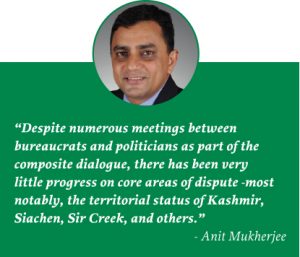 In pursuit of India’s “Neighbourhood Policy”, Prime Ministers from Jawaharlal Nehru to Atal Bihari Vajpayee, Manmohan Singh and Narendra Modi, have all tried to find a modus vivendi in India-Pakistan ties. Prime Minister Vajpayee boarded the “friendship” bus to Lahore. Prime Minister Manmohan Singh had articulated the desire of having breakfast in Delhi and dinner in Lahore to “make borders irrelevant”. His desire to visit his ancestral village in Gah, now in District Chakwal, eluded him. Prime Minister Modi invited Prime Minister Nawaz Sharif to attend his first swearing-in ceremony and also stopped by in Islamabad to visit Prime Minister Nawaz Sharif. These initiatives did not fructify, mainly because Pakistan’s army sabotaged all such moves, leveraging state-sponsored terrorism.
Arguably, both Kargil and India’s decision not to react to the terrorist attack in Mumbai during Prime Minister Manmohan Singh’s government impacted the public mood in India. Prime Minister Modi’s decision to change the paradigm of India’s policy, based on retaliation to Pakistan-sponsored terrorism, has received overwhelming public approval in India. Pakistan has to now factor in Indian retaliation for its state-sponsored terrorist strikes and recalibrate its policy pillar that India will not retaliate because of escalation, to the nuclear level. Pakistan’s policy of promoting terrorism against India is the primary reason for India’s position that “talks and terror cannot go together”. Pakistan’s grouse has been the “unfinished agenda of Partition regarding Kashmir.”
Pakistan is caught in the pincer of economic crisis and pressure from Islamists plus geo-political changes, in addition to pressures created by being on the FATF grey list and the COVID pandemic. The economic cost of confronting India and seeking parity with India is rising and is, perhaps, unsustainable. India’s economy is 10 times larger and the lesson of history that the breakup of the Soviet Union has handed down is surely well-understood. Meanwhile, Pakistan’s policy of keeping the LoC active, pushing in terrorists and weapons and keeping Kashmir on the boil, have paid no dividends. The drain on resources, for maintaining a hostile posture along the LoC must be considerable. A new Finance Minister has been appointed in Pakistan, the 4th in 2 years.
If we compare Bangladesh and Pakistan, we find that Bangladesh has left Pakistan behind in every social and economic indicator since 1971. It is noteworthy that Bangladesh’s annual exports are around USD 40 billion as compared to Pakistan’s exports of around USD 25 billion. Bangladesh’s foreign reserves are around USD 34 billion and Pakistan’s around USD 13 billion. Bangladesh-India connectivity, burgeoning trade and investment ties as well as people-to-people contacts have prospered. Bangladesh-India trade is around USD 10 billion, the largest among SAARC countries. Bangladeshi citizens are now the largest number among foreign visitors to India. Pakistan’s “Iron Brother” China is busy negotiating a deal in Ladakh, seeking to normalize relations with India and hoping to protect its trade ties worth around USD 80 billion annually.
Traditional bailouts by rich Gulf countries are no longer available and the only sources left are China and the IMF. Both apply conditionalities of different kinds; China uses debt-trap diplomacy and the IMF nibbles away at welfare measures and subsidies and raises taxes. Many in Pakistan are worried about their country’s growing indebtedness to China and the handover of national assets to a calculating mercantilist benefactor. Ironically, Pakistan has granted permission to a Chinese company to set up a beer factory for Chinese residents in Gwadar port area, despite Pakistan’s Islamist rhetoric. The agitation by the TLP against France is yet another manifestation of the Islamist siege within the Pakistani state. Banning the TLP will not remove the Islamist extremist and terrorist infrastructure that Pakistan has nurtured for decades as part of its state policy. This remains a crucial policy dilemma. These agitations will only add to Pakistan’s image problem and create tensions with Western nations.
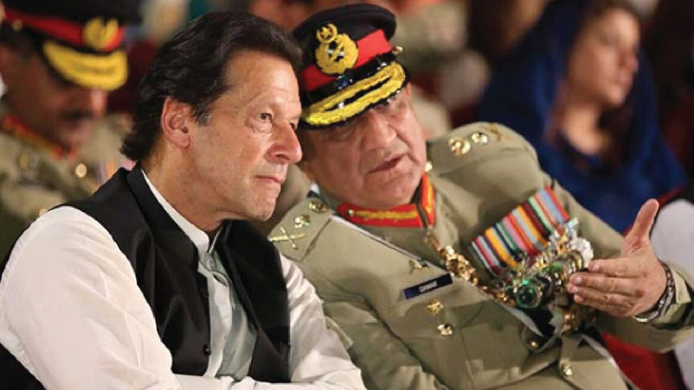
Despite spending millions of dollars on lobbying firms in Washington, President Biden has not spoken to Prime Minister Imran Khan and only the Secretary of State has had a conversation with Pakistan’s foreign minister which focussed on the release of the murderer of American journalist Daniel Pearl by the Supreme Court. The US Secretary of Defence has spoken to the Pakistan army chief. Biden has also not invited Prime Minister Imran Khan to the 40-nation Climate Summit that he will be hosting, though Biden has invited Prime Minister Sheikh Hasina of Bangladesh. The impending withdrawal of American forces from Afghanistan has injected another variable in the geo-security envelope surrounding Pakistan. A final American withdrawal will free the USA from the leverage Pakistan has so far exercised on American interests in Afghanistan. Recently UK has added Pakistan to its list of 21 countries of “concern” for money-laundering and terror financing. The UAE ban on issue of visa to Pakistanis is still in place.
After Kashmir’s status was changed, Pakistan took the high road as an aggrieved party. It downgraded diplomatic representation, banned trade and went into a sulk mode, demanding reversal of steps taken by India. Pakistan glosses over its own actions in changing the status of the part of Kashmir it occupies illegally. Pakistan has also ceded a part of Kashmir, the Shaksgam Valley, to China. Pakistan’s effort to drum up international support yielded no result. The UN Plebiscite issue is dead as a dodo. Beating the plebiscite drum will inevitably lead to the question of conditionalities for plebiscite embedded in the UN Resolutions which Pakistanis conveniently ignore. Flogging a dead horse may be good for political posturing but will yield nothing tangible.
Pakistan’s tantrums on Kashmir will not lead to any change in India’s policy. The LoC is there to stay and there is no space for any solution ignoring this. Pakistan’s pleas of a LoC-plus solution for an international border in Track-2 dialogues is a non-starter. This is not to deny that Pakistan too has difficulty in abandoning the Kashmir issue, having absorbed it in its DNA. I firmly believe that a working bilateral relationship is a desired objective, grounded in a people-oriented approach, pragmatic principles, the reality of geo-politics, and toning down the rhetoric and actions of the past. Reciprocal restoration of High Commissioners, relaxing visa norms and opening up trade are easy options and must be exercised. Reopening of consulates in Karachi and Mumbai can also be considered down the road. We have much to gain from normal and mutually beneficial ties.





Leave a Reply