



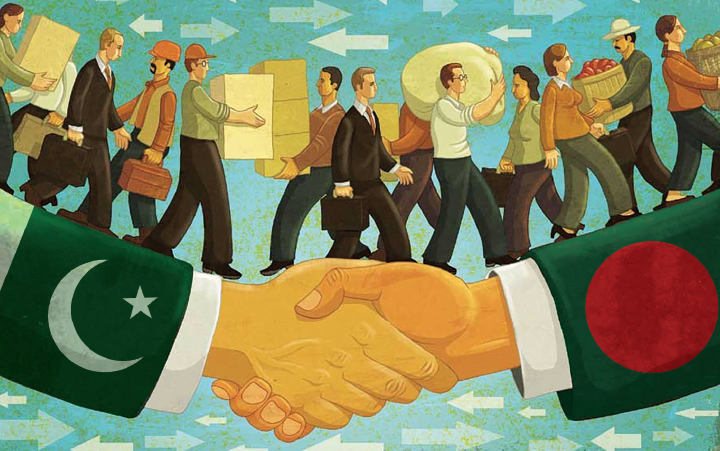
When it comes to culture, history and a collective interest in various regional and international issues, Pakistan and Bangladesh have a solid foundation for a mutually beneficial relationship. In fact, these two nations have already built significant bridges having struck deals between such organizations as the Non-Aligned Movement (NAM), D-8 Organization for Economic Cooperation, South Asian Association for Regional Cooperation (SAARC), the Organization of Islamic Cooperation (OIC), the World Trade Organization (WTO), the United Nations and numerous other corresponding agencies.
With the break-up of Pakistan and Bangladesh rising up as an independent country, both countries have been proactive in extending their trade links with other industrial nations over the past 35 years based on their expertise, resources, equipment and intermediate goods. This has resulted in low efforts for any bilateral trade between them. However, both official and private sectors in both countries have started to understand the need for such a union, with the official level recognizing future benefits in the formation of the SAARC and the SAARC Preferential Trading Arrangement (SAPTA), and quite recently the South Asian Free Trade Area (SAFTA). In addition to that, this realization is further recognized in the Joint Economic Commission (JEC), which is dedicated to furthering economic cooperation in trade and other areas of interest.
An interest surrounding a Free Trade Agreement (FTA) between Pakistan and Bangladesh surfaced in 2002, which unfortunately did not develop further. However, this interest has been sparked yet again in Islamabad and Dhaka to rediscover this possibility. The Least Developed Country status of Bangladesh is set to lapse in 2026; therefore, the Bangladeshi government is exploring opportunities to maintain key market access through important trade agreements.
For the last decade alone, talks of bilateral trade between Pakistan and Bangladesh have been in favour of the former. However, Pakistan’s exports to Bangladesh decreased from $947.23 million in 2011 to $583.44 million in 2020.
Overview of Pakistan’s Exports to Bangladesh
Pakistan’s exports to Bangladesh include cotton/fiber, cotton fabric machinery, plastic product, skins, vehicles, cereals and food stuff with exports amounting to: ‘Cotton’ ($427.6 million); ‘Salt; Sulphur; earths and stone; plastering materials, lime and cement’ ($73.7 million); ‘Edible vegetables’ ($17.5 million); ‘Raw hides and skins’ ($9.8 million); ‘Machinery’ ($9.7 million); ‘Inorganic chemicals’ ($4.4 million); ‘Man-made staple fibers’ ($4.0 million); ‘Plastics’ ($3.9 million), ‘Tanning or dyeing extracts’ ($3.9 million) and ‘Edible fruits and nuts’ ($3.2 million).
Overview of Pakistan’s Imports from Bangladesh
Pakistan’s imports from Bangladesh include raw jut, fertilizer, bulk tea, cut flower, tobacco, pharmaceutical and jute goods with imports amounting to: $46.78 million with the major import ‘Jute and other textile base fibers’ (HS-530310) being solely responsible for 75.5% of total imports in 2020.
 Opportunities
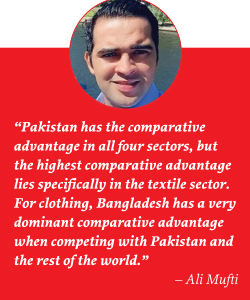
Pakistan can benefit from an export potential of approximately $2.95 billion in Bangladesh in sectors including agriculture, foodstuff, textiles, plastics, chemicals, base metals, and salt and cement products. In fact, the collective export potential for the highest 25 commodities stood at $1.4 billion in 2020 but unfortunately, only $435.78 million worth of goods were exported. 10 of these top commodities can be categorized as “Denim and Woven Fabrics of Cotton” (HS 52-55) of which Pakistan had the opportunity to export a worth of $522.74 million, but only managed to export $341.25 million to Bangladesh in 2020.


Based in London, the writer is a chartered accountant from London School of Economics and Political Science, and an Oxford University alumna with diversified experience in consulting and entrepreneurship. She can be reached at mishaanwarmalik@gmail.com
Leave a Reply