




It has been seventy-three years since India and Pakistan became independent nations. One of the foremost rationales for partition of the sub-continent was to ensure that the two neighbouring countries would be able to live in peace as good neighbours pursuing goals in consonance with their culture, heritage and values and promoting the interest of their people. The contrary has been the reality. The two countries have fought two major wars, and several major skirmishes and their relationship remains highly antagonistic. Kashmir remains the bone of contention as India has forcefully occupied two thirds of the territory and refuses to engage either with its people or with Pakistan, which has rightly taken a principled position that the Kashmiris be given the option to determine their choice. India, despite being a party to the UNSC Resolutions, will not concede as it is aware that it has no chance of being close to getting even a fraction of the peoples vote in its favour. Meanwhile, the people of occupied Kashmir continue to make huge sacrifices but are not relenting to India’s highly unjust and forceful occupation.
The raison d’être of partition was that the provinces with Muslim majority were given the option to choose whether they would be part of Pakistan or India. In respect of states the option was deliberately left to the ruler and not the people to decide whether the state would join India or Pakistan. This was a highly politicized decision as Kashmir being a Muslim majority state and contiguous to Pakistan was expected to be a part of it. But the Maharaja betrayed his people and succumbed to Indian PM Nehru’s manipulations and joined India. The British government of the time did not play fair and for expedient reasons facilitated the illegal accession of the state to India.
The conflict has taken the focus away from the multiple advantages that would accrue had these two developing countries worked toward a cooperative relationship.
Should Pakistan wait for the barbarism and human rights situation in Kashmir to improve or engage now to influence New Delhi to take back the abrogation of Article 370 and relent from its recent decisions in the larger interest of peace. Pakistan’s present primary interest is that Kashmir gets back its statehood. It is plausible that a congenial environment would be a better approach for achieving the interests of the Kashmiri people and those of Pakistan. And it would enhance the democratic credentials and image of India.
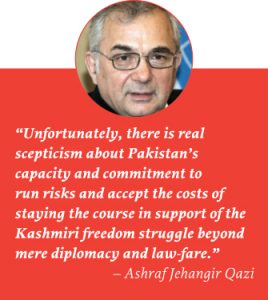 The immediate impact of reduction in tensions would allow Pakistan and India to focus on the economy and allocate proportionately more resources on human and infrastructural development. A critical factor that influences a country’s global or regional influence is its state of economy. It is not that the dire human rights situation in Kashmir is not known to the West but they view India’s violations with a different lens as their strategic and economic interests are involved. Expressing disquiet on the Kashmir HR situation by a few think tanks and relevant organizations is a welcome development but is not a substitute to a foreign government expressing its concern.

The writer is a retired lieutenant general of the Pakistan Army and a former federal secretary. He has also served as chairman of the Pakistan Ordnance Factories Board. |
|
Cover Story
|
|
News Buzz
|
Update |
Leave a Reply