


Region
DHA Debacle
The record-breaking deluge exposed the fragility of the city’s civic infrastructure
and drew attention to the lack of political will to correct faults.

Plagued by a fractured command structure and divided political ownership, Karachi needs a cohesive, all-embracing strategy to tackle its infrastructural crisis. Over the last few decades, the country’s financial hub has hobbled under the weight of an erratic system of power and water supply, an unreliable public transport network, and a disorderly mechanism for waste disposal. In the absence of political incentive and an empowered local government, any attempt to rectify the challenges faced by citizens remain futile.
However, it would be wrong to assume that the civic needs of specific neighborhoods can be addressed in a vacuum. The unprecedented rains that crippled life in Karachi on August 27, 2020 are a glaring testament to this belief.
The record-breaking deluge exposed the fragility of the city’s civic infrastructure and drew attention to the lack of political will to correct faults. Although various localities were adversely impacted by the downpour, the upscale neighborhoods of Clifton and the Defence Housing Authority (DHA) become the nucleus of a longstanding debate over civic apathy. Disgruntled by prolonged power cuts, property damage and the ineffectiveness of the storm drainage system, many residents participated in a series of protests against the DHA and the Cantonment Board Clifton (CBC). For the very first time, the well-heeled elite were spotted holding placards and shouting slogans to demand accountability from an institution that had failed to meet their expectations.
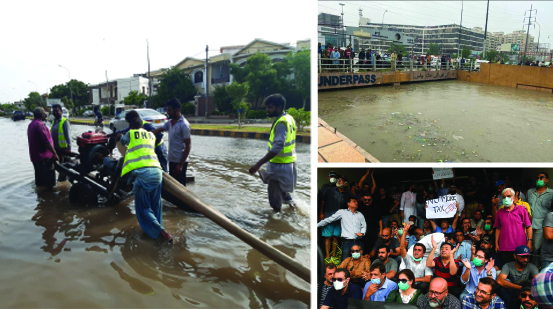
The first protest was held outside the office of the CBC – which provides municipal cover to DHA’s eight phases, various parts of Clifton and a few slum areas. While the protest remained peaceful, it was apparent that many protesters had no previous experience in dealing with civic issues in their residential area. Skeptics on social media criticized the sheer magnitude of elitism and tone-deaf privilege among some participants at the protest. In addition, a large number of demonstrators didn’t know the name of the chief executive officer of the CBC and instead mistakenly addressed their pleas to the Citizen Police Liaison Committee (CPLC) head. Their ignorance can be attributed to several decades of evading confrontations with the relevant authorities and opting for informal mechanisms of addressing water and electricity shortages.
Even so, the demands of the protesters were fuelled by legitimate concerns over a lack of transparency and ought to have been taken into consideration. Through the sit-in outside the CBC office – and subsequent protests outside the DHA Office and Frere Hall – residents were raising questions about how the authorities had utilized the money that is paid to them every year. If the DHA’s regulations are anything to go by, the housing authority is not permitted to collect taxes, but has the right to charge fees from residents. As a result, DHA residents have a right to demand a diverse range of privileges in exchange for this fee. As per its protocol, the DHA Board must conduct an audit every year to determine how the funds are allocated. The protesters were merely requesting an independent audit over how their money was being spent.
Unfortunately, after more than forty years, the situation is grimmer and graver.
Faced with questions over its transparency, the housing authority could have pacified the protesters by promising to either publish its audit report on a regular basis or include residents in the process of deciding how funds are utilized. Instead, the CBC filed criminal cases against 22 protesters for making derogatory comments against state institutions, trespassing the CBC premises, threatening government staff and disrupting relief work. On the day of the protest outside the DHA office, shipping containers were placed to prevent protesters from reaching the premises and security personnel were deployed to stave off any untoward situation.
In hindsight, the police complaint was an extreme measure and has been temporarily suspended by the high court. Be it a tactic to avoid accountability or a sincere attempt to protect the authorities from unruly demonstrators, the complaint was a clear indicator that the search for transparency is filled with obstacles.
For their part, the housing authority issued a statement after the torrential rains to explain why the storm-water drains had failed to prevent urban flooding in Karachi. According to the statement, the drains were constructed in keeping with Karachi’s precipitation record over the last 100 years and that the August 27 downpour exceeded their maximum capacity. The housing authority categorically claimed that it didn’t “consider [itself] absolved from [its] obligation towards mitigating the woes” of its residents. In light of the weather anomalies, the DHA may have a legitimate justification for their inability to act promptly. But urban planners ought to contemplate the possibility of constructing climate-resilient drains in a country like Pakistan, which is especially vulnerable to climate change.
The tensions between the DHA and its residents can be insulated from the civic issues and political dynamics in the city as a whole. While it is tempting to pin the blame on the Pakistan Peoples Party-led Sindh government for ignoring the provincial capital and weakening the local government, administrative concerns cannot be ruled out. In an opinion piece for Dawn, titled ‘Karachi’s faultlines’, Zahid Hussain has pointed out that various parts of Karachi don’t fall within the municipal jurisdiction and are managed by cantonment boards or the DHA. During an online seminar organized by the Pakistan Institute of Labour Education and Research, the economist Kaiser Bengali referred to these authorities as “supra-federal institutions that are laws unto themselves”. Doing away with these institutions might be both an inadvisable and radical move, especially in an ever-expanding city like Karachi. The city’s civic infrastructure can only be resolved if the local government system is strengthened and political players gain the incentive to streamline the city’s civic management. Prime Minister Imran Khan’s Karachi Transformation Plan promises to bring all the relevant stakeholders on the same page. Only time will tell if they will be able to match political consensus with a suitable agenda that can truly transform the city. ![]()
The writer is a journalist and author. He analyses international issues and can be reached at tahakehar2@gmail.com |
|
Cover Story
|
|
Special Editorial Feature
|
|
News Buzz
|
Update |


Leave a Reply