
Region
Apocalypse Now
Bad governance and development shortcomings in Karachi have created vulnerabilities
at different scales that are likely to exacerbate the impacts of climate change.

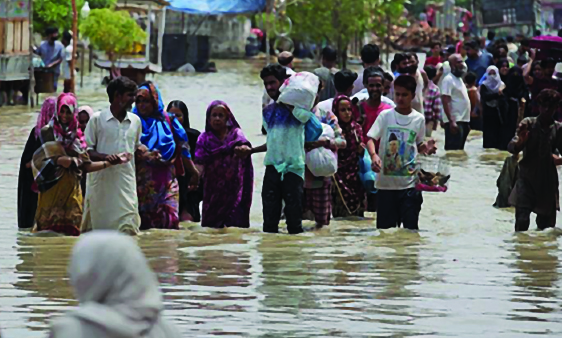
In August when torrential rains flooded Karachi and other cities in Pakistan, Melbourne and parts of Victoria in Australia were also smashed by powerful storms and gusts of up to 158 km, causing widespread damage. Three people died because of falling trees and countless homes were left without power. Victoria SES (State Emergency Service) received thousands of calls for help. While living close to Melbourne in Australia, as a Karachite, I was more concerned about my city and was trying to monitor the flood-like situation that wrought havoc and destroyed life in Karachi. Most of my family live in Karachi and because of the flash-flooding, I was worried about their health and safety.
While watching the rain situation in Karachi on TV, I received a SMS from the water company responsible for supplying clean water to Melbourne and its outskirts. The message said the storm had disturbed the power supply to the water treatment plant and, as a result of the power outage, undisinfected water had entered the water supply. They asked us to boil the water before using it for drinking, food preparation or other purposes.
My wife followed the advice and started to bring tap water to a rolling boil before use. But I didn’t like the taste of boiled water; it seemed that the water had absorbed the aroma of the boiling container. I filled a glass with tap water and noticed that the water was not murky but rather sparkling like a mirror. I sipped the tap water and felt that the taste of tap water was better than the boiled water. I started to use tap water for drinking but my wife preferred to consume boiled water for the kids and cooking purposes. After a day or two, I received another message from the water supply company, informing me that power supply had been restored and, after water quality testing, the water boiling advisory had been lifted and it was safe to use tap water. With a polite smile I ignored the message.
Again, after a few days, I received an email from the water supply company, expressing profound regret over the inconvenience caused by the power outage due to the storm. The company further requested that during the advisory period if costumers had purchased bottled water, they were to contact the water company for a refund.
When we examine the situation in Karachi, the stark reality is that people who are at the helm of affairs in the Water and Sewerage Board, are not willing to take responsibility for the city’s situation. I am not comparing the resources of developed country with Pakistan, though it would not be unfair as, in two years, we will celebrate the diamond jubilee of our independence. But, unfortunately, we have not shown any progress in civic or infrastructure development. Development has retrogressed since independence.
My father used to tell me about the heavy rains during the monsoon season of 1977 in Karachi that caused floods in the city and Landhi and Korangi were completely cut off from the rest of the city. Unfortunately, after more than forty years, the situation is grimmer and graver. The torrential rains completely exposed the inefficiency of the government and no significant change was observed in terms of storm water drainage and other civic facilities.
The Mayor of Karachi held the Sindh government responsible for the dilapidated infrastructure of the city. The Sindh government put the burden of responsibility on the previous government; if the previous government had the opportunity to defend itself, it might have held the Mughal emperors as being responsible for the disaster or would have tossed back the responsibility on today’s rulers; the vicious circle would never be completed.
I am not playing down the intensity of the flood caused by the recent torrential rains in the city’s infrastructure. The government said that the encroachments blocked the storm water drain system and it needed long planning to solve the problem. What about the Civil Defence or the rescue services that help people during disasters?
I would like to again quote the example of the August 27 Melbourne storm. The Victoria State Emergency Services (VICSES) received thousands of calls and most of the calls were responded to. SES is an emergency service funded by the government and is run mostly by volunteers. It is a collection of a number of organisations that provide emergency services during or after minor or major incidents from under one umbrella.
SES operates in all the states and territories of Australia. Why couldn’t we develop such services in Pakistan? Even for a lower level of emergency, the paramilitary and military services are called for rescue and rehabilitation purposes. During the Musharraf era, the NDMA (National Disaster Management Authority) was constituted to plan, help and rescue in case of disaster or natural calamity. But this is also not as effective as it was expected to be. People of the Punjab at least have Rescue 1122, but the millions of people in Karachi and Sindh don’t even have a public sector ambulance service and they rely on charity organisations like Edhi or Chhipa.
The people of Karachi and Sindh are equally responsible for their sufferings. When they know that their representatives are not delivering, they don’t have to elect them. Karachi used to be renowned for its vibrant culture. Various political parties claimed that they were the true representative of the city and, to prove their strength, they never hesitated in demonstrating their street power. This time, only a few hundred residents of affluent the city’s localities protested against the inundated streets and lack of other civic services in the areas; their aeas do not even fall under the city district government. Political and religious parties are known for staging demonstrations and occupying the streets of Karachi to serve their vested interests. Now they are in a state of dormancy and it looks like that they are not interested in the problems of Karachi. They will only become visible when they need votes. ![]()
The writer is a senior TV journalist based in Australia. He can be reached at adeel644@yahoo.com |
|
Cover Story
|
|
Special Editorial Feature
|
|
News Buzz
|
Update |


Leave a Reply