With strong political will, Pakistan can successfully tap its Rare Earth Elements (RREs) wealth to become a major player in the global high-tech metal market
BySyed E. Hasan, PhD. | December 2025
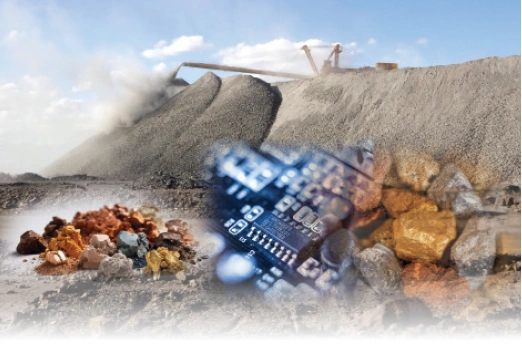
Over the past two decades, leading economies worldwide have conducted detailed studies on the availability of certain minerals and chemical elements, collectively referred to as Critical Materials (CMs), which had previously received little attention. This interest stems from the unique physical and chemical properties of selected geological materials, which make them indispensable for manufacturing high-tech devices and equipment essential to the modern economy. It encompasses smartphones, digital notebooks, semiconductor devices such as Light-Emitting Diodes (LEDs), fiber optics, 5G networks, spacecraft components, automobile catalytic converters, supercomputers, windmill components, advanced military devices, Electric Vehicles (EVs), and many other applications.
The use of metals in mobile phones best illustrates this growing demand: vintage mobile phones from the 1980s contained only a few metals, whereas modern smartphones contain over 40 metals, many of which are of high value and rare in occurrence.
The article explains what CMs are, and discusses the origin, occurrence, and distribution of Rare Earth Elements (RREs), and how Pakistan, with proper planning and exploitation, can develop its RRE and CM resources to emerge as a dominant economy in the modern world. In fact, the author predicts that RREs will compete, if not entirely replace, fossil fuels as the primary natural material driving the global economy.
Critical materials are defined as geological materials that are essential to a country’s economy and security but are vulnerable to supply chain disruptions, limited national and global occurrence, and are affected by mining, refining, geopolitics, and stock market speculation. As reported by the United States Geological Survey (USGS), minerals like cobalt, gallium, graphite, lithium, magnesium, and several elements belonging to the Platinum Group Minerals (PGMs) bearing the REEs, such as platinum, palladium, rhodium, are in short supply, and their uninterrupted availability is essential for a nation’s economy and security. Additionally, other geologic materials, including chromium, nickel, potash, silicon, copper, silver, rhenium, and lead, are also considered critical materials.
Price volatility
The price of high-value metals fluctuates due to global demand, stock market trading, production slowdowns, miners’ strikes, and geopolitical factors. For example, a sudden increase in the price of rhodium during the 1990s was caused by a prolonged miners’ strike in South Africa, a major producer of rhodium. In another instance, during the economic crisis of 2008, the rhodium price increased to $354 per gram (g) due to speculative trading, but fell to $15.64 per g in 2015 and bounced back to $265 per g in October 2025.
Hidden Potential of RREs in Untapped Electronic and Mine Waste
The global annual market demand for RREs around the mid-2010s was 105,000 tonnes, and was predicted to increase to 210,000 tonnes per year by 2026. With China possessing 58% of RREs, followed by Australia at 17%, Russia and the USA each about 7%, and the rest of the world at 11%, Pakistan can harness its RRE resources to become a major supplier. With rapid industrialization and the impacts of climate change, many developing countries have been increasing their use of electrical and electronic devices, contributing to the ever-growing quantity of electronic waste (e-waste). Worldwide, the amount increased from 44.4 million tonnes (Mt) in 2014 to 62.3 Mt in 2024 and is projected to rise to 74.7 Mt in 2030, with the largest share originating from Asia.
This unprecedented growth in the global use of electrical and electronic equipment, including smartphones, digital tablets, computers, Printed Circuit Boards (PCBs), electric vehicles, solar panels, windmills, military hardware, and space vehicles, has led to a massive increase in discarded e-waste worldwide.
In developing countries, such as Pakistan, people use mobile phones more than any other personal electronic device. Although mobile phone composition varies by manufacturer and model, the bulk of mobile phones are composed of plastics (40%), metals (35%), and ceramics (25%), containing up to 64 elements. These materials include strategic and high-value technology metals, such as RREs, PGMs, gold, indium, lithium, and cobalt, and are classified as Critical Materials or Critical Raw Materials by the United States and European Union.
From a green economy standpoint, discarded mobile phones represent a valuable waste stream for the recovery of rare, high-tech metals, which also offer a secondary source to augment limited natural reserves, stabilize supply, minimize adverse environmental impacts resulting from improper e-waste management, and contribute to the nation’s economy.
RREs will compete, if not entirely replace, fossil fuels as the primary natural material driving the global economy
It is estimated that 1,000kg of discarded mobile phones contain 270g of silver, 141g of gold, 18g of palladium, 10g of platinum, 53,000g of copper, and 3,300g of RREs, valued at approximately $30,000 (October 2025 price). Smartphones contain higher percentages of metals and RREs, valued at $83,000. With an average weight of 100g per smartphone, it will require approximately 13,000 smartphones — a small fraction of the millions of discarded smartphones —to recover large quantities of valuable metals.
Pakistan’s population in 2025 was 255.2 million, of which approximately 60% fell within the 15-64 age range, which also happens to be the largest group of digital device users. According to the Pakistan Telecommunication Authority, Pakistan had approximately 200 million mobile phone users as of June 2025, of which smartphone users accounted for 73 million. Though an accurate estimate for the average life of a mobile phone in Pakistan is not available because of reuse, refurbishing, etc., it can be assumed to be about 10 years (compared to below 2 years in most Western countries). This would mean that in a given year, 20 million mobile phones may be discarded. Using a conservative estimate of 50% of these being refurbished and reused, approximately 10 million discarded mobile phones are still dumped in landfills each year. These discarded phones contain high-tech metals that can add $2.2 billion to the nation’s economy per year.
Mine waste, also known as tailings, holds great potential for the recovery of RREs. Historically, advancements in technology have also increased the demand for new or previously unused elements. For example, mica from pegmatite — an igneous rock that hosts several valuable minerals — was extensively mined during the first half of the 20th century to extract the mineral muscovite, the pure form of mica, which was in high demand in electrical heating appliances, such as toasters and space heaters. Since muscovite comprises a minor percentage of a typical mass of pegmatite, after extracting muscovite, the bulk of the pegmatite, considered waste rock, was discarded.
Later, after the discovery of nuclear technology for electric power generation, one of the pegmatite minerals, beryl, which was previously discarded during mica mining, became a highly sought-after mineral because it was found to act as a moderator to control the rate of nuclear fission in the reactor core.
This discovery led entrepreneurs to invest in setting up beryl recovery operations at waste rocks dumped at abandoned mica mines. Similarly, selected waste mine rocks from phosphate and aluminum mining should be inventoried and evaluated by the Pakistan Geological Survey to determine the potential resource of RREs. This project is neither technically complicated nor expensive, and it can be accomplished with a low budget. Other potential secondary sources of RREs include coal combustion products, blast furnace sludge, red mud from alumina production, acid mine precipitates, and industrial wastewater sludges, among others, which should be evaluated for their potential to recover RREs.
To facilitate an efficient operation for the recovery of high-tech and other valuable metals, setting up a regional campus for receiving, storing, and recycling e-waste should be given high priority to extract valuable RREs and other elements from discarded e-waste. It is a major project and requires coordination among dozens of companies and institutions to establish a Critical Materials campus at a central location in Pakistan. Engagement and commitment from businesses, planners, financial institutions, government agencies, universities, informal e-waste recyclers, and other stakeholders, along with effective coordination among all entities by an experienced manager, will be imperative for the project’s success.
The Way Forward
Potential availability of critical materials in Pakistan in the Gilgit-Baltistan area, and in Balochistan, along with secondary recovery of RREs from e-waste, etc., holds significant promise. Using a RRE concentration of 300 parts per million (ppm) as a recommended level for profitable recovery, Pakistan can unearth a sizable quantity of this valuable commodity.
Overcoming the existing challenges related to exploration, technology, investment, and infrastructure requires a long-term visionary commitment, strategic planning, and effective execution. Geologically, Pakistan is endowed with a variety of high-tech and valuable mineral resources. With strong political will, Pakistan can successfully tap its RREs wealth to become a major player in the global high-tech metal market, contributing to the nation’s economic prosperity and technological advancement in a short period. By creating the right balance of judicious policies and their transparent implementation, Pakistan can usher in an era of hitherto unknown economic prosperity for its people.





Leave a Reply