



U.S. President Donald Trump’s recent repeated praise for Pakistan’s military chief and prime minister — in their presence or otherwise — has carried a resonance far beyond diplomatic circles. It has entered the domestic political and psychological theatre of Pakistan, where foreign validation often translates into internal legitimacy. Since the social and political milieu in India is not too dissimilar, the warming of Pakistan-US ties has been declared a setback for Indian diplomacy in opposition circles there.
Trump’s offhand remarks are characteristic of his flamboyant personal style rather than any coherent foreign policy shift. Despite the ongoing tariff fight, there has been no decline in the core US–India defence relationship. The three foundational pacts — LEMOA (logistics), COMCASA (secure communications), and BECA (geospatial data-sharing) — remain in place. These legal frameworks, signed before the tariff spat, continue to underpin interoperability and technology sharing. Trump has not sought any change in these agreements or their terms.
What India has paid is the price of large new US tariffs (estimated in the tens of billions of dollars), political risk to projects that depend on US sanction exemptions (notably the Chabahar port), and the extra cost of any shift away from discounted Russian crude. Indian sources claim defence sales and cooperation with the US are “on track.” The Indian ministry and multiple reporting outlets confirm that planned U.S. arms purchases and high-level defence engagements continue despite the tariff escalation. CAATSA/S-400 friction has not produced crippling U.S. sanctions. Congress has discussed India-specific waivers, and the relationship has been managed politically.
In short, the threat level is high, but large-scale defence decoupling has not happened. Political relations appear strained, but the resilience of the legal and operational building blocks for close military cooperation — including data sharing, logistics support, and secure communications — and a steady pipeline of U.S. defense sales have not been affected. The defence relationship largely remains functional.
India suffered significant losses primarily in trade, economic costs, and future investments. Indian exports were subjected to some of the harshest tariffs on various pretexts, at times higher than those imposed on China. The U.S. moved from earlier duties to much higher “reciprocal/penalty” tariffs (effectively 50% on many Indian goods). Independent analysts estimate tens of billions of dollars of exports at risk — roughly $30–50 billion. India’s own reported estimate is about $48.2 billion of exports likely to be hit, especially in labour-intensive sectors like textiles, apparel, gems, jewellery, furniture, and engineering goods, eroding their competitiveness in the U.S. market.
India’s strategic investment in Iran’s Chabahar port (the overland route to Afghanistan and Central Asia that bypasses Pakistan) has previously been allowed under U.S. waivers, but recent policy moves created uncertainty. Some outlets reported that earlier waivers were revoked, while others cited temporary exemptions. Pakistani media noted these developments but underplayed them. Pakistan, meanwhile, never felt the port could compete with Gwadar, as its future depends on U.S. policy choices and periodic waivers. That uncertainty reduces the value of India’s trade plans through Chabahar.
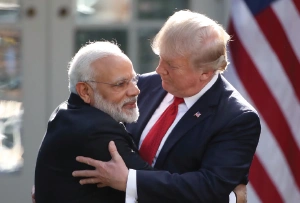
The bigger stumbling issue remains India’s purchase of discounted Russian crude and its resale in world markets — something the U.S. president insists should stop. Shifting away from Russian crude could cost India an additional $3–5 billion annually for modest reductions, with greater costs if scaled up. Trump has claimed India agreed to reduce Russian oil purchases, but New Delhi has not issued any policy statement. Apparently, it is doing so quietly, avoiding the impression of caving to U.S. pressure. Opposition parties argue that Modi’s close ties with Trump have yielded little tangible benefit, yet Modi has not once publicly criticised him. Both made political miscalculations, but neither allowed personal grievances to affect strategic relations.
Where the Pakistan-US bonhomie affects India most is in the less visible strategic domains — bargaining leverage, trust, and negotiating space. Tariffs have eroded mutual trust and complicated broader discussions on trade and technology. They raise the political cost for India of aligning too closely with Washington and may drive it to diversify suppliers or deepen ties with other partners such as Russia, the Gulf, or China. Too much was also read into Modi’s recent visit to China. Even the tariff-loving Trump appeared unsettled by it, but later called Modi “a good friend.”
In a period marked by economic crisis, political fragmentation, and eroding public confidence, external approval from a Western leader — particularly one as high-profile as Trump — serves as a narrative asset for Pakistan’s ruling establishment. Positive remarks are widely showcased in national media as evidence of restored international respect, reinforcing the civil–military narrative of competence and global acceptance. This has been the norm since independence, and today it has assumed an exaggerated form in both Pakistan and India.
Trump’s praise for Pakistan’s military chief and prime minister has reverberated through political and media circles, generating an unusually buoyant reaction in Pakistan. The military establishment projects an image of strategic indispensability to global power centres, countering domestic criticism and Indian propaganda that Pakistan was sidelined internationally. For the civilian government, it provides short-term political relief — portraying external confidence in its stewardship amid economic strain and public discontent. There are no more anti-Pakistan U.S. Congressional resolutions criticising human rights or detention of opposition leaders. Pakistan has been invited to major international events related to the Middle East and South Asia once again.
In Pakistan’s perception-driven politics, even symbolic approval from a Western figure can have tangible domestic consequences. The elite and public alike often interpret such gestures as indicators of Pakistan’s global standing — a legacy of its postcolonial psychology and dependence on foreign aid and military partnerships. Consequently, Trump’s compliment is being used as political currency — a sign that the state’s power centres remain relevant internationally.
 These symbolic gestures from the U.S. have momentarily shifted Pakistan’s domestic narrative — reinforcing the establishment’s claim to external credibility and internal control. This is projected as a validating certificate of diplomatic triumph over the Modi government’s failures. However, opposition and independent analysts view this celebration as largely performative, pointing out that such remarks carry no policy implications and do little to alter Pakistan’s economic isolation or diplomatic limitations. Pakistan remains unable to resolve its problems with Afghanistan, and its connectivity projects have stalled. Trump’s praise did not bring substantive policy change in bilateral relations — only political optics, offering the power structure a fleeting sense of validation and prestige. The government even attempted to adopt the 27th Amendment unanimously but failed, exposing deeper political fragmentation.


The writer is a former ambassador and can be contacted at rahimmkarim@gmail.com
Leave a Reply