



“Violence breeds violence. The autocracy and authoritarianism induce intolerant, violent, and militant tendencies in society, prejudicial to the state. At the same time, democratic, participatory, representative, and rule-based governance tends to appeal to and bring out the goodness of citizens by instilling in them the importance of respecting laws and promoting peace, the common good, and collective well-being. Underdeveloped or developing societies prevent crime by instilling a fear of the law and law enforcement. In contrast, developed nations emphasize the importance of law-based conduct in a society where wrongdoing is generally viewed as an offense against the well-being of the entire society and the state, resulting in severe social condemnation and pressure on law enforcement to apprehend and prosecute the perpetrator of the crime.
We live under different conditions with an omnipresent and omnipotent establishment that manages every state affair, from politics to the economy, judiciary, and defence, and exploits fault lines within society to strengthen its grip. The Tehreek-e-Labbaik Pakistan (TLP), a far-right Islamist party, was formed by a firebrand preacher, Syed Khadim Hussain Rizvi, in 2015, allegedly at the instigation of some deep state elements to deprive the PML (n) of the rightist votes in the general election scheduled in July 2018. His followers were religious diehards and reacted violently to any perceived blasphemous remarks at home or abroad. Although based in Lahore, he would direct his guns towards Islamabad in any situation requiring protests to pressure the ruling clique. He organized such sit-ins during the eventful tenures of Pakistan Muslim League (n) and PTI from 2013 to 2022 and made victorious returns to Lahore.
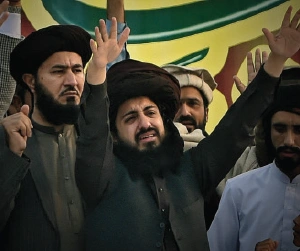
Syed Khadim Hussain Rizvi passed away in November 2020 and was succeeded by his son, Saad Hussain Rizvi, as the second Ameer of the party. He continued following the ideological and political footprints of his father, acting as the self-appointed guardian of the blasphemy laws and reacting violently to any event perceived as blasphemous or injurious to Muslim interests. This time around, the party wanted to record its protest over the unjust Gaza Peace Plan in front of the US Embassy in Islamabad.
U.S. President Donald Trump unveiled his peace plan for Gaza on September 29 and solicited the support of the major Muslim countries. Nine major Muslim countries, including Pakistan, supported the plan. The TLP took offence, calling the peace plan a disgrace to Palestinians, and announced a long march to Islamabad. The federal and Punjab governments were clearly embarrassed, particularly in view of Washington’s recent bilateral tilt towards Pakistan, with President Donald Trump untiringly admiring our senior political and military leaders. Syed Saad Hussain Rizvi misjudged the likely reaction of the authorities in Islamabad and Punjab to protests outside the US Embassy.
On the first Friday of October, the party was unable to gather a sizable crowd to move towards Islamabad, as the Punjab police successfully sealed all roads to prevent the convergence of crowds in Lahore. However, on the second Friday (10 October), the TLP activists fought a pitched battle to break the police siege. They took the Grand Trunk Road to Islamabad. At Muridke, the administration had dug up deep and wide trenches to stop the long march. A heavy contingent of armed police and paramilitary forces, accompanied by armoured vehicles, had cordoned off the area. The marchers chose to camp there instead of ending their march. The atmosphere was overcast with apprehension, and the air was heavy with the nauseating odor of human blood. A gloom hung over the surroundings.
On 13 October, the security forces, in the wee hours of the night, launched a violent crackdown on the demonstrators using armoured vehicles. This caused heavy loss of previous lives, forcing the marchers to disperse. Later, the Federal authorities, on the recommendation of the Punjab administration, proscribed the TLP. Per law, the leaders of a proscribed party would be barred from holding any elected office in the future unless they disassociate themselves immediately from its ranks. Thus, many TLP leaders have announced their disassociation from the party. The mosques and seminaries of the TLP have been handed over to a committee of religious leaders, rather than the province’s Auqaf and Religious Affairs Department. This appears to be an apparent concession made at the behest of religious leaders. The Federal Government would now refer the matter to the Supreme Court to confirm or dismiss the proscription of the party.


Based in Karachi, the author is a former member of the Foreign Service of Pakistan and has served as Ambassador for seven years.
Leave a Reply