



 When was the last time you wrote a letter? I don’t think most of us remember, except perhaps the one we wrote in school just to secure a good grade. Today, we write constantly: texts, posts, story captions, and whatnot. With the rise of large language models, the situation has become even more intense. On the other hand, the missive — more careful, more deliberate, more permanent — endures; it carries significance, requiring exhilarating composition, intricate editing, meaningful thought, and most importantly, constancy towards the other individual.
In the chronicles of writing, this art has remained interminable and alive: from the West, inter alia, there are Letters to Milena by Franz Kafka, Camus’ Correspondence, The Letters of Vincent van Gogh and The Rosenberg Letters between Julius and Ethel Rosenberg; from the East, inter alia, we have Letters from Prison by Faiz Ahmed Faiz, Makatib-e-Iqbal (Letters of Allama Iqbal), Ghubar-e-Khatir (by Maulana Abul Kalam Azad), and Mohabbat Namay (Letters of Amrita Pritam).
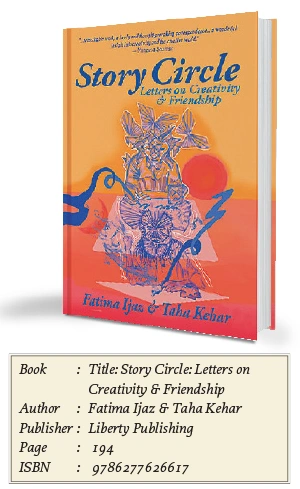
Amidst this fading epistolary tradition, Fatima Ijaz, a poetess and short-story writer, and Taha Kehar, a novelist and literary critic, have co-authored Story Circle: Letters on Creativity and Friendship. A series of 48 letters exchanged over five intensely creative weeks, with the former in the United States and the latter in Pakistan. What makes this venture remarkable, beyond the very act of letter writing itself — albeit through email, given logistical convenience — is that both writers are, in their letters, at once creators and confidants, vulnerable yet unguarded before each other.
Interestingly, in these letters, dreams become a recurring site of mutual psychoanalysis, with each writer interpreting not only the other’s subconscious but also their own. What makes these exchanges especially intriguing is the context they provide for their writings — a rare glimpse into the creative “backend” that readers are seldom privy to.
The correspondence feels intimate and immediate, as if the reader were living alongside them. Both share what they are doing, what they are getting exposed to, and what they are thinking. At times, they discuss deep philosophical questions — especially the limitations of language and its inability to express the inexpressible. At other moments, they exchange beliefs (like the magical manifestation of Quranic verses in instances of real life) and superstitions.
They review and discuss a range of writers, situating their reflections within a broader literary and philosophical conversation. In a sense, the letters serve as a meta-commentary on creativity itself: a reminder of how lonely, cathartic, and cumbersome the creative process can be.
They also confront the complexities of human relationships — grappling with betrayal, the loss of a parent, difficult choices (Fatima pursuing literature against her parents’ expectations), the ache of failed love, and other deeply human conditions and calamities. And yet, the letters are not without levity. The two often discuss lively topics, such as Bollywood, mimicry, music, reminding us how easily we dehumanize writers, imagining them as ideal beings untouched by ordinary flaws and propensities for the “common” things.
Together, they navigate the dilemmas of writing: the tension between inhabiting one’s inner landscape and meeting others’ unrealistic demands and expectations, as well as the delicate role of the editor, who must resist the urge to overpower the writer and their words. Reading this book may nudge readers to immerse themselves in the craft of letter writing to a friend, family member, or beloved. Blurring the line between the profound and the ordinary, letting real life seep in through its interruptions and intimacies, and revealing the writer’s most authentic, unguarded self.
Leave a Reply