



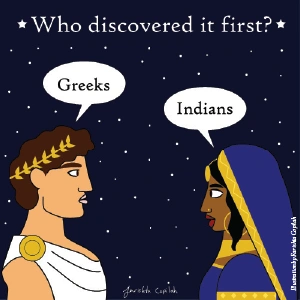
 The story of Western history of science typically begins with the Greeks, with Aristotle often being claimed as the leading scholar of ancient times. Dig a little deeper, and an uncanny similarity between Greek and Indian philosophy, science, and mythology begins to appear. However, modern science, as a triumph of Western civilization, is typically attributed to the Greeks as its starting point.
The interaction between the Greeks and Indians is well-documented, dating back to the arrival of Alexander the Great in 327 BC and even earlier, under the Persian Achaemenid Empire, which stretched from Anatolia to the northwestern regions of India. There are far more historical records that we rely on from the Greeks than from Indian scholars, who, it seems, did not leave as many records behind. We shall explore just some of the uncanny similarities between Greek and Indian ancient science, as to who influenced whom often remains an open question. At the same time, most Western scholarly writing attributes the influence of Greek culture on India.
Common human needs give rise to similar developments. For example, all cultures seem to venerate the skies due to their common need for survival through agriculture, and thus the importance of understanding seasonal patterns, time-telling, and directions. This is common to all people, regardless of their location. So, common themes emerging in the archeoastronomy of the ancient people are not surprising.
However, creating similar mythologies based on pseudoscience, which is essentially a form of storytelling, is a different matter. Let us look at some examples of uncanny similarities between early Greek and Indian scientific ideas and what is essentially considered pseudoscience today.
Why are there seven days in a week? Not many people realise that it is linked to ancient astronomy and the observations of the ancient people. While archaeological records indicate its origin in Mesopotamia, we commonly learn that it was propagated by the Greeks and Romans, where each day represents a god in the sky linked to a celestial body that moves among the stars. The ancient Babylonians invented the seven-day week around the 7th and 6th centuries BCE, based on their observations of the seven visible celestial bodies in the sky – the Sun, Moon, Mars, Mercury, Venus, Jupiter, and Saturn. As such, the Western nomenclature, originating from the Greco-Roman tradition and the Anglo-Saxon or English adaptation, reveals that Sunday is linked to the Sun, Monday to the Moon, Tuesday to Mars, Wednesday to Mercury, Thursday to Jupiter, Friday to Venus, and Saturday to Saturn.
In the Indian culture, the days of the week in Hindi are linked as follows: Sunday is related to the Sun (Surya) - Ravivar, Monday to the Moon (Chandra) - Somvar, Tuesday to Mars (Mangal) - Mangalvar, Wednesday to Mercury (Budha) - Budhavar, Thursday to Jupiter (Guru/Brihaspati) - Guruvar, Friday to Venus (Shukra) - Shukravar, and Saturday to Saturn (Shani) – Shanivar. They are identical and clearly one culture borrowed from another, but which came first? India and Mesopotamia are the oldest ancient river civilizations, and there is archaeological evidence of connections between these cultures long before the occupation of the Western regions.
Our following example comes from the ancient world of astrology, which is built around the idea that the planets and their positions influence humans’ lives on Earth. Therefore, let us look at horoscopes.


Based in Port of Spain, the writer is a Professor of Astronomy at the University of the West Indies in St. Augustine, Trinidad and Tobago. She has a keen interest in the history of science and can be reached at shirin.haque@uwi.edu
Leave a Reply