



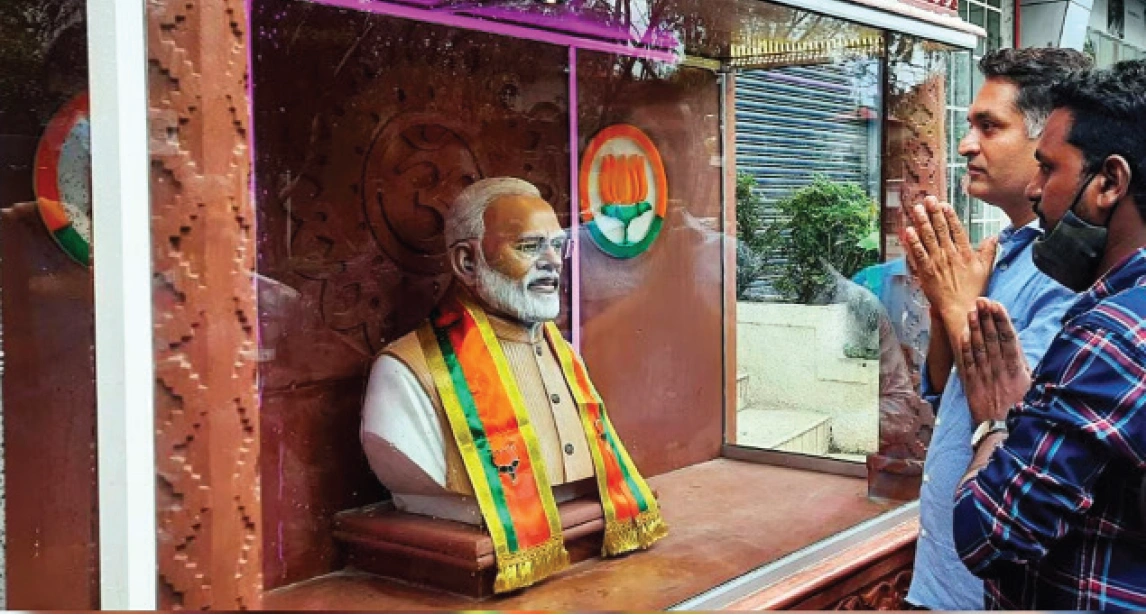
Modi hai toh mumkin hai. An alliterative yet seemingly innocuous election slogan best describes the present-day India, veering off track, despite its august credentials as the world’s largest democracy and in spite of its noble intentions on a quest for rapid socioeconomic development, laced with grandiose ambitions in pursuit of regional hegemony. The rise and rise of Narendra Damodardas Modi, India’s three-time Prime Minister, who now embodies the untoward turn taken collectively by the Indian junta en masse, that too in the opposite direction of history, has more than merely political relevance to the over 1.5 billion people of the world’s most populous country.
More justifiable to say, Indian Prime Minister Narendra Modi, per se, boasts of an extraordinary historical development with far-reaching implications not only for the ultimate political destiny of his nation as well as of the bordering states in the subcontinent, but his steady yet phenomenal ascent to the political forefront of a Hindu-majority nation heralds a watershed moment for the Hinduism, the world’s third largest religion, with its 95% believers concentrated only in one place: India. This demographic reality makes the matter more worrisome and alarming for rational minds.
The remarkable yet repeated climb of a staunch RSS (Rashtriya Swayamsevak Sangh) activist to the country’s premiership in general and to the spiritual stronghold of Hindu fandom in particular is not an occasional coincidence but rather a fated outcome of a historical process now fast culminating in a full-blown reality, which could be referred to as ‘Hindu Awakening.’ Lurking behind Modi is a centuries-long deprivation of India’s pretty dominant Hindu populations, who had remained disempowered, demoralized, and disfranchised in their own land at the hands of foreign invaders and colonial powers, although they were quite few in numbers.
A glorified personification of an exceptional moment that never comes too often, Modi is the face of Hindu Awakening and for his diehard followers numbered in millions, Modi ji is a divinely-driven reincarnation of yet another mahapurush mahatma who has been brought in the world with purpose, which is to establish Hindu hegemony within India and make the country an overtly Hindu rashtara or Mahabharat in sacred terms.
Leading Hindutva disciples refer to him as an “incarnation of God,” likening him to Lord Ram, Krishna, and Vishnu. Since God takes avatar in a human form, as per Hinduism, the lot of his ardent followers see Narendra Modi as an ‘Avatari Purush’ (incarnate), who has been born and brought in this part of the world in a human form to end prevailing despair, stop widespread atrocities, and lift humanity out of acute misery as successfully did by Lord Ram and Krishna. Modi, by himself, claims he is not born biologically and is sent by God, and the energy and strength he has been gifted in his body is not biological or from his body but bestowed upon him by the Almighty. “That’s why God also gave me the ability, strength, pure-heartedness, and also the inspiration to do this. I’m nothing but an instrument that God has sent,” in the words of Modi.
Though such statements are overlooked mainly as an improbable assertion made by an intoxicated mind or out of self-aggrandizement and overblown narcissism, this also reflects the rising wave of Hindu revivalism and resurgence, championed by PM Modi himself with full might and vigor, which is intrinsically based on dogmatic ideals and deeply held convictions corroborated by sacred scriptures and selective interpretations. Therefore, one needs to see beyond the surface as the Bharatiya Janata Party (BJP) is solely the political façade of purely a transnational far-right ideological uprising, chiefly grounded on religiously endorsed premises of Hindu supremacy, with pent-up expansionist motives to turn India into a Mahabharat, comprising all the neigbouring countries namely Bhutan, Nepal, Sri Lanka, Bangladesh, Myanmar, Afghanistan, and, of course, Pakistan.
It is an erroneous belief that the political fall of Narendra Modi would also fend off the prevailing Hindu nationalism wave sweeping across the Hindu electorate, because if Modi falls, an ultra-Modi, or in other words, someone acting with more partisan motives, malignant intentions, and a hate-driven nationalist mindset, would likely replace Modi ruling India today.
Therefore, as mentioned above, the ultimate exit of Modi from the political scene one day would be more consequential, alarming, and disastrous for the Indian subcontinent, paving the way for yet another Hindutva-driven ultranationalist warmonger put at the helm of power with a more revengeful outlook, punitive attitude, and disproportionate desperation to fulfill the Hindutva agenda left unfinished by his predecessor.


The writer is Executive Editor of SouthAsia and can be reached at faizan@southasia.com.pk
Leave a Reply